Sherlock Holmes Is Finally Free To Be Gay
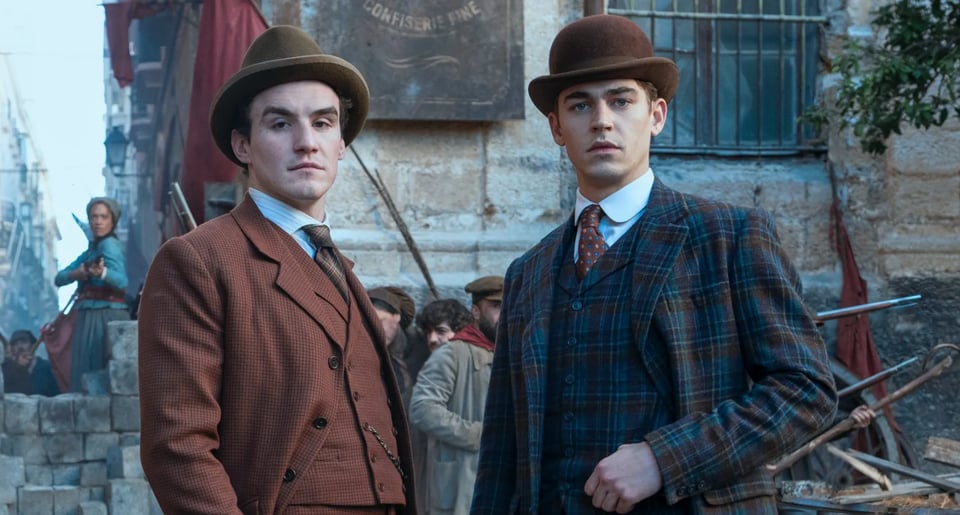
I recently watched the utterly ridonkulous TV show Young Sherlock, which takes some delightfully strange liberties with the character of Sherlock Holmes. (Among other things, Holmes has an intensely homoerotic friendship with Moriarty, his family is a whole disaster, and he's utterly useless as a detective.)
Watching all of these gloriously silly goings-on, my first thought was: I don't know if this could ever have been made if Sherlock Holmes hadn't entered the public domain.
So yeah — for those who missed it, as of April 2023, all of Sir Arthur Conan Doyle's writings are now in the public domain in the United States. (They'd been public domain in the UK since 2000.) This puts to an end decades of lawsuits over things like the Ian McKellen film Mr. Holmes, an anthology of original Holmes stories, and most recently Netflix's Enola Holmes. It also puts an end to years of copyright holders trying frantically to prevent any depiction of Holmes and Watson as lovers.
My guess is that being fully in the public domain will be extremely good for Holmes — as I wrote a few years ago, it's worked wonders for Arsène Lupin. Holmes has been one of the most popular characters in film and TV pretty much since the invention of the film camera. And for decades, the Conan Doyle estate exercised a certain amount of control over how the character could be used — depending on who was in control at the time. And some of that control? Was rather homophobic.
Subscribe now! ! ! !When I was a kid, I had a vinyl record of Basil Rathbone playing Sherlock Holmes. I never saw any of his movies, that I can recall, but I listened to that record countless times and was transfixed by the stentorian authority in his voice. I also remember Jeremy Brett playing a very serious, buttoned-down version of Holmes in the 1980s and 1990s. The Holmes I grew up with was theatrical, masterful, aloof, Victorian, and never without his deerstalker hat and fiddle.
In recent years, though, we've gotten a slew of off-beat Holmes portrayals, ranging from Benedict Cumberbatch to Jonny Lee Miller to Robert Downey Jr. to Will Ferrell. Not to mention the astounding Sherlock Gnomes!
As Holmes has moved with agonizing slowness into the public domain, people have been able to take bigger and bigger creative risks — and I can’t wait to see what’s coming next.
So here's what I've been able to learn about the history of Conan Doyle's heirs and their control (or lack thereof) over Sherlock.
According to this fascinating chronology in a 2010 New York Times article, Conan Doyle's son Denis controlled the character until his death in 1955, and was responsible for fairly serious adaptations like those Basil Rathbone films.
When Denis died, the rights passed to his brother Adrian until Adrian's death in 1970. That period when Adrian Conan-Doyle controlled the rights to Holmes, from 1955 to 1970, appears to have been the period of some of the greatest micromanaging of the character.
A 1959 Hammer movie, Hound of the Baskervilles, featured Peter Cushing as Holmes, and the production was required to hire Adrian as a technical consultant. In spite of Adrian's direct involvement, however, the estate was displeased by the changes that Hammer made to the original story in order to give it a stronger horror feel. So plans for further Holmes movies starring Cushing had to be scrapped. (Cushing did play Holmes again in a later TV show and a 1984 movie.)
In 1962, a German production company made a film called Sherlock Holmes and the Deadly Necklace, starring Christopher Lee as Holmes. Decades before Sherlock and Elementary, this film was to be set in the present day -- but the Conan Doyle Estate (meaning Adrian, I guess), objected. According to various sources, the Conan Doyle Estate had approval over the dailies, meaning that they got to view the footage that had been filmed each day, and they were prone to randomly rejecting some scenes here and there. The result was a finished product that makes very little sense and is allegedly set in the past, except that people drive cars in some scenes. (Go to about 48:00)
After Adrian’s death, the 1970s saw the rights passing through a few hands, including Conan Doyle's widow, Denis’s wife, and a Hollywood producer named Sheldon Reynolds. And it seems pretty likely that the constantly shifting control over the character created some opportunities to push the limits somewhat.
Case in point: The Seven Percent Solution is widely credited as being the template for the modern age of Sherlock Holmes stories. It leans into his canonical cocaine use, but also takes greater liberties with the character, depicts him as neurotic and twitchy, and pairs him with a famous historical figure, in this case Sigmund Freud. Writer/director Nicholas Meyer told Alec Nevala-Lee last year in The Atlantic that the book version was delayed for months by negotiations with the Conan Doyle estate. Meyer had mistakenly believed Holmes was in the public domain, and had to convince the estate to let him go forward with his unconventional take on the character.
I'm not sure how Gene Wilder was able to make The Adventure of Sherlock Holmes' Smarter Brother in 1975. I can't find any info about it online — it's possible that because this movie was a parody, it was covered under fair use.
An early 1980s anime series called Sherlock Hound, which was partially created by a young Hayao Miyazaki, featured — you guessed it — a canine version of Holmes, in a world full of anthropomorphised animals. This TV show was massively delayed due to interference from the Conan Doyle estate, and Miyazaki had to depart the project after only working on the first few episodes.
In 1980, control over Sherlock Holmes fell into the hands of Conan Doyle's youngest child, Jean Conan Doyle (1912-1997). A former British Women's Royal Air Force officer, Jean served in the military for thirty years, working in intelligence during World War II before being promoted to a squadron officer in 1944.
Jean wanted to do justice to her father's legacy — but according to the Times article, she also had a "whimsical" streak and was keen to authorize more fanciful works like Young Sherlock Holmes. Plus Without a Clue, the comedy in which Watson is the real genius detective, and Holmes is a paid actor who's there to give Watson plausible deniability. (One website claims she attended the premiere and exclaimed that her father would have loved the joke.)
Subscribe now!! ! It’s freeee!(At a certain point in the early 1980s, Jean claimed control over the rights to Holmes, but so did a producer named Sy Weintraub, resulting in a lot of confusing litigation over dueling TV productions in the U.K.)
There's a pervasive myth on the internet that Star Trek: The Next Generation fell afoul of the Conan Doyle estate when an early holodeck episode featured Data as Holmes, squaring off with a holographic Moriarty. Supposedly the producers of TNG thought Holmes was already in the public domain — but in fact, the attorney who represented the Holmes estate, Jon Lellenberg, told me back in 2009 that Paramount had obtained permission to use Holmes and Moriarty from the Conan Doyle estate.
Apparently, at a certain point Jean changed her mind about allowing people to take liberties with Sherlock, judging from this 1988 interview. In it, she lays out some ground rules that would have prevented many of the best recent adaptations:
I won't give permission for [a film or TV show] to be done unless the characters are shown in character and in period and are very well written. For a time I did allow pastiches to be published on these terms, but always against my inner judgment and I don't allow it any longer… Jon Lellenberg, who acts as my agent, has certainly had to say no on my behalf to many projects… I am a protector of Sherlock Holmes' reputation, and therefore, my father's literary reputation.
At the time that interview happened, Sherlock Holmes was in the public domain in the United Kingdom (though he went back under copyright there from 1996 to 2000). During that period, a book came out which depicted Holmes and Watson as lovers. My Dearest Holmes was written by Rohase Piercy and published by Gay Men’s Press.
Jean was decidedly not amused, telling her interviewer:
That is a book produced by some homosexuals in society. I think they've got some rather inappropriate name, and I think they're absolutely disgraceful to suggest that there was a homosexual relationship between Holmes and Watson. There was never any such thing.
When Jean died, she bequeathed the copyrights to the Royal National Institute for Blind People, which ended up selling them back to the Doyle heirs.
At a certain point, multiple parties were claiming to control the rights. Both Sheldon Reynolds's ex-wife Andrea Plunket and the Conan Doyle estate separately collected payments from Warner Bros. for the Guy Ritchie Sherlock Holmes movie, according to the Times article.
Plunket — whose claims to control over the Sherlock Holmes copyright seemed somewhat tenuous — shared Jean Conan Doyle’s revulsion at the notion of making Sherlock Holmes gay. After Robert Downey Jr. told David Letterman that Holmes might be a “butch homosexual,” Plunket threatened to withdraw permission for Warner Bros. to make a sequel. She said, “I am not hostile to homosexuals, but I am to anyone who is not true to the spirit of the books.”
In 2011, the Conan Doyle estate authorized a brand new Sherlock Holmes novel by Anthony Horowitz, in what was described as a final effort to return the character to his roots, without any of this recent "blasphemy."
A 2013 lawsuit over an anthology resulted in a finding that all of Arthur Conan Doyle's Holmes stories and novels were in the public domain — except for ten stories that had been published after 1923. (Weirdly, this ruling relied on Silverman v CBS, a 1989 case involving notorious minstrel-show characters Amos n' Andy, who were adapted for a Broadway musical at the time based on the understanding that they were in the public domain.)
The judge in the 2013 case wrote: "Characters and story elements first articulated in public domain works are free for public use, while the further delineation of the characters and story elements in protected works retain their protected status."
That finding left the door open for a lawsuit over the 2015 movie Mr. Holmes, in which Ian McKellen played the character as an old man.
As recently as 2018, the excellent Japanese TV show Miss Sherlock was apparently paying the Conan Doyle Estate for the right to use the character, as were the producers of the comedy Holmes and Watson.
Finally, there was a 2020 lawsuit over Netflix's first Enola Holmes movie, because the Conan Doyle estate insisted that Netflix's film was using aspects of Holmes's character that had been established in those final ten stories that were still under copyright. In particular, the Conan Doyle estate argued that those final ten stories, which were still under copyright, were where Holmes began to show more emotion and became "warmer." Netflix's attorneys countered that "copyright law does not allow the ownership of generic concepts like warmth, kindness, empathy, or respect." This case was settled, which means we never got to learn whether "respecting women" is a trait that can be covered by copyright.