My Favorite Books of September!
Hi! ICYMI I’m going to be in Australia in a week and a half. I’ll be at the Brisbane Writers Festival and the Canberra Writers Festival, and doing events in Sydney and Melbourne in between. Details here.
Star Trek Zero Point #1 comes out on Oct. 14! Check out a preview.
You can pre-order my book about time-traveling vampires, justice, and love: Good Things Are Coming Your Way. (Get a signed/personalized copy!)
The Books I Loved in September!
It’s still September for a few more days — so here are three September books that I read and massively enjoyed. This month was JAM PACKED with big incredible books from major established authors as well as newcomers, and I’m still catching up. What was your favorite September book?
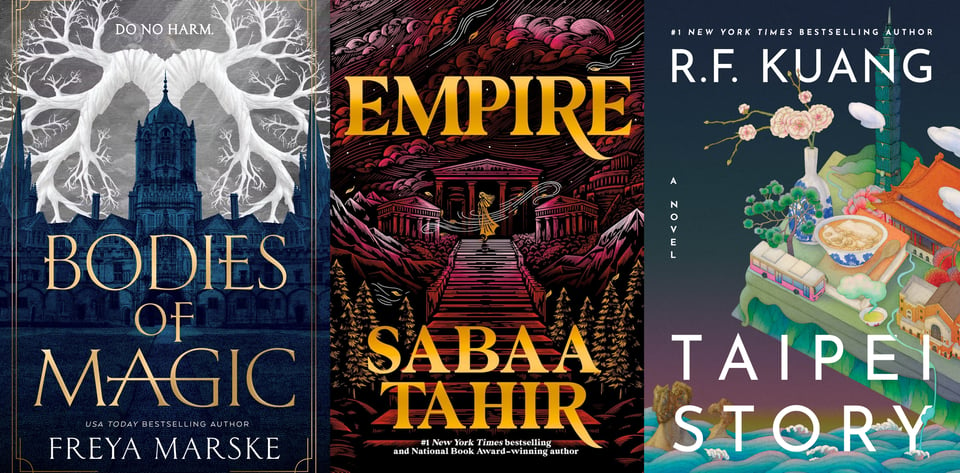
EMPIRE by Sabaa Tahir
Tahir combines young adult fiction with epic fantasy in the second book of this duology, in which various characters are grappling with the fallout of their mistakes and failures in the first book.
Sirsha, an outcast from a society of magical assassins, tried to destroy the malevolent entity known as Div but ended up bonded to Div instead. And Div’s previous host, the urchin girl Aiz, is continuing her war of conquest while draining the life force of small children to maintain her magical powers. Various other characters strive to save Sirsha and stop Aiz, with the help of the ghost of Ruh, a boy that Aiz and Div murdered in the previous book.
Tahir’s fusion of YA and epic fantasy is often most interesting when the edges of those two formats rub against each other: YA is about self-discovery and self-actualization, while epic fantasy contains those things but is largely about such grand stakes as the fate of gods and empires. (People in epic fantasy tend to discover who they are in the context of a prophecy or a grand role in the larger tapestry.)
Subscribe now!! !! !The major theme of this duology slowly becomes clear: traumatized people inflict suffering on others, leading to more trauma and more suffering. This cycle can only be broken by understanding the deep stories that underlie the trauma — and those stories are felt rather than told. At one point, Sirsha warns Div that it cannot undo the past, and adds:
“No matter how many times we try to retell our story, there is one truth the universe knows. And it lives in our bones. My mind might forget. But my body would not.”
The other thread of Empire is pretty much straight out of epic fantasy: the right to rule. Aiz has claimed a prophesied mantle that doesn’t belong to her, the saviour known as the Tel Ilessi, and in this book we find out who does deserve that mantle. Both Sirsha and her lover Quil also have to claim, or reclaim, their inheritances from their respective royal families. But that thread, too, is bound up with something very YA: Tahir keeps bringing up examples of people being severely punished for childhood mistakes, while the adults who led those children down a terrible path are let off the hook.
Empire is a thrilling read, and despite its great length it goes by incredibly quickly. Romances sizzle, armies clash. It does end with some situations unresolved and some mysteries still hanging — presumably to set the groundwork for another duology, or some other followup. But all in all, it’s one of the most satisfying fantasy epics I’ve read lately.
Bodies of Magic by Freya Marske
In a fictional city where healers use magic to cure diseases and repair wounds, five medical students gather for their final set of tests — but one of their fellow students turns up dead. Ysabel, the dead girl, was a total prodigy, the most gifted student in their year, but she appears to have either killed herself or overloaded her own magic, resulting in her death. The five students soon have reason to believe that Ysabel was murdered — so they set about investigating.
Bodies of Magic is a bit slow going at first, mostly because Marske makes all five of the med students-turned-detectives into POV characters, and introducing all five perspectives takes a bit of time. But the pace soon picks up, and all five characters become vivid and compelling, to the point where I found myself happy when each of their POVs came around again. And the murder mystery provides a fantastic way to uncover tons of layers of Marske's rich worldbuilding.
Early on, Bodies of Magic hooked me for a couple of reasons:
1) The medical school setting felt very lived-in and true to my own experience, as someone who was in a serious relationship with a med student/resident back in the day. All of the institutional callousness is here, along with a desire to work young people to exhaustion — and the fact that magical healing draws on the healers' own energy creates a very on-point metaphor.
2) A decade earlier, a mysterious plague struck Sieuxerr, the city where healers were trained, causing lingering effects including exhaustion, chronic pain, and an inability to work. Many ordinary citizens responded by blaming the healers for somehow causing or inviting this plague, and hostility towards medical expertise remains. Yep, it's a pretty stark portrayal of covid and especially long covid, something that most fantasy books have been afraid to touch.
Subscribe now!! !! !As the book goes on, though, it drew me in further. All five characters grow and change — and claim their power — in ways that feel believable and lovable, and there are a couple of extremely sweet romances as well. The aforementioned complex worldbuilding has a lot to say about privilege — Sieuxerr has a fairly rigid class system, there are immigrants who moved their with the hope that their children might become healers, and the whole way that medicine is practiced is overly hierarchical, something that Marske slowly builds an awareness of.
And I especially loved the theme of young people being assigned roles, or duties, with no consideration for what they want or who they might actually become. Healers' talents are in such demand, and so many students have been forced to take on such steep loans, that most of the characters have their whole paths mapped out for them. (Even if they might want to do something else.)
Marske's prose is beautifully crafted, and there's the occasional startling turn of phrase. Like, "His face was the two edges of a wound drawn together." And one late passage, in which an older character explains that the medical school is designed to isolate students so that they "let the work squeeze the juice out of [them]," but that people need to hold onto love and family, hit like a ton of bricks.
By the end of Bodies of Magic, I was utterly enraptured. Definitely check this one out!
TAIPEI STORY by R.F. Kuang
Kuang's latest book is a return to literary realism after last year's fantastical Katabasis. It's the story of Lily, a Chinese-American college student who spends a summer in Taipei to improve her Mandarin only to find herself in an identity crisis.
I myself spent a summer in Taipei when I was a college student, working on my Mandarin and teaching English as a foreign language part-time to help pay my way. I had tons of Chinese-American and Chinese-British friends at the time, who were dealing with a lot of the same anxieties that Lily experiences in Taipei Story.
Upgrade now! If you want. I’d appreciate it.In fact, Taipei Story feels like it comes as part of a wave of a novels by Asian diaspora authors dealing with questions of belonging and connection to cultural roots. I thought particularly of Ghost Cities by Siang Lu, in which a Chinese-Australian translator is caught using Google Translate and becomes famous in China under the sobriquet #BadChinese.
Kuang continues to explore her obsession with linguistics and translation, which was a centerpiece of her novel Babel. The (in)famous Sapir-Worf Hypothesis, which claims that language shapes thought, is woven throughout a lot of the discussions, finally becoming a major part of the text toward the end. Characters question if you can lie in a language you're not fluent in, or whether being fluent in multiple languages makes it easier to hide parts of yourself. There are some interesting meditations on the difference between grammar and common usage, and the challenges of learning Mandarin, a language with very little formal grammatical rules but complex pronunciations.
Lily's feelings of being not Chinese enough are kind of juxtaposed with Taiwan's ambiguous status as part of China but also separate — these conversations reminded me of the arguments about Taiwain in An Arrow to the Moon by Emily X.R. Pan.
The writing in Taipei Story is crisp and matter-of-fact, tinged with poignancy. One issue I did have is Kuang's habit of ending sections with a pithy line that kind of sums up everything she just conveyed, as if not quite trusting the reader to make the connection on their own. It felt a bit like spoonfeeding at times. I'm sensitive to this because it's something I tend to do as well, and have been trying to root out of my own writing.
But in general, Taipei Story is a quick, enjoyable read that leaves you with plenty to think about (and plenty of feelings) afterward. I was left consumed with hatred for JC, a total douchebag who seemingly courts Lily only to turn out to be a total creep. Kuang captures a lot of the experiences of studying in a foreign country and attempting to have language immersion, including the requisite toxic roommate situation. In the end, Taipei Story is mostly just a great coming-of-age story about someone figuring out who she really is — rather than the person other people want her to be — and how to relate to where she comes from.
Music I Love Right Now
Oh He Dead is an “indie soul band” from Washington, D.C. — honestly their music feels like a blend of R&B, synthpop and soft rock to me. Their lead singer, CJ Johnson, has a gritty, soulful voice laced with snark, which reminds me a bit of Macy Gray.
Anyway, I enjoyed Oh He Dead’s first few albums quite a bit, but their latest album, Vertigo, feels like a revelation. It’s one of my favorite albums of 2026 so far, with a more confident sound that combines sharp, aggressive drumming with groovy rhythm guitar, bouncy, sinuous bass-playing and some atmospheric synth. The band’s songwriting chops seem to have matured and leveled up.
The lyrics hit hard, too, with lines like “The monster you made will be at your door” and “You better cover up so they can’t track your username.” This feels like music for the mid-2020s, full of anxiety and tenderness, laced with paranoia.
As a devoted lover of old-school funk and R&B, it definitely doesn’t hurt that Vertigo is a bit funkier than previous Oh He Dead albums, especially the break at the end of “I Need a Man” but also throughout. This is a very dancey album that is proving to be excellent music to write to.
And hey — Oh He Dead is on Bandcamp. And this coming Friday is Bandcamp Friday, the day when artists get to keep all the proceeds from the music you buy. You know what to do.