Maybe "Extrovert" and "Introvert" Aren't Really Opposites
First of all, some housekeeping… I’ve decided to add paid subscriptions to this newsletter. I’ve now gotten enough subscribers that it’s actually costing a lot every month to send it out via Buttondown, and meanwhile I’ve lost some sources of income that I had previously counted on. (Long story. I’m fine, but I could use more income right now.)
Also? I’ve been publishing this newsletter pretty much every week since 2020. I’m still having a lot of fun, but I could use a bit more encouragement and motivation at this point. So if you’ve been enjoying this newsletter and want to give me $$, I would be super appreciative. (I’m also going to be starting another project soon, so there’ll be more than one way to support me online. And of course, the best way to support me is always to buy my books.)
With that out of the way, here’s this week’s noodling…
Let’s Smash the Introvert/Extrovert Binary
I can remember the first time I heard the phrase "introverted extrovert." Or was it the other way around? Either way, I was in my early twenties and in a romantic relationship with someone else who subscribed to that label — and I realized it spoke to me as well.
The term “extroverted introvert” has always felt as though it describes a dichotomy in my personality: I can be a major extrovert, but I also need to hide from everyone for long periods of time.
Pretty much my whole life, I've been good at grabbing the center of attention — and I had a lot of fun being ridiculous in front of a crowd. But I've always had a side to me that craved solitude, needed space, had to get away from people. As I've gotten older, and especially since the height of the pandemic, that introverted side of me has taken over more and more.
I was a classic class clown in school, and by high school I was doing skits at school assemblies and performing my own utterly terrible Weird Al Yankovic-style song parodies. This started out as a way to compensate for my severe learning disability and sensory integration disorder. I couldn't make sense of anything and everything I touched fell apart instantly, but I could make it into a joke. People were going to laugh at me no matter what, so I might as well have a role in engineering the joke. Over time, clowning became a major feature of my personality.
Upgrade now! (If you can afford to)I think my high school yearbook actually labels me as the "Class Clown." One time, a girl I had a crush on walked up to me and told me I was a folk hero. (Folk horror?) I do not think she was saying she reciprocated my crush.
My first week of university, I was on my class clown bullshit once again, including more skits at some freshman gathering. I even played Frank N Furter for a rendition of "Let's Do the Time Warp Again". I could see myself starting to have the same persona in college as in high school — and then I had a moment of clarity. Maybe I didn't want to spend my college years stuck in that obnoxious persona, which had made me a "folk hero" with very few real friends. I still had a chance to reinvent myself. I made a conscious effort to dial it back, and have real conversations with people instead. It felt like growing up, a bit.
This worked okay. I had a few very close friends in college, two of whom I'm still in touch with pretty regularly. That's also how I met the person who told me that I might be an introverted extrovert, or an extroverted introvert.
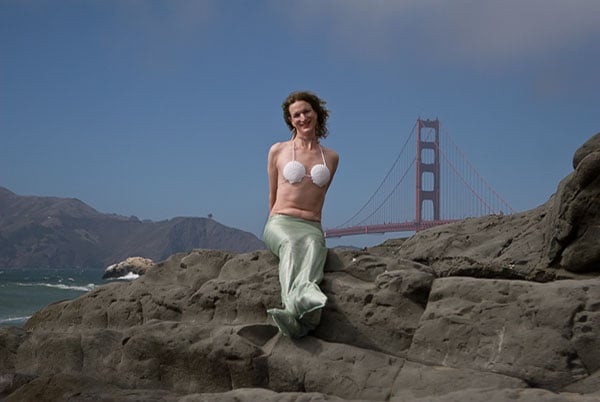
When I moved to San Francisco in 1999, I started extroverting again, but this time it felt more purposeful. I was experimenting with femme presentation — and pretty soon transitioning — and getting involved in a ton of sex positive organizations and queer arts scenes. I started MC-ing events, including my own monthly literary night, with a weird off-the-wall persona and fanciful bios for all the participants.
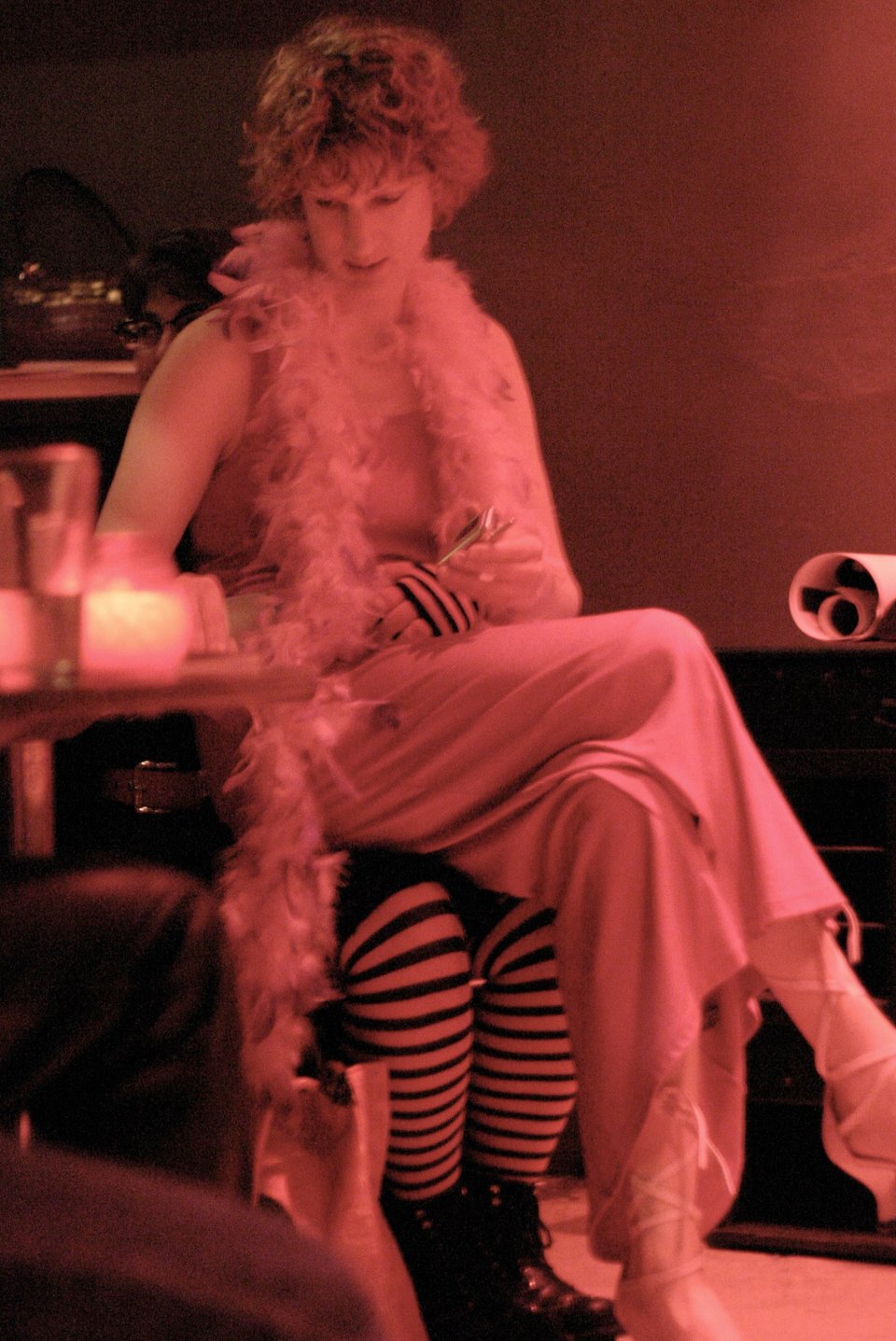
I joined a queer performance scene that rewarded outrageous weirdness. I did drag, kinda. I did performance art. I performed acrobatic but uncoordinated routines in six-inch stripper heels and somehow didn't break my ankles. At one show, I did a striptease while reciting Alan Greenspan's "Irrational Exuberance" speech. And I started hosting a monthly literary event, using a gonzo logorrheic persona and giving each reader a surreal fabulist bio.
The good thing about it was that I didn't just try to be the center of attention all the time. I made friends with other over the top performers, weirdos, former class clowns, antic weirdos.
To me, being an extrovert always felt best when it was part of being a pervert: in your face progressive sexuality and queerness, as part of a performance meant to destabilize hetero-cis-patriarchy, etc., etc.
Hey, you can also subscribeFor twenty years, I was a local character — maybe even a folk hero, I dunno. But I also learned better hygiene, in terms of not stealing the spotlight from other folks, and taking time to recharge my batteries. I was having the time of my life.
Then two things happened:
1) I became an author, and had to channel a lot of my extrovert energy into promoting my own work. (The moment a performance becomes mostly about your career and convincing people to buy a product, some of the fun goes out of it.)
2) Covid hit, and most of my opportunities to seize an audience's attention suddenly came with a high risk of debilitating illness, something I'm honestly still a bit traumatized by. I started needing a lot more time to myself, and getting overwhelmed more easily.
Even before covid, I was starting to think about how to spend more time with fewer people, have more quiet conversations instead of shouting at crowds. The introvert part of my nature was coming to the fore once again, especially now that being an extrovert was so bound up with self-promo and social media nonsense.
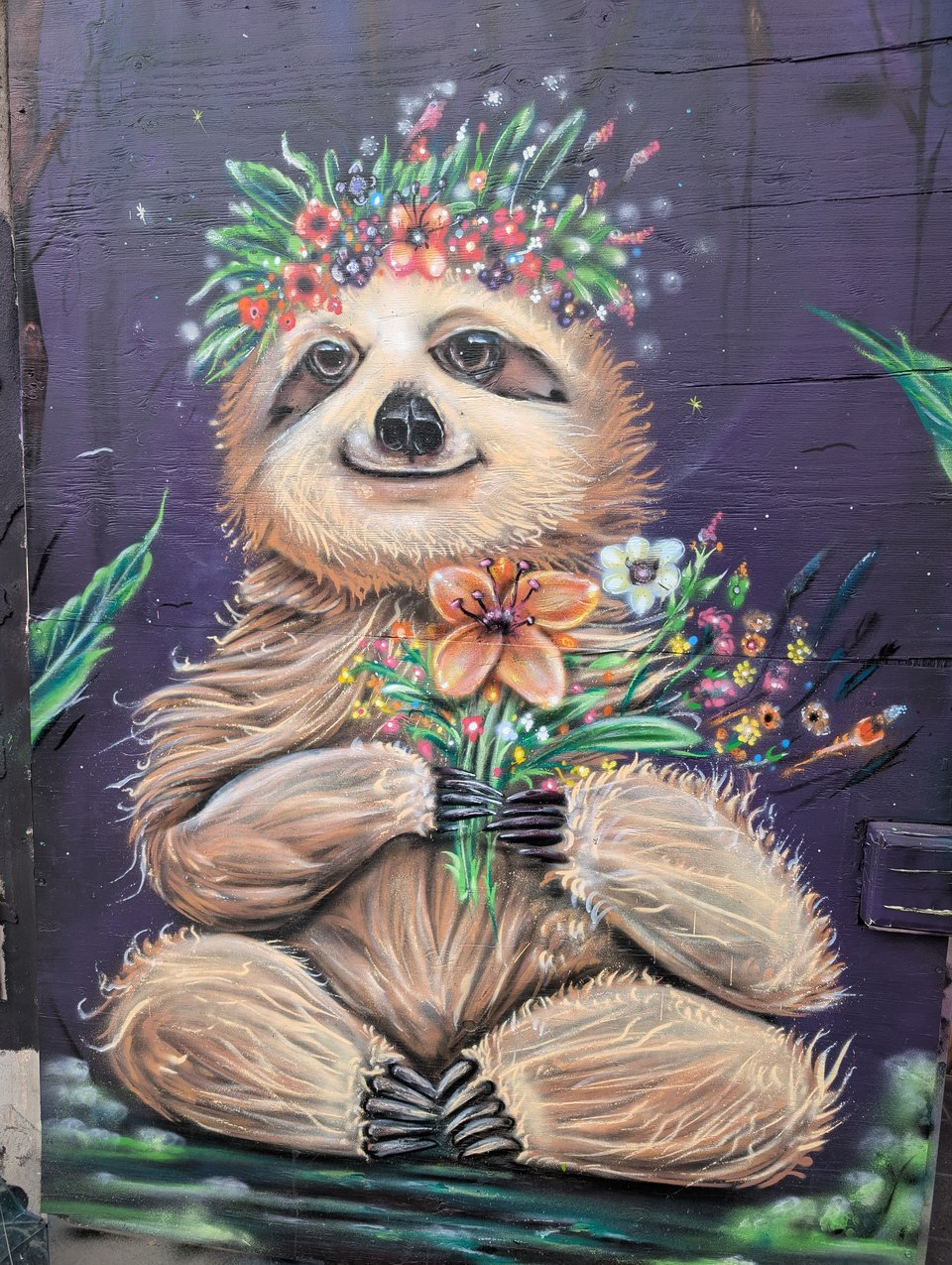
It's only recently that I've started to enjoy being an extrovert again. Dressing up in colorful outfits, being a loud queer goofball, flirting (with permission), reading scandalous erotica, laughing too loud. I MCed more literary events, including one with a massive crowd in Seattle last year, and have been making a conscious effort to be more colorful and silly in public again. I’m hoping to go back to karaoke. Being unapologetically loud and weird feels like a giant middle finger to the fascists. And because it helps me feel connected to my people, my fellow queer screech-owls and howler-monkeys. It helps us find each other and build something for ourselves.
Subscribe nowAnd that's the best surprise of all: being loud and taking up space doesn't have to be about centering myself. On a good day, it can be a way of building alliances and lighting a fire for your friends.
Let’s bust that extrovert-introvert dichotomy
I am somewhat deliberately trying to turn busting dichotomies and binaries into part of my brand. So here we go again.
I believe introvert and extrovert are neither opposites nor mutually exclusive states of being. A ton of experiences have left me convinced that extroversion and introversion are two ways of approaching the world, and that it's possible to be both at the same time, to some extent. Or to go back and forth with relative fluidity.
The stereotypical extrovert views the world as their audience, while the stereotypical introvert wants nothing to do with anyone. Still, I have addressed huge crowds while feeling a bit inward-directed and quiet, because the magic of microphone technology lets me address hundreds of people while using my quietest, most thoughtful voice. I've also had times when I was keeping to myself and speaking to no one while feeling very focused on the outside world and on how people were perceiving me.
In fact, I had a bit of a light-bulb moment a few years ago, when I was on a panel with a couple of larger-than-life characters who were bringing tons of energy and brashness to the audience. I definitely had things I wanted to say to the crowd, but I was feeling more subdued and more, yes, introspective. Even as I tried to match the energy of my fellow panelists, I knew that what I really wanted to do was speak to this audience from the quietest part of myself. So I did, and it was fine.
I've found a bit of usefulness, in fact, and not always being the loudest voice in every room. I don't know how many people listen to me when I don't raise my voice, but I know some folks do and sometimes there's a value in it.
The suffix “vert” in “introvert” and “extrovert” refers to turning, is if one’s whole self is swiveling to face inward or outward. But that's not how people work: people are always, to some extent, turned both inward and outward, and the world will never let us withdraw completely.
Upgrade nowI've also thought a bit more about why I need time to myself both before and after bringing my outside voice to the indoors. It's not just because I need to recharge my batteries away from other people — though that is a huge part of it — it's also that if I don't spend some time with myself, then I won’t have anything to say when I have to address a crowd. I need time to myself to reflect so when I speak into a microphone, something interesting will come out. There's nothing worse, as James Brown taught us, than Talking Loud and Sayin’ Nothing. (Here’s my fav cover version of that song.)
The introvert/extrovert thing has also gotten more complicated in the age of social media. Increasingly, social media is all about “one to many,” about building yourself a "platform," about peforming a version of yourself for masses of other people. It’s about speaking to an audience rather than having any sort of conversation — but some of the most successful social-media personalities are deeply introverted in real life, merely creating a loudmouth persona for the online masses.
Social media stopped being social a long time ago.
The whole internet, at times, feels as though it’s trying to warp all of us into cartoonish versions of loud pick-me bitches.
Final thought: These days, I’m increasingly all about building and nurturing community. And community membership means both listening and speaking. You have to do both. It means paying attention to others while sharing stuff. It means, to some extent, being both introvert and extrovert.
Music I Love Right Now
I mentioned this a while back on my list of things to buy on Bandcamp Friday, but… You should really check out Mega*Nut (aka Lonnie Marshall.)
Mega*Nut was the lead singer of Weapon of Choice, one of my favorite new funk/rock bands of the 1990s. Their first two albums, released on a major label, remain among my favorite albums of that decade. They were connected to Fishbone and their members sometimes collaborated with some Fishbone members, including on a spinoff group called Trulio Disgracias. Their sound was heavy on metal-ish guitar and drums, with a thick, chewy horn section, and sarcastic lyrics. They very much operated within the tradition of Parliament-Funkadelic.
Anyway, back in 2020, Mega*Nut set himself to the task of releasing a ton of new music in a steady stream. The result included three outstanding albums: 2020 Nutvision, That Would Be Dope, and Cosmic Relief, Groove Healing & Verbal Remedies. I finally got into these records recently, and they’re outstanding — especially That Would Be Dope.
The sound is very different than classic Weapon of Choice, but the wordplay is as sharp as ever, and Mega*Nut’s songwriting is if anything more inventive and crisp than before. As far as I can tell, every song features live drumming (on a drum kit), with some energetic bass-playing thats’ somewhere between strumming and thumping — it reminds me of the bass licks laid down by Rodney “Skeet” Curtis and Cordell “Boogie” Mosson on much of Funkadelic’s One Nation Under a Groove album. Some of the songs on That Would Be Dope also use a sitar to pump up the groove, with incredible effect.
So I would go to Bandcamp and scoop up all of Mega*Nut’s 2020 releases, especially That Would Be Dope.