Let Your Characters Teach Us About their World
My book about using creative writing to get through hard times, Never Say You Can’t Survive, is just $2.99 in all ebook formats for the next few days. (And DRM-free!)
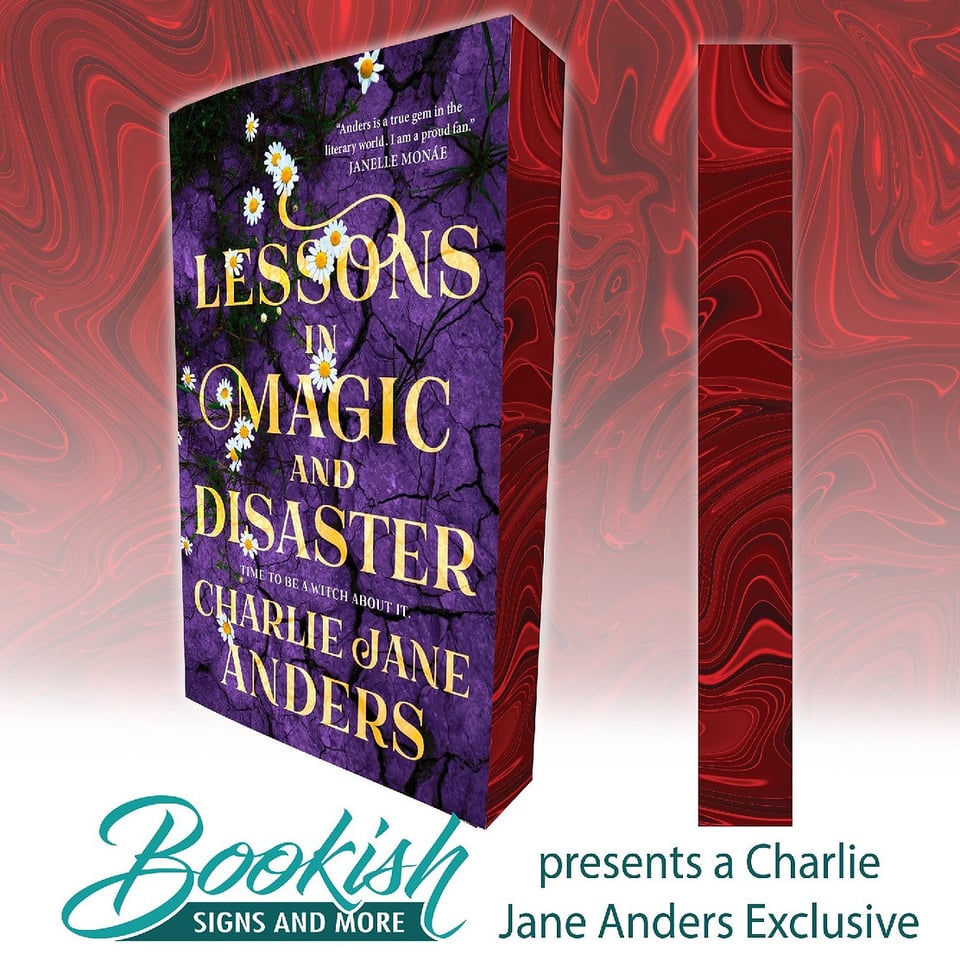
The paperback of my mother-daughter witch novel Lessons in Magic and Disaster comes out in August. And you can pre-order a special signed edition, with excellent sprayed edges, from Bookish Signs and More!
This past weekend I was one of the instructors at Sandia Starforgers, a speculative fiction writing conference in Alburquerque. I actually ended up attending virtually, because I was feeling poorly, but I still had a wonderful time and really enjoyed my conversations with the amazing students.
One common thread that kept coming up in those conversations was the question of how to introduce your readers to the fictional world in your story. I already had been noodling a bit about this, and I ended up doing a craft talk on the subject the other day — which I wanted to share with all of you.
The good news? Getting to know your characters and learning about the world they inhabit can go hand in hand. It’s the same process, in fact. The more we can inhabit your POV characters’ perspectives, the better we’ll be able to understand the place they live and the society they belong to. We get to know the characters and their milieu at the same time, and the characters help explain their surroundings to us.
So here are some thoughts about how a strong narrative POV can serve to introduce us to the setting of your story.
I. How well does your protagonist know the world?
a) Total novice (portal fantasy hero, or raised by wolves)
Think of Brave New World by Aldous Huxley: John the Savage is raised in the wilderness, and stumbles into this "advanced" society, which he has to learn from the ground up. We discover it along with him. Or a portal fantasy!

b) Native but partial knowledge (knows one neighborhood/stratus but not all)
A lot of popular fiction lately features a protagonist who comes from an impoverished background turns out to have a unique ability which leads to them going to a magical academy or a palace — think dark academia.
c) Expert level (knows all corners of the world very well)
This is someone who has traveled and studied, and might know multiple languages. This character knows how to navigate lots of different social strata and is familiar with many different sorts of neighborhoods.
d) Super boss (knows more than literally anyone else)
The most common example of this is if you have a a spymaster character, or someone who has eyes and ears everywhere. Or a literal tour guide.
Side rant: “portal fantasy” and “native fantasy” represent two different sorts of relationships with a world: discovering it for the first time (alongside with the reader) versus being deeply familiar already. Portal fantasy has somewhat fallen from popularity, because people crave that feeling of being immersed in a world from the jump — which is also why most narrators these days are tight third person or first-person, present tense.
II. How does your narrator experience their world?
The stronger the emotions your character feels about their surroundings, the more they’ll stick in the reader’s head.
a) Resentments
I love a character who is annoyed by the things they encounter as they make their way through the world. It can be small annoyances, like the guy who always seems to be delivering fertilizer just as heading to work. You can work in a lot of interesting details and give more of a flavor of them through the character finding things obnoxious.
b) Memories
“This is the place where I got stabbed.” It’s easier to remember the place when something interesting happened there. Memories can also be collective rather than personal — in The City in the Middle of the Night, I worked hard to put the scars of past wars and economic upheavals into the buildings and the landscape.
c) Favorite places
“This is where I get those buns I like.” Things that are comforting and friendly can establish an emotional connection that’s as powerful as resentment or annoyance. This can help to make us remember a place and feel anchored there.
d) Stuff they notice regularly
Including sensory details! Scents, sounds, the feeling of cobblestones on the soles of their feet, and so on. Smells are really powerful in terms of giving the reader a sense of a place, because scent has powerful associative properties.
Extra thoughts: A strong narrative voice or POV is closely linked to sense of place. They really are two sides of the same coin, in many ways. When you introduce a character, part of what you're establishing is a character's relationship with the place they live.
Obviously, if it's a portal fantasy, the relationship starts when they go through the portal, and it's almost like a romance: the portal is the meet-cute and then they get to know the place and they have ups and downs in their relationship.
Subscribe nowBut any fictional character is going to have a an evolving relationship with the place they live. Or if they have to leave town and go on a road trip, they're going to have different feelings about their home as they're traveling. And they'll obviously have feelings about the places they visit. A character’s relationship with wherever they are is part of their overall development, and can include positive and negative stuff that they learn or decide.
Also, read Blackfish City by Sam J. Miller. It’s a masterclass in getting to know a setting through the eyes of the characters.
III. Personal relationships reveal social divisions
a) Romance is frequently about class antagonism
In romantasy, two characters often come from “different worlds”: one character is a prince, and the other character is an assassin from the gutter who was sent to kill the prince but is now working for him instead. Every interaction between these two characters is going to tell us something about the world, via their different perspectives.
b) Friendships are situated within a larger context too
This may be less dramatic than romance — but friends often will have different viewpoints. One of them is a student, the other one works in a cafe, and they're going to be comparing notes. So we'll learn stuff from watching the two of them together. Any conversation is an opportunity to drop in some information.
c) Mentorship is p. obvious
A mentor is going to be telling their mentee stuff about the world and how things work, because that's part of what mentorship is.
d) Rivalries often are a microcosm of larger divisions
A rivalry will often have elements of, “I deserve this because X.” “Well, I deserve this because Y.” And the reasons why the characters believe they deserve to win often tell us something interesting about the world, and the contradictions and antagonisms within it.
d) Characters can have low-stakes disagreements
You might love a restaurant that I think is an overrated, overpriced tourist trap. Your friend might always want to meet at a cafe that you find annoying. Some workers might be on strike, and two characters might have varying levels of sympathy for their complaints. I love a good infodump — but you can also sneak in a lot of details about the world through having the characters have mild differences of opinion about it. Anything that creates friction will stick in the reader’s mind.
IV. How do we learn more about the world?
Up to now, we’ve mostly talked about being introduced to a world, getting to know it through the eyes of characters rather than through long expository passages. But once we know the world reasonably well, we can still keep learning more and peeling back layers of world-building.
a) A plot twist, by definition, reveals the limits of your protagonist's knowledge
A plot twist is usually a matter of, “I thought I knew where I stand and how the world works, but oops.” Luke Skywalker thinks he knows who he is, until he learns more about his father Anakin. Ned Stark thinks that he lives in a world of honor, where things work a certain way, and he learns otherwise.
Side note: I like plot twists where the characters were misled about something. I don’t like plot twists where the reader has been misdirected by the author, because that’s usually cheap bullshit. Play fair with your audience, people!
Subscribe now!!! !!!b) What's the place your protag doesn't want to visit? Make them visit it!
This could be the Chasm of Doom, or the one neighborhood that’s pretty dangerous. Or just the place where their ex lives. Making a character go to places that are unsavory, dangerous or unpleasant always deepens our understanding of the world. A Raymond Chandler novel often sends Philip Marlowe into every nasty corner of L.A., overturning piles of garbage, and we learn so much in the process.
c) A shifting relationship with the place means seeing it from different angles
This brings us back to the rags-to-riches protagonist who’s everywhere in speculative fiction right now. This can also work for riches to rags. Any sort of fish-out-of-water story is going to be about learning a part of the world that we didn't know before. A character might grow up in the Jewish ghetto of a medieval town, and know the ghetto intimately but have a limited understanding of the rest of the city — until circumstances force them to go elsewhere.
d) Relationships are often place-based. Allegiances too.
Allegiances tell us a lot about like how someone experiences the place where they live. See above, re: the character from the Jewish ghetto. The Netflix show Warrior, based on the writings of Bruce Lee, does a great job of showing how its characters belong to Chinatown rather than the larger community of San Francisco — and within Chinatown, they have allegiances to different gangs or organizations.
Whether a place feels like home depends on your feelings of belonging — if you have a sense of family, or membership in something, you’ll think about a place differently than if you are an outsider.
e) A strong sense of place puts limits on the characters' actions, but also provides opportunities
Worldbuilding is partly about what you can and can't do. People often think of worldbuilding in terms of grounded details that don’t affect the plot, like what time the bread truck arrives, or the train line that just came to your neighborhood. But worldbuilding also places limits on some actions, and facilitates others.
You can't just walk up to a cop and smack him in the face. That's not going to work out great for you.
Another example: you might have a situation where a character needs to get across the river to save their friend, but the bridge is raised to let a barge through. The hero’s best friend is about to be murdered, but the bridge will be up for the next twenty minutes. But maybe the hero’s friend has a little boat, or there's a secret tunnel from the bootleggers that used to smuggle booze back in the day.
It's exciting when you learn a detail about the world that also helps the plot to move forward or creates an obstacle for the character.
V. What sets are you gonna build?
This is kind of random but I often think of worldbuilding in terms of building a few standing sets. Think of a sitcom: you’ll typically have the main character’s workplace, their home, and the place where they hang out with their friends. I will think of a few locations where the characters are going to spend a lot of time, and invest more energy into describing them really well so the reader has a clear picture of them. Other locations, that we only see once or twice, can get a more cursory description.
Final thought: By definition every story is partially about a character's shifting relationship with their home or the place where they find themself. This is a powerful engine for conveying a lot of information about the world overall.
Music I Love Right Now
Sly Stone died nearly a year ago, and I’m still not over it. He was one of the greatest musical geniuses of all time, who transformed funk but also reinvented all of popular music. (See the documentary Sly Lives! on Hulu.)
One of my favorite funk bands of the twenty-first century, Dumpstaphunk, has been doing concerts where they just cover a ton of songs by Sly’s group Sly and the Family Stone. It’s absolutely incredible — and the indispensible Internet Archive has a good-quality recording of their recent set on Feb. 28, 2026. (The Internet Archive also has a bunch of other Dumpstaphunk concerts available for streaming or download!) It’s also on YouTube.
This is such a fantastic set — Ivan Neville and Dumpstaphunk don’t just cover the major hits like “I Want to Take You Higher,” they also do some amazing deep cuts like “I Cannot Make It” and “I Get High on You.” Almost anybody would perform either “Thank You Falettinme Be Mice Elf Agin” or the slowed-down version of that song, “Thank You For Talking to Me Africa,” but they do both. Which is amazing. It’s essential listening.
And it should go without saying but — if you download any Dumpstaphunk concerts for free or watch them on YouTube, you should go buy their albums, which are all essential. (Even if you listen to their music on Spotify or whatever, buy their shit from them if you can afford to. Support artists. For real.)