
This Moonlit Body
My March and April 2026 in Media
Apologies for skipping last month’s missive. A great many things were afoot in the world, including a birthday, a little trip, some existential spiralling, and the acquisition of a Nintendo Switch 2. But now we get a bumper blog! Woo!
BOOKS READ:
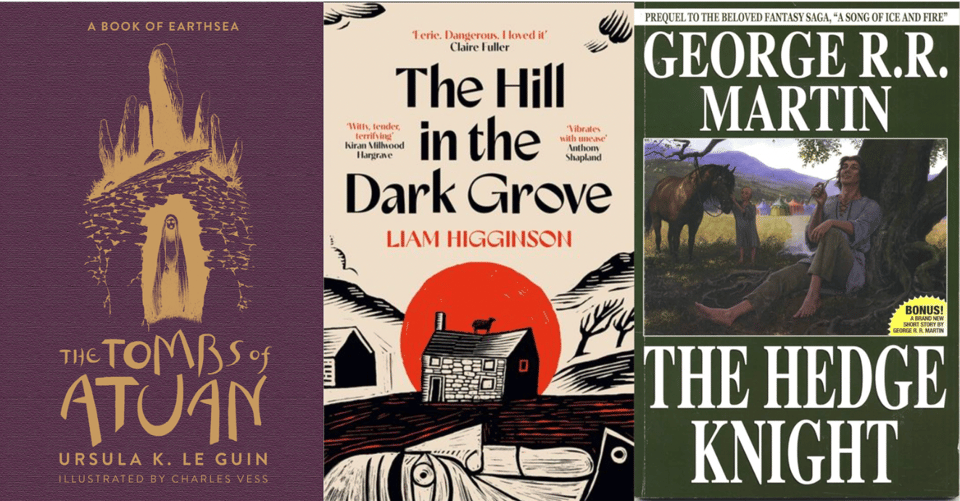
THE TOMBS OF ATUAN by URSULA K. LE GUIN (1971) This is the second book in the Earthsea Cycle and picks up quite a few years after A Wizard of Earthsea. From the perspective of a brand new protagonist (a delightfully sulky priestess stolen as a child to serve as the new incarnation of a brutal and sacred order), we see one of Ged’s many triumphant adventures touted in a A Wizard of Earthsea play out. It’s a really neat shift that opens up the world of Earthsea even wider and allows us to see how Ged has put all his hard-won wisdom to good use (while getting himself trapped in a subterranean death labyrinth.)
THE HILL IN THE DARK GROVE by LIAM HIGGINSON (2026) A Welsh couple in their sixties on the brink of losing their farm are plagued with odd, violent troubles after a pair of lost English hikers unearth a strange carving in a forgotten paddock. Higginson does some really wonderful character work and atmosphere in this one, bringing this particular patch of Wales to life across generations (and centuries!) with much to say on the topic of disrespectful tourists and the quiet community poisonings of part-time holiday homes and AirBnBs. Loved the older protagonists and the interstitial vignettes (historical and contemporary scenes were equally evocative and engaging), but was left a bit cold by the decisions Higginson made in the main narrative. The story never quite came together or resolved for me, but I enjoyed the rest enough to keep an eye out for Higgins’ future work.
THE HEDGE KNIGHT by GEORGE R. R. MARTIN (1998) Never have I seen a more faithful screen adaptation than the one based on this novella. I kid you not when I say the entire thing is on the screen, word for word, in A Knight of the Seven Kingdoms. The show, however, adds a bunch of scenes that I would argue are much to the story and its characters’ benefit. The book is great, the show is even better. Go straight for the adaptation on this one. I won’t bother reading ahead.
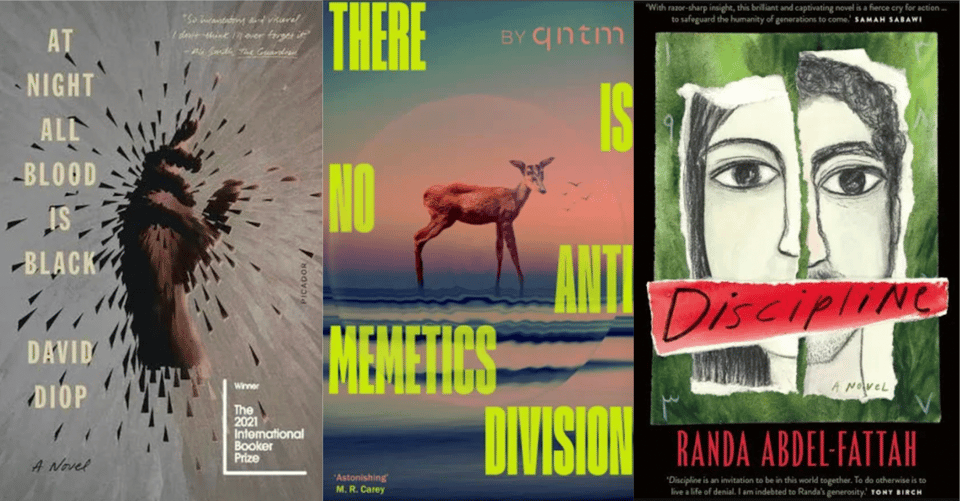
AT NIGHT ALL BLOOD IS BLACK by DAVID DIOP, TRANSLATED FROM THE FRENCH BY ANNA MOSCHOVAKIS (2025) Written from the perspective of a Senegalese soldier serving in the French army in World War One, this gory novella charts his descent into guilt, murder and (arguable) madness after refusing to honour his best friend’s pleas to be put out of his misery as they lay wounded together in no-man’s land. I could have done with fewer of the landmarks of war being compared to various features of women’s bodies and alleged proclivities, but the exploration of grief and guilt, the role/exploitation of colonial troops and the lines drawn between the “good” and “bad” kind of murder between combatants was pretty fascinating.
THERE IS NO ANTIMEMETICS DIVISION by qntm (2025) A secret agency responsible for containing memory-deleting entities is eaten alive by The Big One, leaving a scattered, amnesiac few to stop it from consuming the world. Although the central conceit wore a bit thin after repeated instances of memory holing, and had an ending that eventually had me shrugging and saying “sure” as the narrative had to keep one-upping itself on twists, turns and zaniness, this was a cracker of a read. I would say it’s one for The X-Files fans, but out of respect to the protagonist, who bonds with her husband over how much they hate The X-Files, I will refrain. A fun way to spend a few evenings from a promising debut author.
DISCIPLINE by RANDA ABDEL-FATTAH (2025) This is Abdel-Fattah’s adult debut after a significant career writing for kids and teens, and the result is a highly readable and damning portrayal of Australian’s mainstream media and academic institutions. The story follows two Muslim Australians who take very different approaches to workplace survival when a student at a local Islamic school is arrested for protesting a university’s connection to an Israeli weapons manufacturer. Hannah, a journalist in an all-white, mostly male newsroom keeps being barred from reporting on the story (or the latest wave of IDF bombings on Gaza that prompted the student’s protests) due to her perceived implicit bias. “Ash,” an academic at the university in question who strongly believes that assimilation is the way for Islamic and West-Asian migrants to succeed in Australia, is called upon to create a program to de-radicalise Islamic youth. Hannah and Ash never interact, but due to a multitude of community threads they circle and mirror each other as the waves of one act of non-violent protest ripple outwards.
If you’ve paid any attention to the Australian literary scene in the past year, you probably know that Abdel-Fattah has been branded a a violent anti-Semite, responsible in part for the horrific Bondi mass shooting, and has had several appearances cancelled or boycotted. These serious claims are based entirely on her involvement in the Free Palestine movement and her critiques of the Israeli government and armed forces. The irony is that this is pretty much what Discipline is about. Abdel-Fattah has written from her experience as a Palestinian Australian and has been further validated by the outsized backlash to said work. That alone would make this book worth a read, but the great news is that it’s also just really good. Abdel-Fattah does excellent character and situational work, painting a portrait of contemporary Australia that is rich, nuanced, and difficult to be proud of.
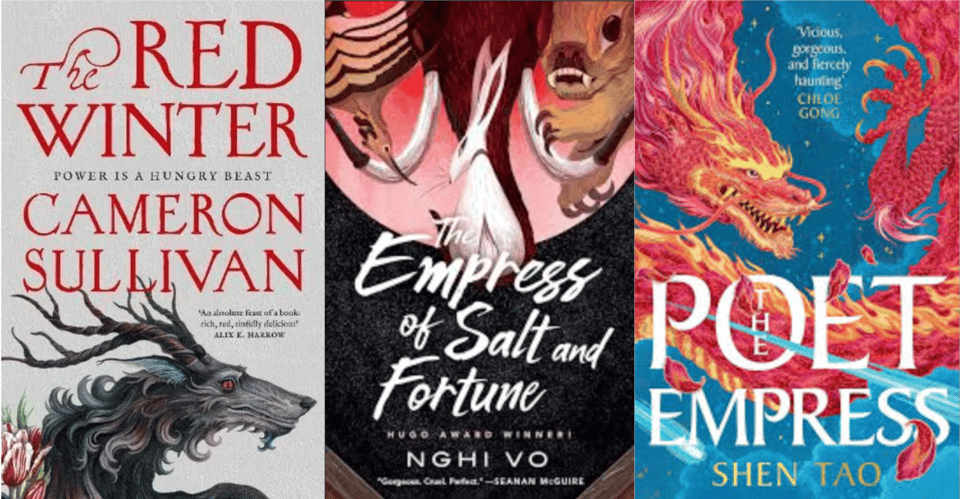
THE RED WINTER by CAMERON SULLIVAN (2026) Another Australian author, this time in historical fantasy! The Red Winter is a connected narrative taking place across three timelines (or four, really, if you count the into and outro). In the main thread, Sebastian Grave, a several-thousand year old mortal man in a body-sharing pact with ravenous but otherwise chummy demon Sarmodel, is called to Gévaudan to finish off the murderous, rampaging beast he thought he and a former lover had killed twenty years ago. In the secondary thread, we see the bloody events of Sebastian’s first visit to Gévaudan, and in the third, we follow Sebastian’s contracted servant/succubus several hundred years earlier as she seeks the truth behind Joan of Arc’s power. It all ads up to a wonderfully layered, darkly humourous and quite aggressively gory warning against the cost of insatiable appetite: whether it be for power, money, sex, or violence. There’s a bit of an attempt to counter this with the power of love, which was undercut for me by a wholly underwhelming love interest, but overall this is a very high concept, big swing of a debut novel and Sullivan executes it to an impressive standard. I had a great, sad time with this.
THE EMPRESS OF SALT AND FORTUNE by NGHI VO (2020) The first in a series of connected but standalone novellas (i.e. you can read them in any order, or drop in and out wherever you’d like) sees a story-collecting cleric travel to the remote, abandoned palace of the former empress to learn her story from a devoted servant. This is a very gentle fantasy, and Vo makes some interesting and, I think, successful choices in framing the narrative. I made the arguable poor choice of making this my in-bed reading, as the writing was so lovely and the story so chill that I only ever got through about 4% at a time before falling asleep (I think I might hold the record for longest stretch of time spent actively reading a book under 200 pages), but it’d make a very pleasant way to spend a drizzly afternoon.
THE POET EMPRESS by SHEN TAO (2026) Wei, a plain, rural teenager in a land ravaged by famine throws herself into the running to become a royal concubine in the hopes of improving her village’s access to precious resources. When she is chosen (out of spite) to be the cruel and unkillable heir to the throne’s fiancee, she begins plotting his intricate downfall.
While The Poet Empress pleasantly surprised in the subversion of what would ordinarily be a very typical YA fantasy or adult romantasy set up (Wei is a homely, uneducated girl thrust into court politics who finds herself increasingly relied upon by a cruel, wounded, and very pretty man, and the fact that Tao never lets you feel like Wei could fall for her abuser while exploring his motives is actually refreshing), and had some interesting use of perspective and conflicting understanding, I found Wei so unengaging as a character and a narrator, and Tao’s choices in the framing of this story so odd and, ultimately, ineffective, that I could never really get into it. This adult fantasy debut has been an absolute hit with a bunch of my bookish friends and the broader reading community, so I’m glad they had much better (and apparently face-clawingly emotional) time with it than I did, but it I fear it wasn’t my cup of tea.
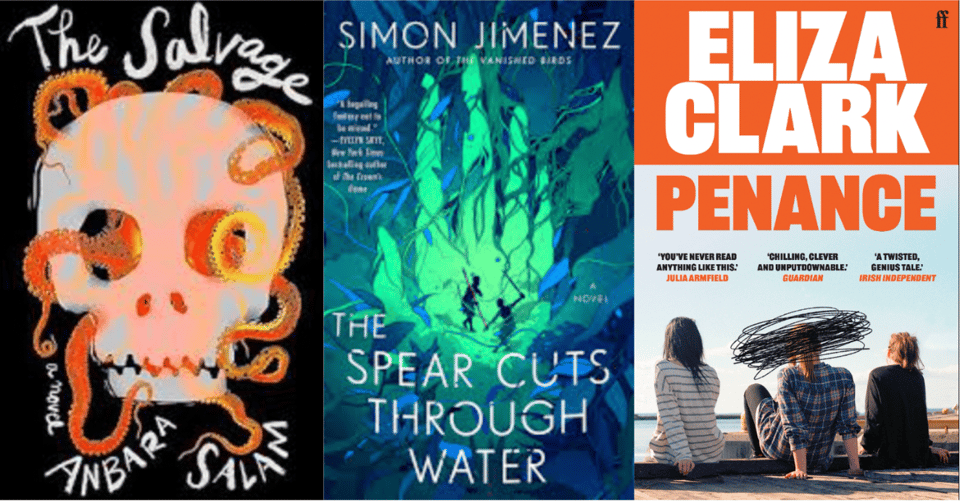
THE SALVAGE by ANBARA SALAM (2025) Now here’s a book that went down just fine! Marta, a marine archaeologist from Glasgow, is sent to catalogue and retrieve the contents of a sunken ship off the coast of a small Scottish island and is marooned there by a particularly violent winter during the Cuban missile crisis. And as if the snow, the possibility of nuclear apocalypse, and the fact that her soon to be ex-husband/boss is looking for any excuse to sack her isn’t bad enough, Marta seems to have brought a ghost and a string of karmically bad luck to the island with her.
This book is a soapy delight, much more drama than horror. Marta is a complete mess of a person, frequently behaving in ways that probably earn her the ‘unlikable protagonist’ tag, but I found her wildly endearing: impulsive, paranoid, snappish, and really quite funny. The characters of the island (and their many foibles) are vividly drawn, and I found the way Salam writes landscape and culture to be particularly effective (I have so many highlights where I was just delighted by certain descriptions). The Salvage is rich in a sense of time and place, and while the narrative dragged a bit in spots, I really enjoyed my time with it. I’ve already purchased Salam’s other Scottish period piece to read in bed after I’m done with the next Earthsea book, as it made an A+ bedtime book (I managed about 10% at a time of this one, which is my bedtime sweet spot).
THE SPEAR CUTS THROUGH WATER by SIMON JIMENEZ (2022) This is the kind of fantasy novel I live for. An incredibly ambitious standalone, The Spear Cuts Through Water is a nesting doll narrative in which an unnamed young man visits a mythic theatre in his dreams and watches a play about two ancient heroes helping a god to slay her monstrous husband and sons. The prose itself is appropriately dreamlike, shifting effortlessly and often between the viewer, his life, and the context in which he knows parts of the story on the stage; the performance; and the story of the performance itself. Always, there is a chorus performing the inner thoughts of peripheral characters within the play, both individual and collective.
It’s a huge swing of a book, covering a second-world in vastly different points of its timeline (the man watching the play is from a time of trains and radios embroiled in a long world war, the play is from a time of magic, talking beasts and feudal scheming) and Jimenez knocks it out of the park. The modern world, the ancient world, and the moonlit theatre are all so beautifully evoked in such simple and succinct prose. The character work is lovely, the love story between the two heroes wonderfully earned and patiently developed, and the threads of plot are so deftly woven together that I felt like a cartoon character with an exclamation point over my head every time the narrative hit a new landmark. It’s a book written with such bold and fantastic craft that I want to grab the author and shake him. It feels old and new and absolutely mythic, and somehow Jiminez pulls it off in a neat 525 pages (girthy, but hardly a tome when you’re talking about adult epic fantasy). This is hands down one of the best books I’ve ever read, and while I think it’ll take me at least a year to feel ready to tackle it again, I’m already looking forward to spending time with it again.
Finally, a huge shout out to Joel de la Fuente, whose voice work in the audiobook is phenomenal. It’s not the easiest book to read in either format (you really need to trust the author on this one), but it’s worth the effort.
PENANCE by ELIZA CLARK (2023)
Speaking of rereads, I first read Penance exactly two years ago and for some masochistic reason I decided it was time to go again!
Penance is a fascinating, horrible book. It is presented as a non-fiction novel written by former tabloid, now investigative journalist Alex Carelli, who, having lost his own daughter to death by suicide after a possible spate of online bullying, seeks to portray the brutal murder of a sixteen year old girl by her friends in a sensitive and nuanced way. He does this by spending the year leading up to COVID lockdowns living the seaside town in Northern England, getting to know the local history and interviewing the locals, slowly building trust until he’s able to interview the families of the girls involved. This “book,” in which Eliza Clark as Alex Carelli patiently and effectively parcels out the events of the night in question by way of a series of moving character portraits, is presented to us with a surprising foreword and epilogue: “Penance” by Alex Carelli is mired in scandal. The interviewees take extreme issue with their portrayals and the portrayals of their loved ones, and there is evidence that Carelli has straight up lied, mischaracterised events, and unethically obtained some of his primary sources. What would, on its own, already be an effective piece of fiction about the slow death of a tourist town, the rise of radical British conservatism amidst the Brexit movement, and the horrors of being a teenage girl at a time when the internet is both your source of escape from bullies and a source of radicalisation, becomes a clever puzzle and critique of the true crime entertainment industry in which both you and the wildly unreliable narrator are made tragically complicit.
It’s not a book I’d recommend to anyone with a teenage daughter in their present or near future unless they have a particularly thick skin, but it’s so achingly authentic in its portrayal of lonely, vulnerable girls and their clueless (or dangerous) families, and so rich in its decaying English seaside atmosphere, that it’s taken up a permanent spot in the back of my mind. And to pull it all off in the voice of a manipulative, narcissistic, middle-aged man who doesn’t actually get teenage girls is such a feat. Eliza Clark, the writer you are.
OTHER MEDIA:
As mentioned in the intro, I have been sinking unknown hours into Pokopia, a game in which you explore and rehabilitate a series of mysteriously abandoned worlds populated entirely by lost and lonely Pokemon in the hopes of making it beautiful and comfy enough to entice the humans back from wherever they went to. I usually bounce right off this style of “cosy” game, but Pokopia has just enough story, direction and tasks to keep me fully engaged. Also: Bulbasaur and Squirtle are my best friends.

I started the first two episodes of The Other Bennet Sister with my mum, meant to wait until she came up again to finish the rest, and then got impatient and binged the rest while knitting (a move almost immediately exonerated by a text that indicated she was doing the exact same thing). It’s pure fanfiction building on the very specific portrayal of Mary Bennet in the 1995 BBC miniseries that rewards an arguably autistic Mary with a romantic adventure all of her own, and I loved it. It absolutely pandered to me as a middle-aged, neurodivergent, glasses-wearing, 1995 Pride and Prejudice-preferring woman with a quiet fondness for Mr. Collins, and I’m completely fine with that.
I finished season 2 of The Pitt, and I’m really pleased with how they’re developing the series. The fact that they didn’t try to outdo the high stakes drama of season 1’s pittfest, but instead focused on the emotional burnout and flagging mental health of many of its doctors is, to me, a really positive sign for the longevity of the show. I’m also a sucker for an American hospital show that unabashedly makes its villain the American healthcare and insurance system. Is it still occasionally a bit after-school special-y? Sure. But as so many major institutions and governments get more openly and unashamedly corrupt, it’s nice to see a show sticking to a radical “THINGS SHOULD BE BETTER, ACTUALLY” message.
I managed three whole movies in this two-month period! I did a rewatch of eternal favourite The Birdcage for my birthday, and upon some googling realised that my partner and I are now the same age Nathan Lane and Robin Williams were when they shot the movie, which I think is a bit cute (I am the Nathan Lane in this situation, and probably the relationship). I finally watched Sinners, a movie I’ve mostly been avoiding because I struggle with vampires and vampire media. I usually enjoy Coogler as a director and an artist, and quite predictably, I enjoyed all the parts of this movie that didn’t involve vampires. Unfortunately, as a vampire film, those parts were pretty significant. It did look fantastic, though, and I’m glad it beat some movies that looked very annoying for some awards. Finally, I watched Rental Family, a very nice movie in which Brendan Fraser plays to his strengths as a very nice, earnest man. The story is very simple, and arguably on the saccharine side, but it was exactly what my brain needed. And it, too, was gorgeous to look at.
And that was March and April! Thanks, as ever, for reading along 💕


Add a comment: