
This Christmas Gibbon: My December 2025 in Media
I’m a Christmas person. I put my (giant) tree up early, I decorate the house, I listen to Christmas music (my go-to Christmas playlist is, however, infused with summer bangers to offset the disconnect of playing Winter Wonderland in the southern hemisphere while sweating through ones sun-smart sleeves), I bake spiced, gingery things and pavlovas and I drink bougie little drinks. Since buying a house and therefore being allowed to put nails in the wall for the first time in my adult life, my partner and I have taken to hosting Christmas morning for the local contingent of my immediate family, which has only enabled me into going harder. I watch Christmas movies and TV shows of varying quality, sometimes for the 50th or so time. I do, however, draw the line at reading seasonal books. Festive joy in my heart on all fronts, but the books have to stay at least a little bit depressing. A balanced diet is important.
BOOKS READ:
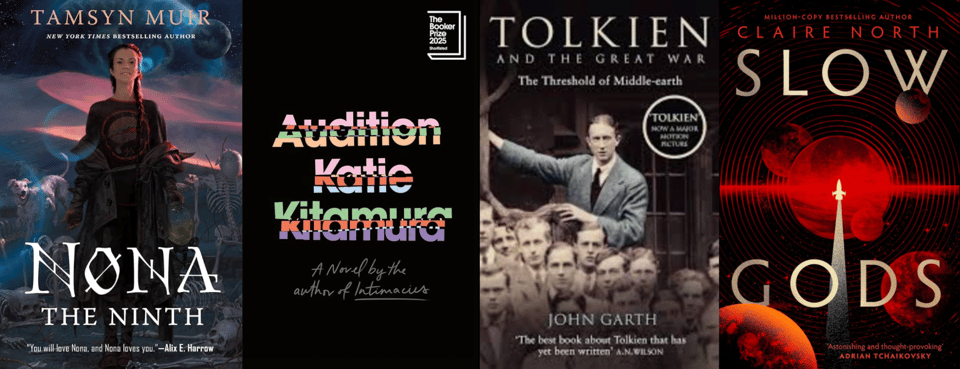
Nona The Ninth by Tamsyn Muir (2022)
Format: eBook (TorDotCom/Harper Collins Aus)
If it was difficult to write about Harrow the Ninth, the second instalment of epic science fantasy The Locked Tomb series, then writing about the third entry is damn near impossible. What I can say, vaguely, is how much I admire Tamsyn Muir’s ability to buck even her own reader’s expectations with each of these books. Nona does not pick up anywhere anyone would have anticipated following the high-stakes conclusion of Harrow, and after a pair of books following two criminally neglected, lonely, broken young women, Nona gives us a fascinatingly naive protagonist who is nothing but loving and loved. Also: there are (almost) no memes in this book, thereby proving that Muir actively choses to sow evil and chaos.
A fantastic series, and I will wait patiently for as long as Muir needs to figure out how the flippity fuck to end it.
Audition by Katie Kitamura (2025)
Format: Hardcover (Riverhead Books/Penguin AUS)
A charismatic young man and an actress old enough to be his mother meet in a restaurant, and things spin out from there. Telling you much more about this very short literary novel would only ruin an experience that, while it didn’t completely work for me in the end, was a very enjoyable page-turner. Katie Kitamura is a compelling writer and I had the most fun when she was taking the loving piss out of working in film and theatre. Weird and meta, which contrasted very pleasingly with the domesticity of it all.
Tolkien and the Great War by John Garth (2003)
Format: Audiobook (Narrated by the author)
A biography recommended to me by a fellow Tolkien fan who knows how much I appreciate stories about trenches (I am not pro-trench, to be clear, but I have unfortunately become someone who finds trench warfare macabrely interesting). Garth focuses on Tolkien’s time at Oxford university (which, as an orphan on social welfare, he attended via scholarship), the close-knit friendship and poetry club he forged with three other English students, and their separate trajectories through the first world war. What makes this book particularly fascinating to me (trenches aside) is the way Garth presents and charts the work of Tolkien and his friends alongside their experiences. He doesn’t draw direct parallels of influence unless there are primary sources to support them, but allows us to appreciate the way their subjects, interests and poetic/literary form changes with age, experience, literary and historical interests and influences, and of course, with their author’s tragic exposure to battle, death, injury, loss.
It’s a really wonderful insight into a man who, without the urging of his children, would probably have been content to write for an audience of one forever, and who survived to publish some of the most beloved books in history by the dubious luck of a terrible case of trench fever. I have been resisting the strong urge to buy his full poetry collection ever since finishing this biography, but I don’t know how long I can hold out.
Sorry, yes, I’m that person who doesn’t think there are too many poems and songs in The Lord of the Rings. Sorry you all hate oral history keeping.
Slow Gods by Claire North (2025)
Format: eBook and Hardcover (Orbit/Hachette Aus)
This was a much anticipated release of 2025 for me, having loved Claire North’s Songs of Penelope trilogy to absolute pieces. It did, to my surprise, take me a while to get into (which is probably my fault for setting it as my bedtime ebook and reading cerebral sci-fi while tired), but once I realised what North was doing, I was hooked.
Slow Gods is a standalone space opera that manages to be both big-brained and epic in scope, while also remaining close focused and surprisingly domestic. We follow Mawukana na-Vdnaze who wakes up from a fatal tragedy as a ghost, a monster, a legend, and maybe a god. He is desperate for connection and purpose in a universe he doesn’t often understand, much of which is in mortal danger from the shockwave of a collapsing star. Too bad the evil, capitalistic empire of his birth is too busy waging war for anyone to really focus on the whole collapsing star thing.
At a character level, it’s a fresh and insightful depiction of the autistic experience (North is an autistic author), which is manifested both in Maw’s general personality (pre-tragedy) and in his monstrosity (post-tragedy). Maw is feared for his otherness, his inability to connect, and for the potential horrors he can unleash if he is ever ‘disregulated.’ Maw requires rules and craves justice, but the longer his unasked for immortality stretches on, the more he realises there are no rules that cannot be broken, especially in war, especially by the victors. And what, then is justice? How does one stay regulated in the face of so much pain?
It’s hard not to read this book and think of all the geopolitcal hell we’ve been watching unfold over the past 2+ years, with Gaza at front of mind. I don’t know if that works out with the timeline on which this book was produced, but North is clearly a student of history and history, as they say, repeats and rhymes. Slow Gods is frustrating in its realistic portrayal of high level politics. There are no heroes here, no good guys, no easy wins or hands that remain clean. Powers that should know better stand by and let atrocities play out. Populations are sacrificed. Rising threats ignored. War criminals allowed to escape. North doesn’t bother trying to find the positive or the glory in anything that plays out, which should be unsatisfying and maybe it will be for some readers. For me, it was refreshing to see such a pessimistic book written by someone who still, it seems, can’t help looking for the best in people.
MEDIA WATCHED:

Pluribus (Season 1, 2025)
Streamed on AppleTV
I already wrote about Pluribus in last month’s blog, but as the season is now officially OVER (sorrows, sorrows) I feel I have a duty to let everyone know that, for me, it really stuck the landing while paving the way for a potentially very interesting season two.
A thing that’s happened since last month is that a few friends have jumped in and binged the season in an effort to catch up, and their reactions to certain events and decisions made in the show are quite different to the friends and I who’ve been watching it on a weekly schedule. Carol’s decisions have a different weight to them, and my theory on this one is that, in a show centring a pair of characters who are on their own for a great length of time, and who make decisions accordingly, the weekly rollout enforces a great deal of empathy. About two months pass in the story of Pluribus, which is roughly equivalent to how long it took to air. Carol is, by nature, a very selfish character (which I love to see!), and while there are always going to be people who struggle to empathise with a grumpy middle aged lesbian who has what some people are calling alcoholism (and what I think is more of a drinking problem), speedrunning her descent into abject isolation and despair probably isn’t going to help matters.
In conclusion: all hail the weekly release schedule, and if you’re planning to catch up on Pluribus ahead of the already confirmed Season 2 (YAY!), consider spacing it out.
Fallout (Season 1 2024; Season 2 2025)
Owned on BluRay; Streaming on Prime
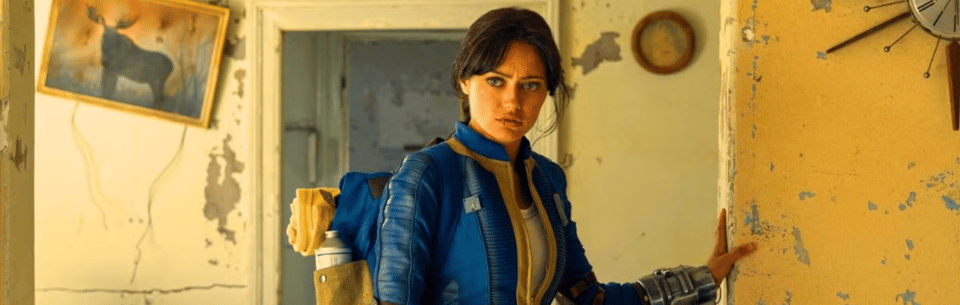
For me, Fallout season one is the gold star of video game adaptations. Rather than making the arguable mistake of adapting any one game and storyline in particular, it tells a new story within the world of the games (a retro-futurist Americana post-nuclear disaster wasteland) utilising player/character archetypes that work both for the pre-existing fan and the casual viewer. My partner and I tested this theory, with me being a person who sunk a couple hundred depression hours into Fallout 4, and he being a nice, normal person who goes outside a lot. We both had a great time with this show, to the point where he has happily rewatched it three times with me in the space of eighteen months.
Following the basic formula of most of the games, the series follows Lucy, an inhabitant of one of the hundreds of vaults built across America in preparation of the coming cataclysm. Her ancestors have been underground and isolated for over 200 years, waiting for the day the poison up above clears and they can get to work repopulating America. But the kidnapping of her father by violent raiders forces her to venture out into the still-fairly radioactive, very grody wasteland in an attempt to rescue him. Here, her perky, can-do attitude is put to the test by various monsters, criminals, cannibals, neighbouring vault-dwellers, a hot gunslinging ghoul, a very cute knight, and a wild hunt for a decaying head. It’s all very fun, and it’s magnificently focused. Despite all the beautifully woven-in nods to the games, alongside a few game mechanics (Stim-paks cure a startling array of life-threatening injuries), Fallout feels first and foremost like a proper TV show (if you pay attention, you can see where each episode is structured around non-existent commercial breaks), and one that it very aware of where it sits in the TV landscape. The series MacGuffin is the severed head of an iconic TV sci-fi actor (Michael Emerson of Lost and Person of Interest) for crying out loud. And I haven’t even gotten to the fact that Lucy’s Dad is the reigning dreamboat of faintly ominous small-screen American charm, Kyle MacLachlan.
Season one is, I’d go so far as to say, a nearly perfect season of TV. The stakes are high, the motivation emotional, the action killer, and the weaving together of four clear storylines and character arcs just a little bit masterful. It’s a sci-fi dystopian romp.
But for all that I love this show, I’m trying not to get my hopes up too high. It is, after all, coming to us from the same team behind Westworld, who, famously, delivered a fantastic first season… and then some seasons so bewildering that HBO seems to have wiped the hard drives containing them. And with only two episodes of the eagerly anticipated second season out, I’m already seeing some warning signs. The excellent narrative drive of the first season is nowhere to be seen, the storylines are getting further isolated from each other, the dialogue clumsier, the locations an excuse to reveal cool video game locations and monsters rather than seeming to serve the story, and glimpses from the season ahead indicate we’ll be zooming in on some specific characters from Fallout: New Vegas, the favourite Fallout game of some of the most annoying gamer people I have ever met (and as someone who worked in a video game store during her cutest years, please trust that I have met a solid sample size). But second seasons are traditionally difficult, so I’m extending grace and optimism for now.
And if season two and beyond all goes to shit, well. I’ll always have that glorious season one.
How The Grinch Stole Christmas (Dir. Ron Howard, 2000)
Streamed on Netflix
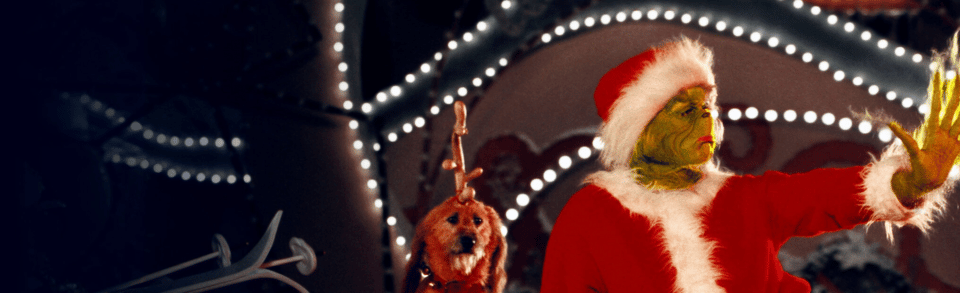
How The Grinch Stole Christmas feels like an ode and a farewell to the 90’s. The humour is deranged, the sets and costumes incredible feats of practical effects, the pacing chaotic. And, like many classic family films of cynical 90’s, it also manages to be about something. How The Grinch Stole Christmas commits on every front. It’s refreshingly bold in its anti-capitalistic, anti-consumerist message (and also in it’s nod to low-level government corruption!). The Grinch is mean, and with good cause! The Whos of Whoville are absolutely godless people—just the worst little fucks around, with the sole exception of Cindy-Lou Who, who has become disillusioned with the materialistic bullshit of her people and craves genuine connection. It’s a fever dream of a film, by all accounts an absolute nightmare to produce and perform in, and did it ever pay off. Twenty-five years later, this genuinely hilarious film is a balm to the modern day Whoville we all seem to be trapped inside.
Last Christmas (Dir. Paul Feig, 2016)
Streamed on Netflix
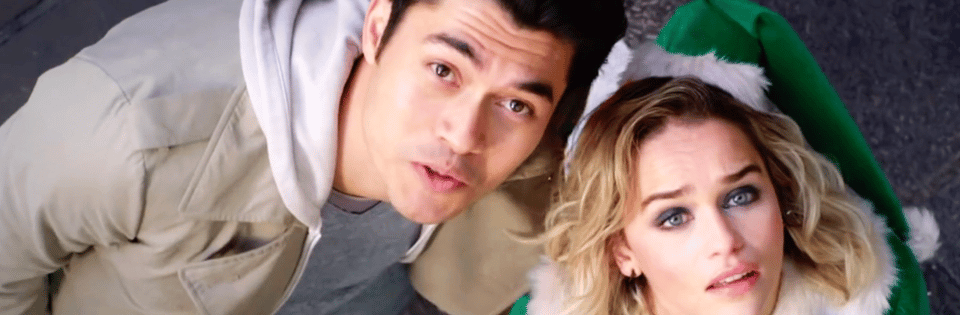
People were very mean about Last Christmas back when it was released, and I’m furious about that for two reasons: 1) this film is absolutely wonderful and everyone who hates it is a joyless shit, and 2) the fact that it flopped so hard quite possibly robbed us of seeing Emilia Clarke become this generation’s Sandra Bullock. She should have fifteen roms and coms and drams and various combinations of the three under her belt by now.
But my broken heart and grudges aside, if you somehow missed it, Last Christmas is a Christmas dramedy that was grossly mismarketed as a romcom. It follows Kate, a full-time Christmas elf and charming hot mess who everyone thought was going to be a star, but is now wildly traumatised from a heart surgery that her friends (and complicated Ukranian refugee family) are long-past willing to extend her grace over. She’s spiralling out and on the verge of losing every last bit of good will she has left when she meets Tom, the handsomest man you have ever seen, who is weird and delightful and very gently steers her on a path to getting her shit together.
This film was written by Emma Thompson as a tribute to the music of George Michael, and while, yes, there is a very literal interpretation of his most festive hit as a major plot point, it’s also just a bloody good script. The dram drams, the edy edies (i.e. the funny bits make me screech and the sad bits make me cry my eyes out) and, like How The Grinch Stole Christmas, this movie dares to be about something (HEALING THROUGH COMMUNITY!) and to plant its flag firmly in a place and time (COSMOPOLITAN LONDON IN THE BREXIT RAMP-UP!) and have THEMES! It explores the immigrant experience! It takes an actual stance against xenophobia! In a film about someone striving to be a successful artist, it defines success as finding passion, connection, and a personally rewarding creative outlet, not financial reward! Kate ends this movie as broke as when she started it, but what does she have instead? LOVE, motherfuckers. Not just the sort-of romantic kind, but the love of her family, of friendship renewed and of friendships newly formed. And is that not the true meaning of Christmas?
Please note: I haven’t discussed THAT OTHER THING, because spoilers, but for the record I’m fully on board with it. What’s more christmassy than a [redacted] helping a selfish jerk become a better person? Nothing. That’s what.
Please also note: The subject line of this month’s blog is taken from a line of dialogue delivered by Michelle Yeoh, who is perfect and steals every single scene.
IN SHORT:
- Dash and Lily is part of my regular Christmas viewing. A six part series adapted from a popular YA book in which a worldly grump and a shy sweetie pie push each other outside of their comfort zone at Christmas time, all via a wildly implausible but charming pen-pal situation. Never fails to get me into a Christmassy mood.
- I watched the other, more recent, Grinch, and wowee! What a limp, nothing of a film.
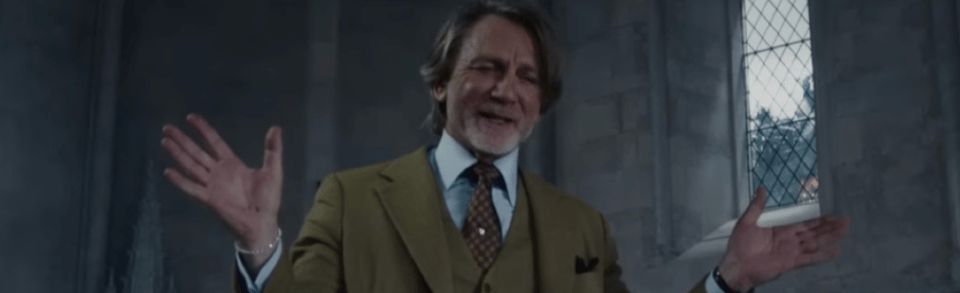
- I’ve seen quite a few people rank Wake Up Dead Man as their favourite or second favourite Knives Out movie, but I’ve enjoyed all three pretty evenly (and by that, I mean, a lot!). The shifting format helps keep things fresh, while Rian Johnston and his team have a great knack of finding the perfect offsiders to balance out Daniel Craig while he has the World’s Most Fun.
- Oh. What. Fun. is one of this year’s brand new Christmas movie offerings, and despite a decent premise and a solid cast led by the always divine Michelle Pfeiffer (and a much enjoyed minor supporting role from Joan Chen serving her very own version of Catherine Martell), it was forgotten so completely after viewing that it’s only been included in this roundup because I logged it on Letterboxed. Messy and bland, with a few nice moments that make me wonder what the original version that won the greenlight looked like. Did a more interesting film used to live here? We’ll never know. Gorgeous house as the main setting, though. Spectacular use of wallpaper.
- Inside The Family Stone are two movies: one is a beautiful, heartbreaking story of a family coming to terms with their matriarch’s terminal diagnosis during their last Christmas together, and the other is an absolutely demented sister-swap romcom that neither roms nor coms. I really like one of these movies, and I really dislike the other one.
- Klaus is a recent entry to the Christmas movie canons, but it’s already a seasonal staple in my heart. What can I say, I love stories about selfish jerks learning to be better people through community and lonely people finding family. Also, the character design and animation is gorgeous.
MISC READING:
“AI is foundationally unethical in ways that go far beyond its creative theft, and which do not only concern the communities from whom that work was stolen. AI is unethical the way billionaires are unethical, and exists for much the same reason and with many of the same risks, because the one is inextricable from the other: a culmination of wildly unregulated capitalist excess which, if left unchecked, legitimately threatens both global democracy and the long-term habitability of our one and only planet.”
Foz Meadows, Australian SFF author, wrote an absolutely fantastic response to the latest writer/dipshit to come out against any attempts to regulate or punish the use of Generative “AI” in published works — in this case, the new Nebula Award rule excluding any work utilising GenAI from eligibility, which is a move that has caused a surprising amount of writers who should know better to show their asses.
Foz’s piece is an excellent cap on the official year of AI slop. Let’s carry its energy into 2026 and continue to resist, resist, resist.
And that was my December, and therefore 2025! Whether you celebrate the season or not, I hope you had a restful and restorative end of your year, and I hope you ring in the new year in whichever manner suits you best. I have been invited to sit on a beach, which is not very me of me, but I will also be home and in bed before 9pm, which is on brand enough to provide a solid experience of dipping my toe outside my comfort zone before crawling back under my doona with my little dog.
Thanks for reading along this month and this year! Stay tuned for my 2025 wrap up which will be with you soon.
x


Add a comment: