
Thinking in Generations · The Catalog · №009
A 10,000-year clock, a house printed in 12 hours, AI newsrooms, and news about my book. The Catalog is a weekly shortlist of what’s worth learning, exploring, or watching.
Welcome back to The Catalog. Here’s what’s worth learning, exploring, or watching this week, so you can start with a shortlist instead of sifting through noise.
CONTENTS
New Arrivals (3D-Printed Home After California Wildfire, Robots Do a Third of the Work, CRMs Rearrange Around AI, Sony Skipping CES)
The Feature (Thinking in Generations)
Observations (News Without Writers, The Unicorn in the Window)
NEW ARRIVALS
01 · 3D-Printed Home After California Wildfire
A robotic printer finished the concrete walls of Los Angeles County’s first approved 3D-printed home, a Spanish-style home being rebuilt in Altadena for Cindy Lopez, who lost her home in the blaze of the Eaton Fire.
It took about 12 hours to pour and print the concrete walls of the roughly 1,500-square-foot house. PCI Builders designed specialized features that were ultimately 3D printed as arched windows, sills, and headers when they came off the RIC Robotics printer. The finished house will carry a waterless fire-suppression system from Sonic Fire Tech, which emits powerful low-frequency soundwaves that disrupt combustion, interrupting the chemical chain reaction fire needs to sustain itself.
02 · Robots Do a Third of the Work
Economists at Anthropic measured what work robots can do today, using Claude to cycle through and measure over 7,000 physical tasks across roughly 900 occupations against robots already deployed or demonstrated. Robots could handle 74% of physical tasks, which represents about 34% of all US working hours.
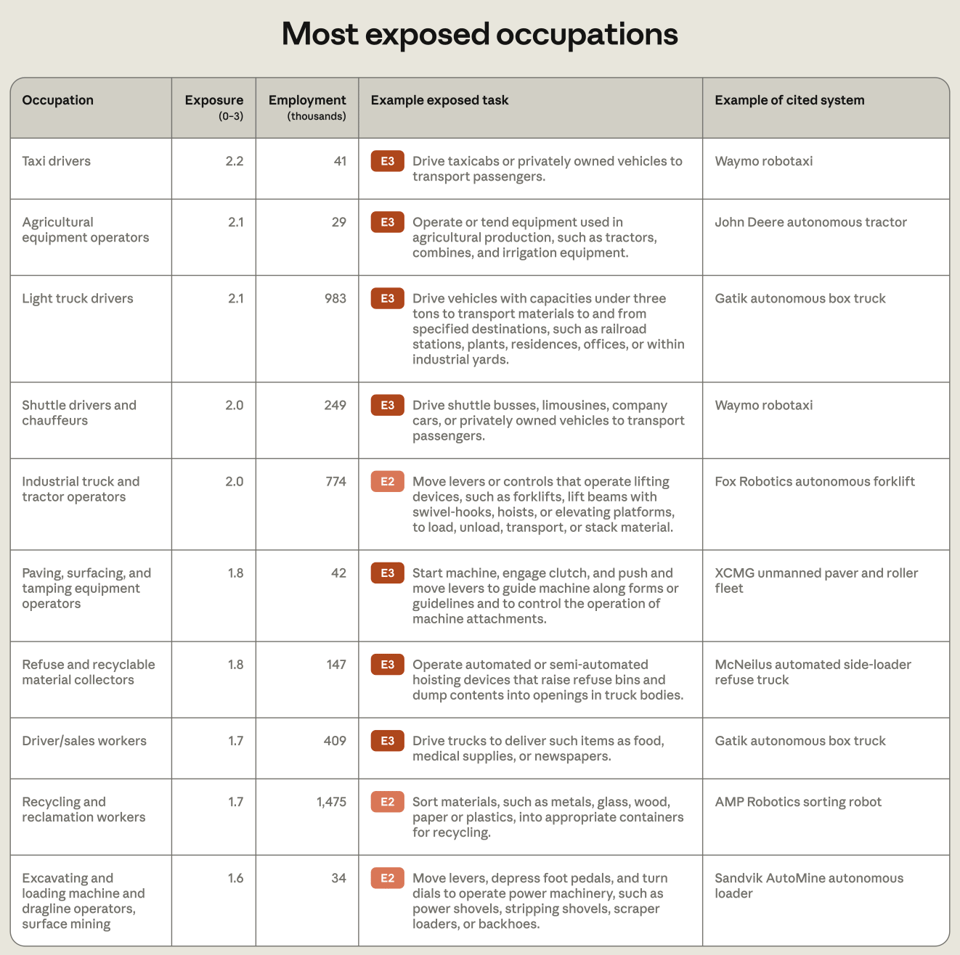
Then they added up all the costs, all the expenses related to deploying the robots. After accounting for the hardware, integration, maintenance, supervision, and insurance, robots were only cheaper than people on less than 1% of physical tasks.
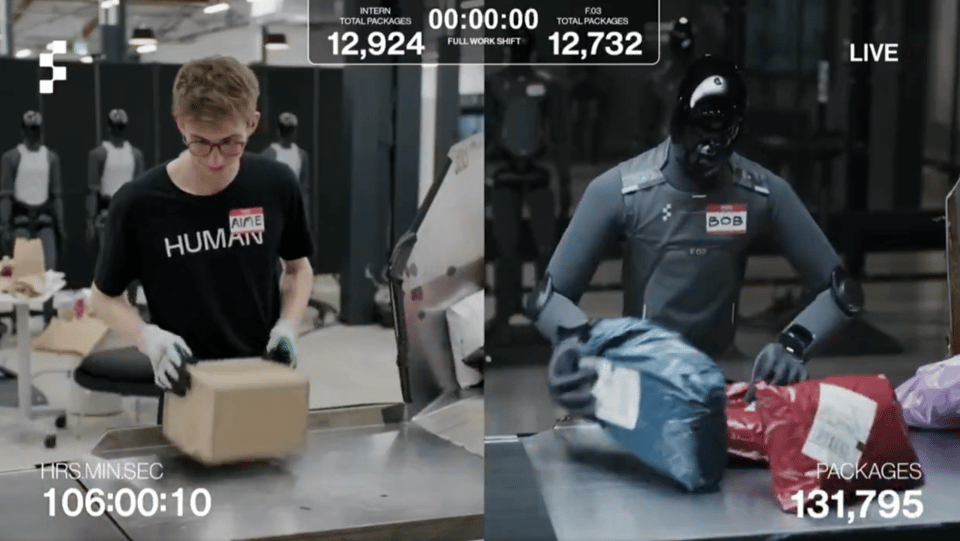
Welding robots, for example, cost about 5x as much as a human welder. One outlier that is ripe for automation today is warehouse packing, where the math works. A packing robot costs about $45,000 a year against roughly $49,000 in labor. You might have seen the human vs robot packing bake-off video (above).
03 · CRMs Rearrange Around AI
Salesforce agreed to buy Listen Labs, a startup whose AI agents interview real customers over audio and video and turn the conversations into research reports in days. TechCrunch reported a price near $2 billion, about 65 times Listen Labs’ annual revenue.
A week later, HubSpot said it would cut about 660 jobs, roughly 7% of its staff, to reorganize around “AI-powered customer outcomes.” CEO Yamini Rangan said AI isn’t replacing those workers.
Customer research used to sit outside the marketing stack, run by consulting firms and agencies and delivered as a ppt deck. Both companies are now betting the customer relationship runs with fewer people in the middle.
04 · Sony Skipping CES
Sony won’t exhibit at CES in January 2027, ending decades of electronics innovations showcased in Las Vegas. Consumer Electronics Show (CES) is the world’s largest annual trade show for consumer technology and innovation and Sony’s participated in it for six decades.
Leadership at Sony say they’re doubling down to focus on entertainment business units like gaming, anime, film, and music.
Most of the hardware Sony would bring to CES has already been sold off. Sony electronics handed control of its Bravia TV brand to TCL this year, and its Afeela prototype car with Honda was shut down months after appearing at CES 2026.
THE FEATURE
Thinking in Generations
I’ve been rewinding and reviewing old travel footage lately, cutting it into ambient videos for a series called Ambient Travel that I post on YouTube.
It’s a strange kind of time travel, sitting with video you shot on walks from a year or two ago, deciding which parts of a trip deserve uploading. That’s how I came across the photo below. On a recent trip to San Francisco, coffee in hand, I visited a room that’s equal parts coffee shop, cocktail bar, and museum called The Interval.
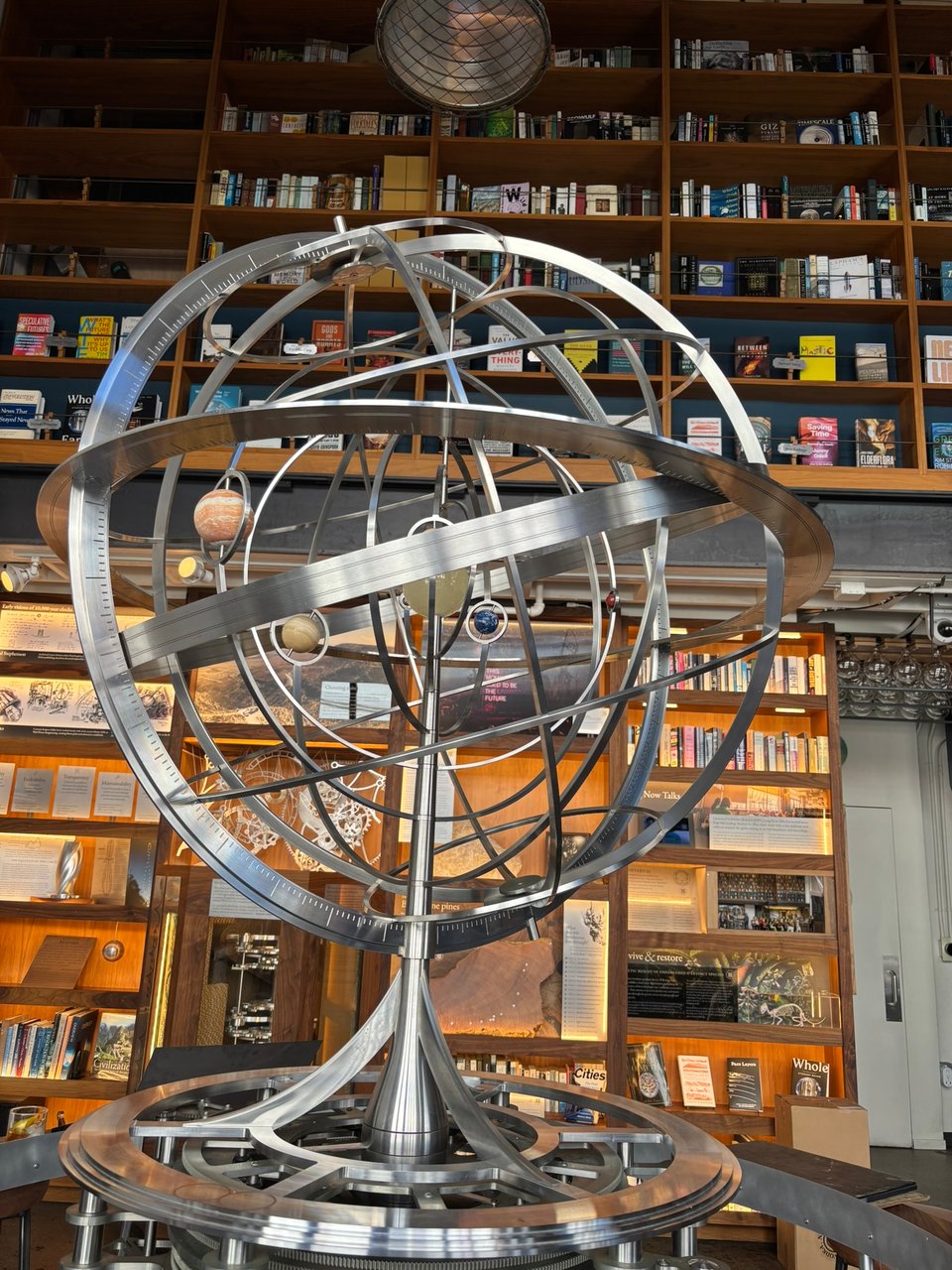
I was intentional about visiting while in San Francisco, as a kind of ambient pilgrimage. Brian Eno, one of my favorite experimental musicians and producers, co-founded the Long Now Foundation and its hq beautifully reflects his signature touch, transforming a physical space into a living, breathing soundscape of long-term thought.
Eno helped develop the chimes for the expansive Long Now Foundation’s 10,000 Year Clock project. It’s an entirely mechanical clock built to keep time for ten thousand years, wound automatically by the daily heat of the sun. In the corner of The Interval, I saw plans for the Clock on display. The real Clock, paid for largely by Jeff Bezos’ $42M, is still being assembled inside a mountain in West Texas. The Clock has ten bells, but they don’t ring on a schedule like a church bell. They only ring when someone is there in person. A visitor who makes the trip into the mountain has to wind the Clock to hear them. Bells rang for the first time in 2022, a year that keeps coming up in this story.
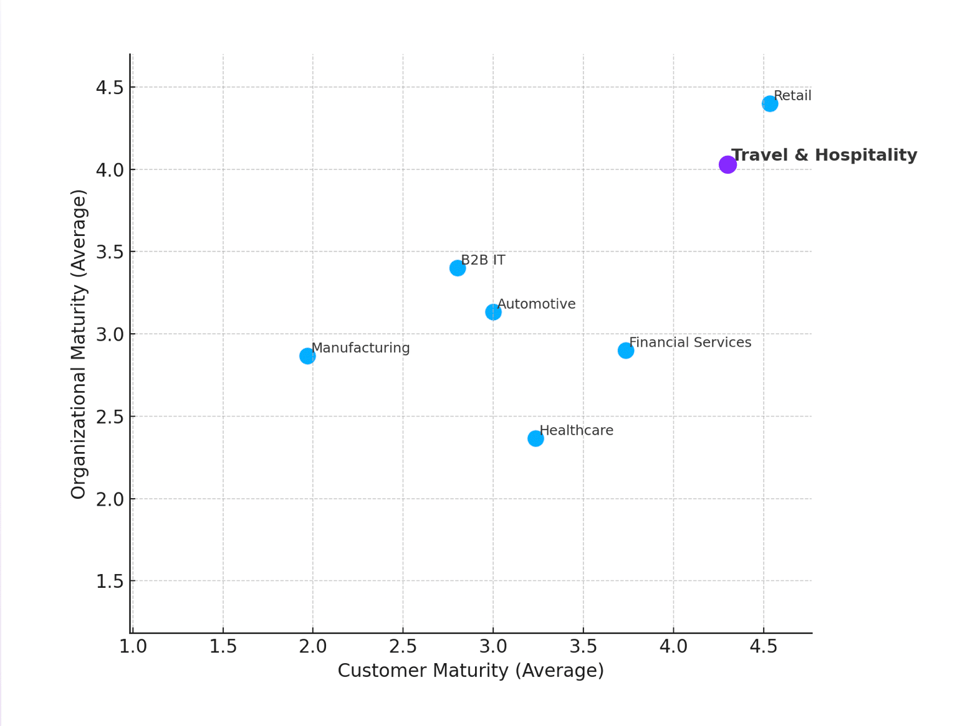
I vividly remember sipping coffee at The Interval, while analyzing survey data and building charts like the one above for an upcoming conference presentation. I’d recently surveyed a room of Sitecore MVPs at the 2024 MVP Summit in Nashville, asking them to rate industries on two dimensions: how ready organizations are to adopt emerging technology, and how much their customers expect connected digital experiences.
Retail and travel and hospitality landed in the top right corner. Companies in those verticals move fast, and their customers already expect to book, buy, and get help on digital channels. Healthcare and financial services told a different story since their customers are fairly digital, but heavy data regulation can slow the organizations down.
The long horizon of the Clock made me decisive, and I left with a renewed focus on travel and hospitality, the industry where my background in experience strategy could make the biggest difference.
There’s another monument I’ve stood in front of built as a message to the future. In 2010 I drove out to the Georgia Guidestones, a 20-foot granite monument commissioned by the pseudonymous R.C. Christian and inscribed in eight languages with instructions for post-apocalyptic civilization. The mysterious stones stood until their destruction in 2022.

I the same sort of feeling there as I did at The Interval, a mix of awe and alarm at the premise of the projects, a presumption that you could leave notes for people who don’t exist yet.
In 2022 someone bombed the Georgia Guidestones off their hill, and the state demolished them entirely by the afternoon. These are both monuments to the future. One gets a cafe and museum in San Francisco, and the other was destroyed by dynamite in the South. I guess when you’re trying to speak to future generations, you don’t always anticipate how they’ll receive it. That’s the risk of thinking in generations. You create things for people you’ll never meet, and then they get to decide what it all means.
And yes, 2022 again. That year I wrote a small book, a collection of essays on documentaries for new and expecting parents, written to my son when he was first born. It’s my own monument, a note to the next generation in my family. Those essays are a little time capsule, preserving the version of me who wrote them.
Now for some news: I’m finally publishing the book in print. The final layout is nearly done, and I’m aiming to launch before the holidays. You’ll hear about it here first.
Which brings me to the new East of Eden on Netflix, a seven-episode miniseries based on John Steinbeck’s 1952 novel. The book follows two families in California’s Salinas Valley stretching across generations from the Civil War to World War I. I read the novel as a teenager, and it became one of my favorite books. Decades later the book remains a classic, and I’m the one who changed. I see storylines and plot points in an entirely new light this time around. The quiet trick of monuments is they stand still while you measure yourself against them.
OBSERVATIONS
News Without Writers
Brown Brothers Media built a network of dozens of “news” websites pulling an estimated 65 million visits a month from mostly AI-written articles. More than half of its writers didn’t exist, according to a Futurism investigation. Some AI bylines claimed careers at NASA and the European Space Agency.
The fake writers were spotted because they gave themselves away. One columnist’s age moved from 66 to 71 to 70 across essays. Another had lunch with his mother, then wrote two days later that she’d died a year earlier. About two weeks after the story ran, the whole network stopped publishing and nearly vanished from Google.
A new breed of AI mass publication is emerging as a kind of newsroom, one that can run without writers at all. A more credible version looks like RuntimeWire, a one-person AI newsroom that runs on about $100 a day.
Remember when OpenAI’s own AI agents hacked Hugging Face? In August, OpenAI researchers talked about how it happened onstage at Black Hat, the big annual security conference in Las Vegas. During the conference, RuntimeWire’s founder was camping in a national park. He fed the session’s live captions to his AI news agents and published the story six minutes later, beating Wired by more than three hours.
The Unicorn in the Window
The opposite problem showed up on TV while I was watching the Braves playoffs this week. Johnson & Johnson’s “Unbelievable” commercial for Icotyde, a new pill for plaque psoriasis, has been running since July. In the unusual commercial, a doctor walks a patient through the results while a CGI unicorn flies by the office window, set to EMF’s 1990 jock jam “Unbelievable.”
Viewers on Reddit decided the doctor in the commercial was AI-generated. They point to stiff movement, plastic-looking skin, and audio that seems slightly off. Nobody has confirmed either way. J&J hasn’t commented, and iSpot doesn’t credit an agency or actor.
Maybe I was primed by the unicorn to think it wasn’t real. When AI slop is suddenly polluting my feeds, one intentionally fake unicorn in an ad for a real, FDA-approved drug makes me doubt everything else on screen. It doesn’t help that the doctor (AI actor?) is terrible at acting. Either way, when viewers can’t tell what’s real anymore, they just assume it’s AI, and then the brand pays for it.
If I’m being honest, I’ve watched this a dozen times and still can’t tell whether the actors in this commercial are AI or not.
There’s no way both of these people are human actors, right?
It’s the first commercial that’s so uncanny I can’t tell. Watch it and let me know what you think.
ABOUT THE CATALOG
These days everything moves at hyperspeed. We’re creating and producing more content, with less certainty, than at any point we can remember. New emerging technologies are fundamentally reshaping how work gets done, how content is produced, and how we communicate with each other, faster than we can keep up with.
As an experience strategist I read a lot, and I continually run across things that are useful or worth thinking about. In fast moving environments, the hardest part can be deciding what deserves attention.
In the Catalog, I aim to capture what I’ve found each week that’s worth learning, exploring, or watching, so you can start with a shortlist instead of sifting through noise.
Learn more about why I started writing this newsletter in Issue 000.
See you next week,
J Corley


Add a comment: