
THE CATALOG logo

THE CATALOG

Archives
Log in
Subscribe
September 18, 2026

Making Canyon Grooves · The Catalog · №006

A canyon that plays music, a phone with no browser, and the hottest summer on record

Welcome back to The Catalog. Here’s what’s worth learning, exploring, or watching this week, so you can start with a shortlist instead of sifting through noise.


September 18, 2026

CONTENTS

  1. New Arrivals (Commodore’s flip phone, Quitting Anthropic, Hottest American summer)

  2. The Feature (The difference six months makes)

  3. Observations (Mathematicians x AI, Bob Dylan’s vault)


NEW ARRIVALS

01 · Commodore is Back with a Y2K-era Flip Phone

Commodore, the company behind the Commodore 64 and most of the 1980s home computer boom, collapsed in the mid-1990s and passed through a chain of owners until a YouTuber bought the brand last year.

Its first product release in decades is a flip phone that very intentionally does not have a web browser, social or work apps. The Callback 8020 ships at $399.

Commodore says other phones are cheap because they harvest data, and they call their streamlined new phone a “speed bump for your mind.” The Commodore brand is a name someone bought, and the phone is a list of things it won’t do. I’d still like to live in a world where using this day-to-day makes sense.

02 · Quitting Anthropic with a Public Warning

Jacob Coxon made waves after he resigned from Anthropic on September 8 and posted his rationale to X. His posts drew 153 million views in 36 hours. He left with equity two months from vesting, and wrote that neither Anthropic nor OpenAI is acting responsibly in this artificial race to AGI.

Headlines have propelled him into the spotlight. In a video interview with CBS, Coxon talks about his decision to resign and why he feels AI could one day threaten humanity. He says the major AI labs “are racing straight to self-improving superintelligence and gambling with our lives.”

Leaving two months of vesting on the table is a stronger signal than 153 million views.

03 · Hot Hot American Summer
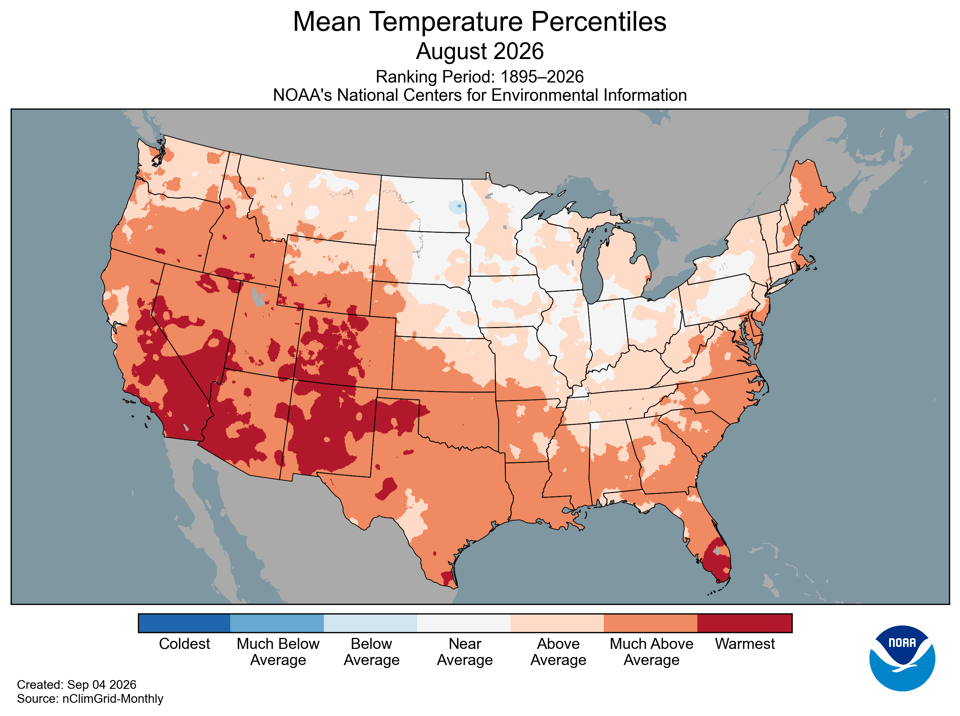
2026 was the warmest Summer in 132 years, via: NOAA

The National Oceanic and Atmospheric Administration (NOAA) confirmed that June through August was the hottest summer on record for the contiguous United States. It beat the previous records, set in 1936 and 2021, by 0.4°F, and ran 3.0°F above the 20th century average. Records like this usually fall by hundredths of a degree.

The drought stats surprised me most. Almost 60% of the country was in drought by September 1, a jump of 10 percentage points in a single month. Arizona, New Mexico, Utah and Colorado all set or tied summer records, which puts the worst of it squarely in the Southwest.

The records this summer broke belonged to the Dust Bowl.


THE FEATURE

Canyon Grooves: The Difference Six Months Makes

I have been waiting all week to show you what I built here.

Canyon Groove plays the actual topography of a canyon as generative music, and it only took me two nights to build.
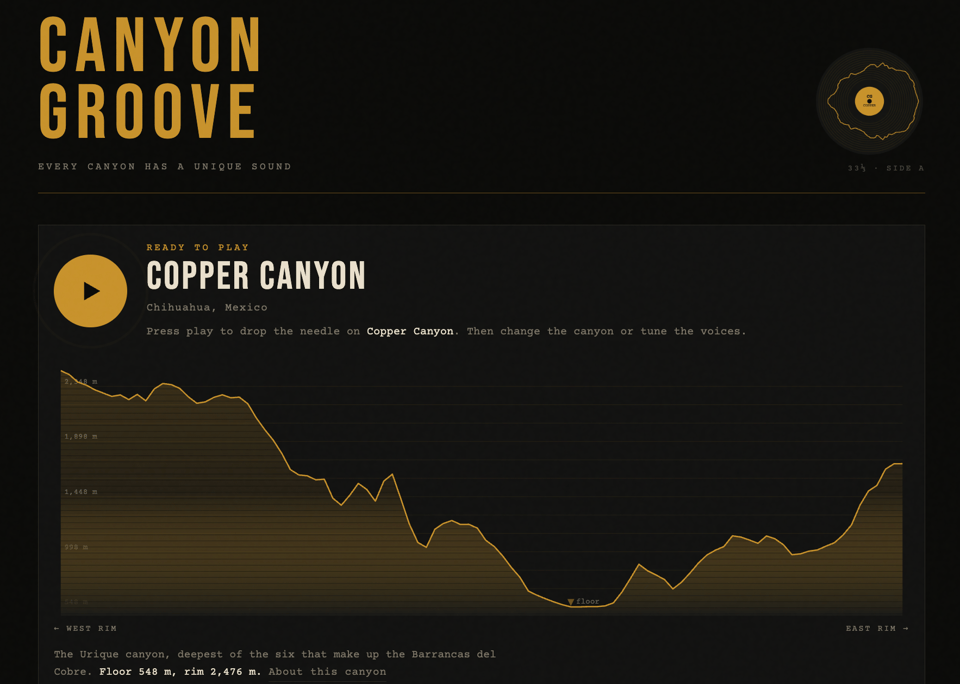
Pick your canyon and make a song

Earlier this year, in March, I was scrolling through Reddit and a photograph stopped me and made me think. It was a close-up, magnified view of a vinyl record player’s needle in the groove of a wax album, with the left and right channel walls labeled on either side. As I stared at the photo, I thought it looked like the vinyl needle was dragging through a canyon.

That simple thought drove me to build a system that plays music for each famous canyon. I opened Claude Code the same afternoon and asked the AI system to help me build a prototype that would analyze Google Maps or other public spatial data for famous canyons and convert it to audio. In early 2026, the frontier system generated a single HTML file with the contours of my idea and a dozen placeholders that sat where all the hard parts needed to be implemented. It was a good conceptual mockup, but my generative music system didn’t play music worth listening to, so I set it aside.

I reopened the same project six months later. This time I’m using Claude Code + Fable 5.1 + Max plan.

My Canyon Groove experiment turns a real canyon into ambient songs. You can select from one of 16 notable canyons, ranging from the Grand Canyon to the Yarlung Tsangpo in Tibet, and the app imports its elevation profile rim to rim, 1,500 measured points along a straight line, and treats that line as the groove on an LP vinyl record. You can press play and a virtual needle rides through it: where the rock drops the sound drops, and where the wall climbs the notes climb with it. Nothing is sampled, and all 1,500 elevation points are synthesized in the browser from the shape of the land.

The floor elevation of any given canyon picks the key, where the floor sits between the two rims sets the mood, width sets how long each pass takes, and depth sets how long the echo hangs. The Grand Canyon arrives in G, warm, on a 44-second loop. Zion arrives in C sharp, bright, on 29 seconds. They are synthesized as different instruments before you fine-tune any controls, and it’s all based on rock that settled millions of years ago. Move the line a few miles along the river and listen to the instrument move with it.

Up to five voices read the canyon, and each one plays something different. Bedrock is a drone rooted in the floor. Strata reads slow chords out of the rise and fall of the ground. Contours rings a note every time its needle crosses a contour line, so steep walls chime and flat floors fall quiet.

I described the general direction, and the model proposed how to get there. Each voice was given its own needle, and the loop lengths were chosen so none divides evenly into any other. They drift in and out of phase the way classic ambient tape loops do, and the unequal lengths keep the combination from resolving or repeating. At the Grand Canyon’s pace, five concurrent loops would need about 12,000 years to line back up. Press play and sit back for a few minutes and you hear a piece of music. Sit for another twenty and it still hasn’t repeated.

I set out to hear what a canyon sounds like and ended up with something that composes generative music.

I’ve been thinking about just how much more capable frontier AI models have become in the six months since I took my first pass at the canyon music system. In March, I had a single-page HTML file that didn’t work well enough to output audio. By September, I was working alongside a capable agent that pulled real elevation transects from public datasets and baked it into the app. Then it wrote a README, with deploy paths for GitHub Pages, Vercel, and WordPress.

I’m a marketer with a technical bent who isn’t a developer. I was able to go from idea to fully functioning system without writing a single line of code.

Try it out and make some music. If you have any ideas, or you’ve got a canyon I should add, send it over. The repo is here.

Six months ago it could not play a note. The distance between an idea and a working thing is collapsing, and mine took two nights.


OBSERVATIONS

Mathematicians Concerned About AI

OpenAI says one of its models produced a proof on a Millennium Problem in 88 hours. The Clay Mathematics Institute still lists Navier-Stokes as unsolved, and the proof introduces a smooth external force that the written problem permits and most working mathematicians leave out of the real question. OpenAI says it isn’t claiming the million dollars.

The run consumed 300 billion output tokens, roughly $22.5 million of compute. Reported as 88 hours it sounds like intelligence. Reported as spend it sounds like capital.

Back in Issue 002 I wrote about Terence Tao’s taxonomy for AI results in math: the machine working alone, the machine rediscovering something already published, the machine building on known work, and the machine working with people. Announced this way, it reads as the machine working alone. A proof on a permitted variant of the problem, built on decades of published analysis, belongs further down that list.

Dylan Opens the Vault

Dylan is releasing 39 discs of the 1976 Rolling Thunder Revue on November 6, the spring leg from Lakeland, Florida to Salt Lake City, with 371 previously unreleased tracks. Almost everything in the box is unheard.

I collect vinyl, so a 39-CD box was never going to be mine, and then I read the rest of the announcement. The May 16 show in Fort Worth is getting its own 3-LP set, remixed from the original multitrack tapes. I just pre-ordered it on Amazon.

Most of what a band plays live disappears the moment the show’s doors close, and the shows that survive are the ones somebody decided in advance were worth recording. Five weeks of nightly tape is extremely rare, and it’s the only reason a box like this can exist fifty years later.

If you haven’t seen it already, I highly recommend watching Scorsese’s Rolling Thunder Revue mockumentary that covers the 1975 leg of the tour. It’s a great film.


ABOUT THE CATALOG

These days everything moves at hyperspeed. We’re creating and producing more content, with less certainty, than at any point we can remember. New emerging technologies are fundamentally reshaping how work gets done, how content is produced, and how we communicate with each other, faster than we can keep up with.

As an experience strategist I read a lot, and I continually run across things that are useful or worth thinking about. In fast moving environments, the hardest part can be deciding what deserves attention.

In the Catalog, I aim to capture what I’ve found each week that’s worth learning, exploring, or watching, so you can start with a shortlist instead of sifting through noise.

Learn more about why I started writing this newsletter in Issue 000.


See you next week,

J Corley

Don't miss what's next. Subscribe to THE CATALOG:
← Newer Going to Buy an Envelope · The Catalog · №007 Older → Faster Than You Can Watch It · The Catalog · №005

Add a comment:

Posting this comment will subscribe you to this newsletter with the email address you enter.
Instagram
www.youtube.com
Twitter
LinkedIn
Powered by Buttondown, the easiest way to start and grow your newsletter.