
Lowered Barriers to Entry · The Catalog · №008
Seinfeld laughs visualized, OutKast at Waffle House, and why new AI workflows make it easier to create but harder to get hired
Welcome back to The Catalog of what’s worth learning, exploring, or watching this week, so you can start with a shortlist instead of sifting through noise.

CONTENTS
New Arrivals (Visualized Seinfeld Laughs, Robots Doing Chores, Apophis the Asteroid, New Elon Documentary)
The Feature (Lowered Barriers to Entry)
Observations (A Season Without Hurricanes, OutKast at Waffle House in ATL)
NEW ARRIVALS
01 · Every Laugh in Seinfeld Visualized
If you’re a Seinfeld fan with an hour to scroll through visualized tv episode data, Andy Kirk’s The Seinfeld Chronicles is “an unnecessary data exploration” of the show about nothing. Use your desktop and turn on audio.
Kirk logged all 176 written episodes by hand from the DVD box set, and the level of detail is staggering. He breaks the episodes down like a musical score, with rhythm and scene structure, and you can filter by characters and locations. Kirk’s project started in 2020 as a printed book limited to 176 copies, one for each episode.
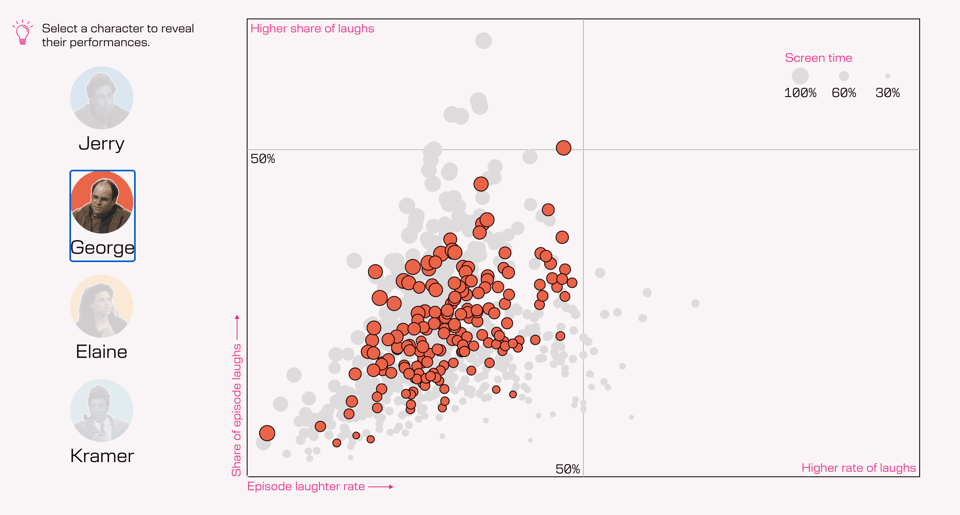
I really like how he measures a character’s peak performance: the episodes where they got a lot of laughs while on screen (laughter rate), a big share of all the episode’s laughs (laughter share), and plenty of screen time (e.g., George in “The Note”).
02 · A Robot Does the Chores
Figure deployed its humanoid robots into 30 Bay Area homes they had never seen, running their new Helix 2.5 model.
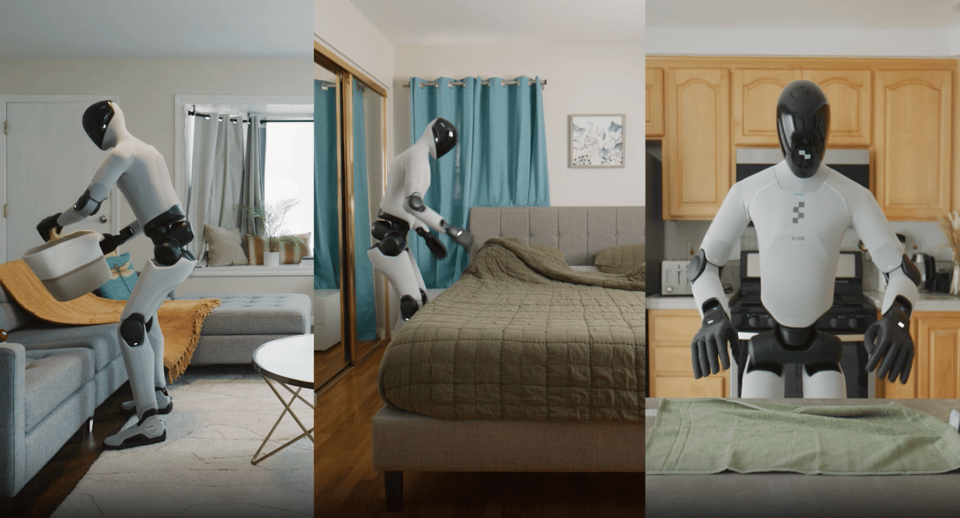
The humanoids autonomously made beds, folded towels, and picked up toys, completing 237 of 420 attempts (56%).
The same model without pretraining finished only 9% of household tasks.
The difference was Index, Figure’s library of human video, which more than 90,000 people add to every week by filming their everyday lives. In №003 I wrote about Waffle Video paying $25 an hour for footage of chores like washing dishes. Five weeks later, Figure is now using this sort of video to train their humanoid fleet.
As a parent of a 4-year-old, I completely understand why picking up toys was the hardest task to complete (40%).
03 · Apophis Is Coming
In April 2029, a 340-meter asteroid named Apophis will pass closer to Earth than the satellites carrying our TV and weather data, about 32,000 kilometers above Earth’s surface.
Apophis, named for the Egyptian god of chaos, arrives on a Friday the 13th.
The cosmic rock is as wide as the Eiffel Tower is tall, and astronomers have been tracking Apophis for a while. In 2004, its odds of hitting Earth in 2029 were estimated at 1 in 37, almost a 3% chance. Years of careful tracking brought those odds to zero.
The European Space Agency says objects this large come this close only once every 5,000 to 10,000 years.
The asteroid will be visible without a telescope in Europe and western Asia, so you might want to start planning a trip to go see it.
04 · New Elon Musk Documentary by Alex Gibney
Alex Gibney’s documentary about Elon Musk opens in US theaters next Friday, October 9. Musk premiered at the Venice Film Festival last month to a minutes-long standing ovation.
Since Musk declined to take part, Gibney built a digital stand-in. An AI-generated Musk avatar reads the real Musk’s past quotes throughout a film made largely from his own words. Journalists like Kara Swisher and his ex-wife Justine Musk fill in the rest.
Gibney is a renowned director behind some of my favorite modern documentaries, like Enron: The Smartest Guys in the Room (2005), which I saw in theaters, and The Inventor, HBO’s 2019 documentary about Elizabeth Holmes.
HBO has streaming rights, so most of us will eventually see it at home, and with a 4-hour runtime, probably in more than one sitting.
THE FEATURE
Lowered Barriers to Entry
Next week, Cumberland Coast Studio is livestreaming the Norcross City Council special election debate. It’s my first livestream since 2013, when I captured Ed Roland of Collective Soul playing holiday songs in the studio. It’s a lot easier now.
This time my whole rig is an iPhone 18 Pro, a MacBook Air, a pair of Rode wireless mics, and Streamlabs into YouTube Studio. I expect to go from unpacking to broadcasting in a few minutes. A setup like this used to take hours of wiring, and weeks of planning.
My iPhone is doing work that used to require a dedicated DSLR camera, and my laptop no longer needs external encoding hardware. The new iPhone 18 Pro has a variable aperture on its main lens, and its autofocus tracking compares with mirrorless cameras. Top-of-the-line phones still have gaps for serious film work, but for a live session in a small room, they’re more than enough.
Lately, with AI’s help, almost everything I build or produce has felt too easy. New software and hardware don’t require me to learn the language first. Here are two more examples from the past month.
I connected one of my WordPress sites to Claude Cowork via MCP, a standard that allows AI to work directly inside other software. Now, I describe a new component or site-wide change in plain English, and it gets built and published. I don’t write a line of code.


