
THE CATALOG logo

THE CATALOG

Archives
Log in
Subscribe
September 11, 2026

Faster Than You Can Watch It · The Catalog · №005

Robotaxis without steering wheels, prove your age to Meta, and splitting the video feed

Welcome back to The Catalog. Here’s what’s worth learning, exploring, or watching this week, so you can start with a shortlist instead of sifting through noise.

September 11, 2026

CONTENTS

  1. New Arrivals (Robotaxis with Drivers, Nathan Fielder meets Elizabeth Holmes, Meta Settlement IDs, Unlimited AI in the East)

  2. The Feature (The Week Between Episodes)

  3. Observations (Casual Dining, AI Music)


NEW ARRIVALS

01 · Robotaxis without Steering Wheels
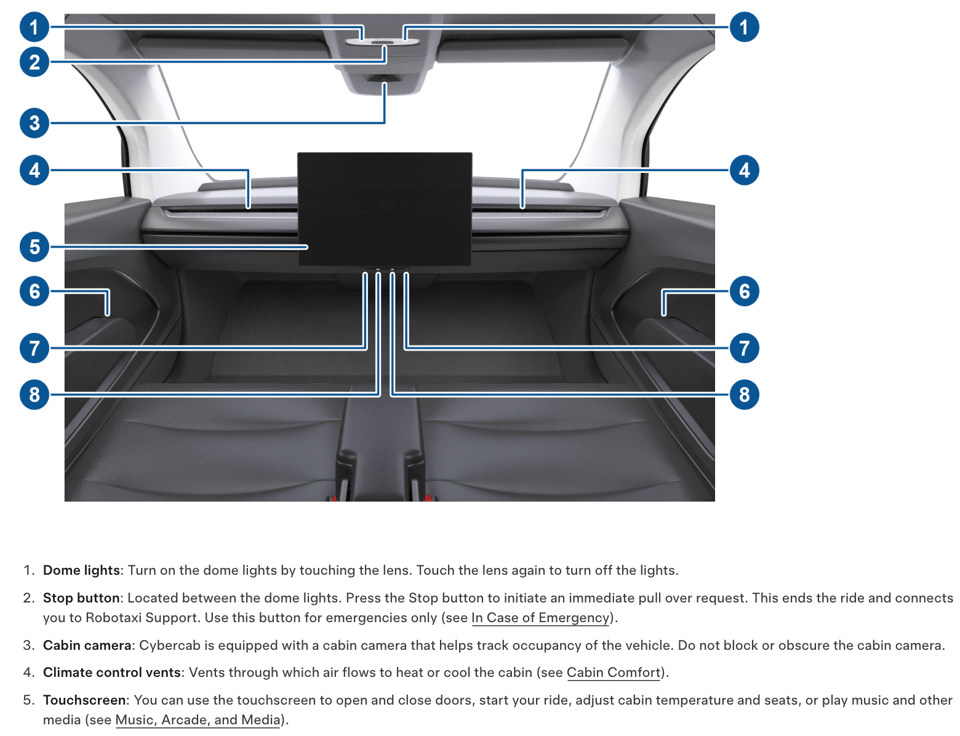
Tesla.com, Cybercab Rider Guide - Interior

Tesla launched a fleet of self-driving Cybercabs in Austin, TX. Cybercabs are a two-seat car with no steering wheel or gas/brake pedals.

You can download Tesla’s Robotaxi mobile app that competes directly with Uber. Crowdsourced trackers watched the autonomous fleet climb to at least 50, and Tesla wants you to register if you want to buy a Cybercab fleet.

No one is talking much about teleoperator mode. At low speeds, there’s someone in the background, a remote driver who takes control from the cloud. So the car with no steering wheel still has a driver, in a room somewhere you’ll never see.

02 · Surprise Elizabeth Holmes Doc with Nathan Fielder

You Can See Everything premiered at the Telluride Film Festival with a surprise screening. It runs 174 minutes, and was cut together partly from prison visits Nathan Fielder made to Theranos founder Elizabeth Holmes in Bryan, Texas, where she's serving 11 years for fraud. Holmes has said almost nothing in public since her 2022 conviction. Fielder somehow captures her on camera anyway.

Nathan Fielder builds elaborate real-world setups and then lives inside. On Nathan for You he ran actual small businesses into absurd comedic territory, and in the second season of The Rehearsal he spent the entire season on airline safety, building full cockpit replicas to argue that first officers are too intimidated to correct their captains. I've been a fan of his particular breed of comedy for years, and cannot wait to watch this new A24 documentary.

His co-director Lance Oppenheim blurs staged and real footage on purpose, so I doubt this will be a straight interview doc. It will be interesting to see a film made to keep you unsure of which parts are real, the same trick Fielder always plays, while pointed this time at Holmes who did it for a living until a jury stopped her.

03 · Meta Pays $17B and Starts Carding

A Los Angeles court found Meta and YouTube negligent in March over claims that Facebook and Instagram harmed young users. The award was $6 million, with the jury voting 10 to 2 and putting 70% of the responsibility on Meta.

Five months later Meta agreed to pay up to $17 billion over ten years to settle claims from 51 state attorneys general. The new terms read like product specifications: social media users under 18 will get a default two-hour daily limit, a block from midnight to 6AM, no visible likes on their posts, and an optional non-personalized feed. Age assurance policies will roll out to every user on the platform within a year. In the grand scheme of Meta’s business, $17 billion over ten years is a relatively small cost, but what’s binding is that a court set the default system settings a product team used to argue about.

I bet it’s hard to sort teenagers out from the rest of Facebook and Instagram, and that will mean Meta’s checking everybody’s age, so part of the remedy for one kind of surveillance is going to lead to more ID checks for the rest of us.

04 · Unlimited AI in the East

South Korea announced it’s giving all 52 million of its citizens free, token-unlimited access to homegrown AI. Beta testing starts this month, funded by a 10 trillion won budget built to cut dependence on foreign systems. That’s a tech subsidy aimed at habit formation, before citizens can get used to American and Chinese systems.

Along similar lines, a Chinese court ruled that a company cannot lay off workers just to replace them with AI systems. The Hangzhou court found that automation alone doesn’t clear the legal bar for cutting a salary or ending a labor contract.

In South Korea’s case, the government is accelerating emerging tech adoption from the top-down, while China limits fallout from the bottom-up. We already saw this pattern one item up (Meta above). The US has neither lever yet. Ours will arrive the same way, likely one ruling at a time.


THE FEATURE

The Week Between Episodes

My friend Jay and I catch up every month or so on Thursday night video calls, which is Friday morning where he is, in Australia. This week Jay said the timing is convenient because his weekly Claude Code allowance resets on Friday afternoons, so Friday morning is a stretch of his week when he’s out of tokens and free to talk.

Aswin, a former Sitecore colleague of mine, recently joked, “Life is what happens while you wait for your AI compute to reset.”

Early adopters of frontier AI did not set out to live in a world where the hardest thinking gets scheduled around when a meter refills. A year ago there wasn’t even a usage meter.

Token usage windows now have the capacity to shape your week.

Jay and I talked through recent experiments and prototypes, mine for touring artists and his recent research into feeding unstructured data into processing systems that generate video. He told me about HeyGen’s new open-source framework that turns HTML into video called HyperFrames. Coming out of our call I started experimenting, and my first project focuses on a real estate listing, tags every photo into a fixed set of room categories, and writes a narrated script where every spoken claim traces back to the listing description, a spec field, or something visible in the photo on screen.

Through your AI app of choice, HyperFrames enables backend video generation (applying transitions or Ken Burns effects, adding chapter titles, animating graphics, even aligning a voiceover script to photos with music underneath).

I hooked Claude Code up to HyperFrames over MCP, and 10 video runs produced 28 minutes and 24 seconds of finished video in 20 minutes and 52 seconds of render. So that’s about 44sec/min, seconds of render per minute of finished video. The real-time break-even line is 60sec/min, so anything under it renders faster than you can watch it.

Output

Runs

Avg Render

Render Rate

720p

5

90 sec

31sec/min

720p + titles

3

157 sec

54sec/min

1080p + titles

2

164 sec

65sec/min

Motion and audio alone come in at 31sec/min, about half of real time. Titles and counting graphics are what push it past break-even.

These are still early days, and I think I’ll be incorporating this into my video editing workflow for things like animations, text and captions.

My quick test videos are up on YouTube, the first listing and the second. They’re basic proofs of concept. I almost never see real estate video on YouTube, which makes me think the opportunity is scaling this to generate a real estate agent’s entire active portfolio of properties at once. If you sell houses please reach out, because I’d love to know if you’ve seen a solution like this before.

Now, let’s put the two facts together.

  1. Production quality video was prompted and generated without a track-based timeline like Final Cut or Premiere.

  2. AI video renders faster than you can watch it.

I think that leads, in a few years, to a stream of content that stops being a library you choose from and becomes a feed that’s custom-rendered for whoever is sitting in front of it.

Mandela Effect debate sparked by Black Mirror Season 7 episode "Bête Noire"

Netflix ran this live last year as a joke. “Bête Noire” is a Black Mirror episode about a woman whose memories stop matching everyone else’s, and at one point the characters argue over the name of a fried chicken chain. Netflix shipped two versions of the episode and handed them out at random. (A) In your version, the cap in the opening scene reads Barnie’s. (B) In your neighbor’s version, the same cap reads Bernie’s. Your version stayed locked to your account, so signing in on another device wouldn’t show you the other one. The plumbing to deliver different versions of a TV episode was already boring enough to use for a gag.

What’s new this year are capable consumer-level AI video content generation engines.

Imagine a near future where we’re watching television episodes with the same script, same actors, same arc, with a pace that’s personalized for the viewer. So, the same episode might be a little more like a thriller for you and a little more like a rom-com for your spouse. The music would be a slightly different score, and nobody has to select the songs because they can be chosen for us. I don’t think I want to watch that show.

I used to host Breaking Bad watch parties at my rental house in the Little Five Points neighborhood of Atlanta. The show was excellent, and during the week between episodes we argued about what Walt would do next. Everyone was wrong in a different way, and the next Sunday settled it for all of us at once. ABC’s show Lost fueled similar fan theory energy before losing its path, and companion podcasts like the one Ben Stiller and Adam Scott release for Severance keep that energy alive, even as they hand you the theories instead of leaving you to build your own.

The wait is mostly gone already, traded away for a full season at midnight. The episode survived that trade, because we all still got the same episode. Personalized generation takes the last piece. If your version was paced for you, I can’t argue with you about it.

If we’re no longer watching the same thing, there’s nothing left to wonder about together.


OBSERVATIONS

Last Call for Casual Dining

I’ve been keeping a running note on chain restaurants closing, and the numbers keep getting worse. Red Lobster sits at roughly 540 restaurants, down from more than 700 before its bankruptcy. Dine Brands plans to shutter 20 to 35 Applebee’s out of about 1,500 this year. Ruby Tuesday ran as many as 945 locations in 2007 and has closed more than 770 of them, which leaves it under 200.

The decline of casual dining restaurants is slow and public, and the final locations closing will be fast and quiet.

O’Charley’s closed every corporate restaurant at 8PM on September 9. It peaked near 250 restaurants in the 2000s and was down to 47 by July. Franchise locations are still open, with no announced dates, and the company’s social accounts are already gone.

Labels Get Paid for AI Music

Generative music startup Suno shipped v6 of their powerful AI music model this week, trained on music licensed from Warner, BMG, and Believe. The announcement says artists can “choose to participate and get paid when they do.”

Warner settled a 2024 copyright suit with Suno in November 2025 and BMG made its deal in August. Sony and Universal are still litigating, and Jason Isbell and three other artists filed a class action on September 1 over names and likenesses. So the training set for v6 seems to be defined by who settled.

These new text-to-music models are surprisingly good, but I hope the general public continues to prefer music generated by human artists.


ABOUT THE CATALOG

These days everything moves at hyperspeed. We’re creating and producing more content, with less certainty, than at any point we can remember. New emerging technologies are fundamentally reshaping how work gets done, how content is produced, and how we communicate with each other, faster than we can keep up with.

As an experience strategist I read a lot, and I continually run across things that are useful or worth thinking about. In fast moving environments, the hardest part can be deciding what deserves attention.

In the Catalog, I aim to capture what I’ve found each week that’s worth learning, exploring, or watching, so you can start with a shortlist instead of sifting through noise.

Learn more about why I started writing this newsletter in Issue 000.


See you next week,

J Corley

Don't miss what's next. Subscribe to THE CATALOG:
← Newer Making Canyon Grooves · The Catalog · №006 Older → The Case for Maintenance · The Catalog · №004

Add a comment:

Posting this comment will subscribe you to this newsletter with the email address you enter.
Instagram
www.youtube.com
Twitter
LinkedIn
Powered by Buttondown, the easiest way to start and grow your newsletter.