
On the Craft of Romance
Regency settings and Regency fashions
This month I’ve made some enormous strides in finishing up Dandies & Dandyzettes, my TTRPG(/writer’s guide to the Regency). The last real hurdle has been figuring out how to print the maps: inside the books, they were too small and got slivers lost in the spine, so I decided to print them separately and just include them in the package — but that requires some extra logistics.
I’m far enough along with that that I feel comfortable announcing that I will be starting to serialize my novel, Mary Marchbanks, in the coming months. I’ll do another post specifically about that later; for now, here’s the landing page to the site I’ll be posting it on. If you’d like to subscribe now, you can be sure of getting the first chapter as soon as it’s posted!
Last month I promised that I was going to talk about KJ Charles’s craft, so here I go.
Since I started mainlining all of Charles’s published works, I’ve been not only enjoying myself enormously getting invested with pairing after excellent pairing, but have also been noting with glee how well her stories are put together. Because I like them so much and want to do similar things in my own writing, I started paying closer attention to the actual mechanics. How does KJ Charles make me read her romance novels so ravenously when I’m so picky about the genre?
A few key things I’ve picked up and am trying to keep in mind as I write or outline:
There are plots. That is, the ridgepole of the novels is the relationship between two characters, how their romance develops and how they come to a place where they can live happily together (for now, if not ever after). However, Charles always situates this in conjuction with another complex plotline that raises the suspense and stakes. In Any Old Diamonds, they’re doing a heist. The Sins of the Cities series involves Dickensian mysteries in the fog tying into the search for a lost heir.
It’s not uncommon for romances to rest all of their weight on, well, the romance, meaning that they live or die on whether or not you believe in the relationship. By including a mystery/adventure/comedy-of-manners plot, the characters have something else to do that is a little bit less obviously going to succeed. Can they get the diamonds? Who is the missing heir?There are serious obstacles to the relationship. Some of this ties into the fact that KJ Charles is writing queer romance, set in periods in which propositioning the wrong man or being caught with the right one could get another man killed. Still, she takes care to layer this with some of your typical romance communication issues but also problems that tie into the plot and have to be resolved along with it. This ensures that the story keeps moving and that the wrap-up hits multiple beats. (She actually has a blog post on this, which I found after I wrote this point.)
For instance, in The Gentle Art of Fortune Hunting, the central conflict of the book is that Robin and his sister are active schemers from a very poor background who are trying to use their good looks and charm to scale the heights of society and become wealthy and secure, while Hart has been wounded multiple times by insincere people who use others as a source of money. The main non-romance plot deals with Robin's aborted attempt to do this with Hart's niece, and Robin's sister's more effective efforts to become engaged to an earl. This gives them a lot to discuss, a lot to argue about, a lot to reveal, and a great set piece for the climax of the story.
The characters interact. I mean, obviously, right? That's what characters in book, especially romance novels, do. But I realized in close-reading and analyzing just how much of a KJ Charles plot is moved by two characters speaking. There is always some action, but everything turns on conversation and argument. The leads interact, and then they separate and interact with other people to digest what just happened (friends and relations are also very important in a KJC — maybe that’s point 3a), and then they come together again with a new perspective. People rarely sit around and think about their problems in internal narration: they reveal them in conversation. And, of course, relationships are progressed and characterization is shown through sex.
The Secret Lives of Country Gentlemen is a particularly action-filled book, as there’s plenty of smuggling and adventure on the coast. However, the action and the romance are all about interaction. For instance, early on there’s a tense courtroom scene where the tension mainly comes from Gareth’s fear of what Joss is going to say to discredit him (that is, that he goes to a molly house) and his own humiliation in retracting his evidence to prevent that. The next chapter sets out conflict in Joss’s family/smuggling gang with his uncle Elijah over who’s in charge, and Joss’s reliance on his grandfather for advice; then he forces a conversation with Gareth. Gareth then has to deal with his own family conflict with his much younger half-sister, and when she’s menaced by thugs, he goes back to talk to Joss on the assumption that it was the Doomsdays behind it. Back and forth, back and forth, engaging with each other and then with other people. Danger is perpetuated by speech just as much as by physical attack (and this is one of the most physical attack-ish of the books, I think).
The characters can hurt/lie to each other. The main characters, I mean. This is controversial (I know people who cannot read the books where one protagonist actually betrays the other in some way), but for me it makes the book much juicier. Having some form of betrayal between the leads in a romance gives them a very serious and believable conflict to get past, as well as a good amount of guilt over their own conduct.
So many of KJ Charles's couples start out at odds and have uncharitable thoughts about each other, which is excellent, but many go beyond that. As previously mentioned, Joss and Gareth have a sticky situation where Joss gives the impression that he’s going to reveal Gareth’s sexuality in order to stop Gareth from testifying against his sister. In The Will Darling Adventures, Kim screws Will over for the sake of the mission time and time again.(And there’s one I would reeeeeally like to discuss but shan’t because it’s a major spoiler. KJC fans know exactly what I’m thinking of, though.)
Queer historical romance automatically has a good answer to the question of what is keeping these two characters apart. However, it’s more satisfying when there’s an actual interpersonal answer on top of that, one based in actions rather than misunderstandings and/or miscommunications.
This is basically a taster … KJ Charles is evidently going to have a book on writing romance out later this year, which will probably make these points and more!
I am working on a first draft of a sapphic romance set in 1819, so I’m thinking more about very late Regency dress lately. Here’s a portrait from the same year:
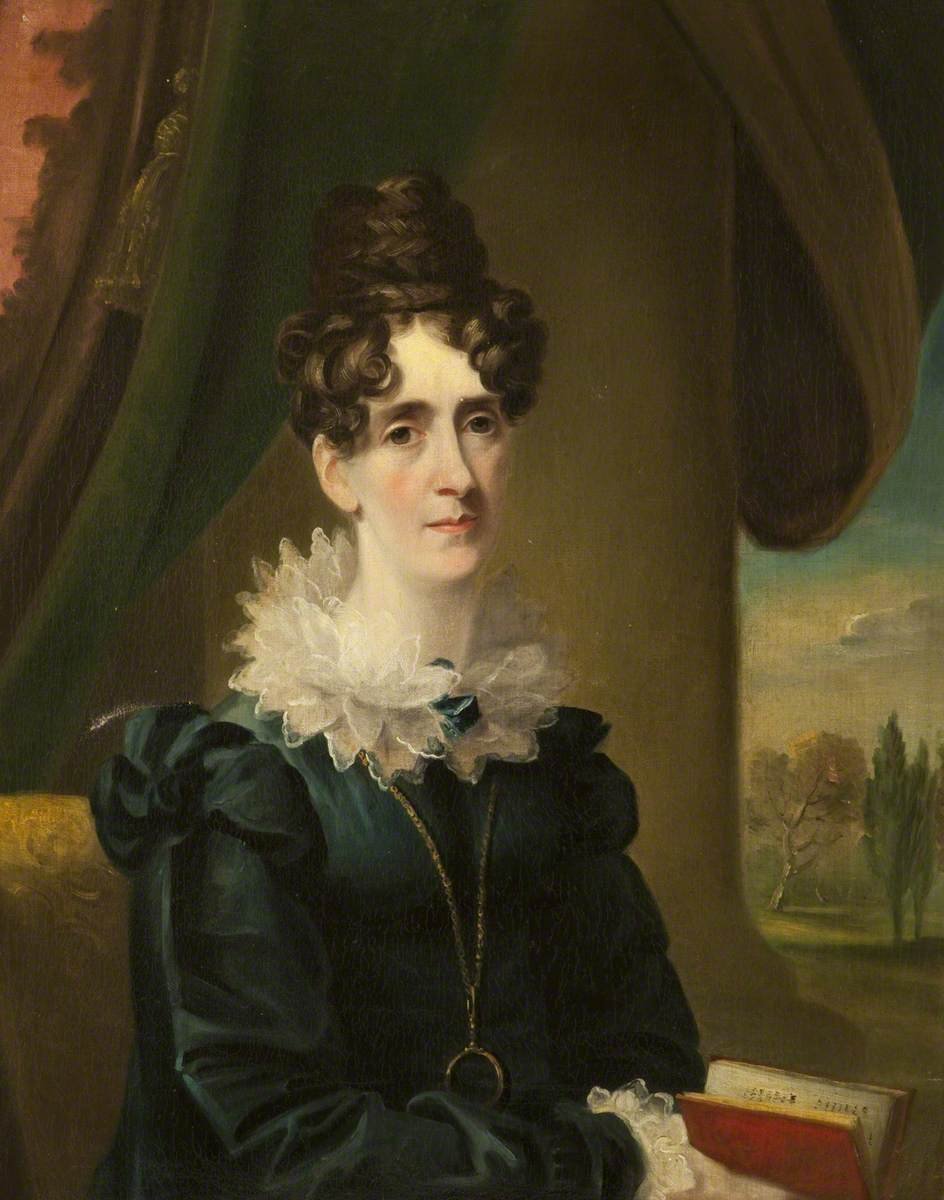
One one level, this outfit is simple: a plain black silk gown with white accessories and minimal jewelry. However, the execution is anything but simple.
The gown has fairly full sleeves, made with puffs at the shoulders that seems to have some kind of complex pleating and maybe slashing, and perhaps even a bow of some kind at the bottom of the puff. These puffs coming back into style mark the beginning of a slow trend that would result in the massive sleeves of the early 1830s.
The darkness of the gown is set off by the bright white accessories. The frill or collerette at her neck is made of what seems to be four or five layers of scalloped muslin, probably identical, that are gathered to some sort of band and tied in the front with a black silk ribbon (a somewhat neutral choice, but here it coordinates perfectly with the gown). This scalloping seems fairly plain, but The Lady’s Magazine and La Belle Assemblée printed free embroidery patterns for subscribers that sometimes included scalloped borders, which could have been used to make accessories like this at home. The depth of the scallops, though, points toward the gothic influence by that point well established in fashion. Elizabeth’s narrow cuff ruffles are much plainer and more utilitarian.
Her hair is not a style most people associate with the Regency. To be honest, the “classic” Regency hairstyle of a small bun with bunches of very defined curls on either side of the face is something more seen in costuming than actual images of the period. Elizabeth has a very large bun made of a spiralling braid, probably supplemented with false hair; in front, her hair is cut fairly short and curled naturalistically over and next to the forehead.
Her only jewelry is a gold chain holding a monocle or “quizzing glass” around her neck.
(The museum has a portrait of Elizabeth’s sister, dressed in a very similar outfit and with the same hairstyle.)
Thank you for reading, and see you next time! If you’ve read this through a link, please consider subscribing for more of the same:


