
Introducing Mary Marchbanks
Odd things happen at Marchbanks Hall with some regularity.
Last month … What a month it was. Medical problems on medical problems. My 500 words/weekday, 1000 words/weekend day habit was completely broken and I’m just scraping myself back up to that. Very sad! I still really enjoy my work(s) in progress, but it’s so tough to write when you’re exhausted, in pain, worried, etc.
(Does anyone else go, “well, at least I can use this to inform my writing in the long run,” when they’re having a bad time, or is it just me? Is this toxic positivity?)
Now, let me introduce Mary Marchbanks to you!
(As promised last time you heard from me.)
The eponymous Mary is a young woman in 1830s England — some other version of 1830s England in which magic is a profession alongside the law and medicine. The third daughter of the widowed Lady Marchbanks, she lives a sheltered life in the countryside.
Odd things happen at Marchbanks Hall with some regularity. New members of staff are sometimes taken aback by them, thinking it might be haunted, but long-term residents find themselves forgetting about any strangeness they come across quickly … suspiciously quickly, perhaps, but they don’t even remember long enough to be suspicious. One might be tempted to believe it’s related to magic, but Lady Marchbanks cannot abide magicians.
Mary herself, very near the epicenter of everything odd happening, is particularly oblivious to it. That is, until a magician unexpectedly pays a visit to Marchbanks Hall, upsetting Lady Marchbanks to the point that she feels the need to bring Mary to London in order to keep a closer eye on her. And then the story really begins.
What’s in Mary Marchbanks, in general tropey terms?
A found family
Coming of age a little late
Historically accurate writing style (this is how I have fun)
Difficult personal choices
Sapphic romance
Magic that’s an ordinary part of the world
Awful family dynamics, and healing from them
If this sounds interesting to you, please sign up on the site — and if you know of someone else who might enjoy it, I’d appreciate it if you forwarded this email or linked them to the web archive version!
(If you’re coming here from a link, consider subscribing?)
Let’s talk technical:
I’m going to be posting the novel for free on the internet, serially. Coming from fandom as I do, I love the experience of reading stories that come out chapter by chapter, and frankly I love the experience of posting them that way — it’s a fun communal activity. Anyone who subscribes to the WordPress site (yeah, it still needs some aesthetic work) will get the chapters emailed to their own personal inbox.
But wait, there’s more!
Getting an email with a new chapter of a story you love is fun. What’s even more fun is getting an actual letter in your physical mailbox.

I will be setting up paid subscriptions for readers who’d like to receive a printed copy in the mail. In keeping with the way the book is written as a pastiche of early nineteenth-century novels, it will of course be typeset in a similarly old-fashioned way. This is fun for me.
The posting schedule will likely be once a week, with physical letters sent out early enough that (I hope) they’d arrive before the email. The monthly cost would be $5, mostly to cover printing and mailing. That would be US-only, though.
Okay, time for fashion! Mary Marchbanks is set in 1837, the beginning of one of my favorite micro-eras of dress, so I’m going to look at a portrait of Princess Victoire of Saxe-Coburg-Gotha, cousin of Queen Victoria, by Sir Edwin Landseer in 1839:
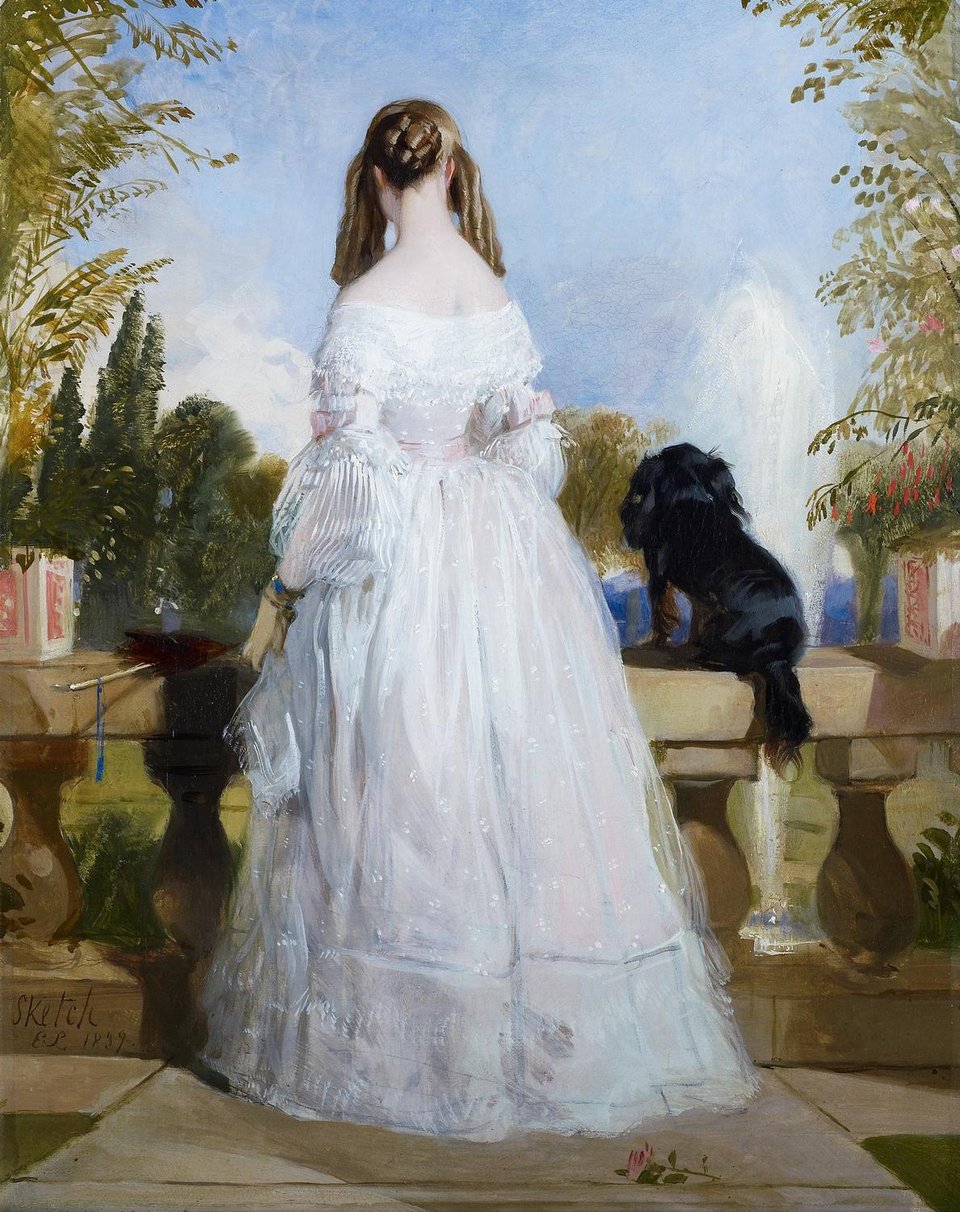
This hairstyle is an imitation of seventeenth-century styles that featured a small bun in the back and some long curls in the front, such as in this portrait of Ninon de l’Enclos (the style was sometimes called à la Ninon, in fact). It looks incredibly odd from behind, but I find that typically the curls look elegant from the front.
Her gown is made of what appears to be a transparent white muslin with more opaque white dots, backed with a white lining in the bodice and a petticoat under the skirt. The low, wide neckline is more characteristic of evening dress, but you can sometimes see it in slightly less formal clothing of the period when worn by wealthy, leisured women. That neckline is adorned with a bertha collar, a loose length of fabric trimmed with lace at the free edge.
The style of sleeve that fit tightly along the upper arm and puffed out below the elbow developed out of the huge sleeves of the early 1830s. The original versions started to be heavily pleated over the upper arm, pushing the volume down to the bend of the arm, and then eventually dressmakers changed the way they cut the sleeve pieces so that there was little to no pleating needed.
Over the course of the 1830s, skirts went from being flared at the hem to being tightly gauged at the waist and worn over several equally full petticoats to produce more of a bell shape. You can see hints of a wide flounce around the bottom of Victoire’s skirt, which emphasizes the circumference of the hem. She might also have a pad or something similar worn under her petticoats to give more fullness at the back — bustles before the bustle era.
I set Mary Marchbanks in 1837 mainly to incorporate the English Victoria becoming queen (and independent of her mother) as a parallel to Mary’s own journey, but also because I think the fashions of the day are just peak. I wanted to be able to imagine the characters dressed this way, and to use the changes to sleeve styles as part of the characterization when relevant.
All right, that’s it for today! Happy spring and/or fall, depending on your hemisphere. By next time, hopefully I’ll have Mary Marchbanks ready to start posting.


