
December is Regency Time
As you may be aware, Jane Austen’s 250th birthday was earlier this month (December 16), so I thought I would write about the Regency.
The end of the year is so busy. I spent the first full week of the month doing the costuming for a local production of Hello Dolly! and then a number of weekends working shifts in the evenings at the light show put on by the museum where I work. (Actually, as I finish up this edition of the newsletter, I’m enjoying a snow day from that as there’s supposed to be a massive storm this evening.) As a result, very little writing outside of absolutely necessary obligations has happened … But I think the new year will bring more free time for me! Hopefully I’ll have done enough editing to be able to tell you about the rerelease of The Happy Secret of It All and the actual release of A Grand and Glorious Feeling and/or Arrow Collar Man in January or February.
Some other links, though:
Do you like video essays? Check out my pal christeah’s channel on the GLAM world! (Galleries, libraries, archives, and museums.)
Recently I made Deer + Doe’s Fougère overshirt as a Christmas present for someone else. It’s a great pattern! Can’t wait to use it for myself. I’ve also been working on the Airelle blouse - I have a lot of vintage blouse patterns, but this one doesn’t require any buttons and therefore no buttonholes, so …
As you may be aware, Jane Austen’s 250th birthday was earlier this month (December 16), so I thought I would write about the Regency.
Over the last decade, there's been a lot of talk in media criticism about accuracy vs authenticity. Accuracy is how correct the history in a book/movie/game/show is, authenticity is how real the presentation of history feels. And these two things don't have to be opposed to each other! They are ultimately just facets of the popular presentation of history, and both can be present in the same media at the same time.
However, the thing that makes people talk about accuracy versus authenticity is that ... they frequently aren't.
Part of the reason so much digital ink has been spilled is that historians complain about inaccuracy, while fans and commentators praise authenticity as being more pertinent to building popular interest in history and to making good fiction. But! The trouble is that authenticity void of accuracy still gives readers/watchers/players the sense that accuracy is present, to the point that when the "authentic" experience is changed to be made more accurate (or in a way that happens to be accurate), they may even complain that the accuracy is inaccurate because it doesn't line up with the expectations "authentic" media gave them. (This is the whole point of Stefan Aguirre Quiroga's White Mythic Space: Racism, the First World War, and Battlefield 1, which deals with white male gamers' outrage that a game set in WWI featured historically accurate female characters and characters of color.)
Most of the time, we get this discourse regarding Dung Ages-esque representations of the past, because they're very very common (and commonly believed to be accurate) despite how much historians complain about them, but personally, I take issue with the opposite pole: the candy-coated version of the Regency created and popularized by Georgette Heyer.
Virtually every representation you see of the Regency today is Heyer's Regency. Her turns of phrase, her map of important places and events, her favored fashions. The main difference is that nowadays there's significantly more sex in Regency romance, but the world of, say, Bridgerton is completely built on Heyer's London Season setting/plot infrastructure. Sometimes I think people don't even realize that the Regency of modern historical fiction is Heyer's Regency rather than an individually researched setting or one based on Austen.
(I have a LOT to say about the specifics of Heyer’s inaccuracies but I won’t get into it here; maybe a future newsletter if people are interested?)
When I think about the period from a fashion history or material culture perspective, it’s pretty well grounded in reality — it’s a part of the continuum of change, just a real time and place (well, huge collection of places). And I can write a pastiche of Austen any time I choose, focusing on the interaction of a circle of individual personalities, usually in the country: characters that value keeping their composure, don’t immediately insist on being first-named, and keep realistic social consequences in mind. I just like it more that way, and I don’t like the way that the setting as written by later authors takes on the feeling of a world that’s always been Regency and always will be Regency. Austen’s work gets reinterpreted through the lens of romance novel conventions that were many years from coming into being when she was writing, flattening complex characters and relationships into cliches, and that’s frustrating.
And yet! there’s an allure to Heyer’s glittering London society, to plots that feature marriages of convenience, to a little bit less composure. I find a lot of the traditional Regency romance conventions fun to play around with — I’ve just recently been inspired to start writing up an outline for a sapphic Regency romance based on some classic post-Austen archetypes.
I think there’s a happy medium. When KJ Charles writes romances set in the Regency, they combine a lot of the traditional modern elements (London Seasons, titles, dandies, schemes) with realistic aspects of history (ethnic diversity, people with jobs, actual precarity), though admittedly not necessarily the same ones that Austen used. I’ve been really enjoying the way that Charles’s romances rub off the candy-coating so much of the genre leaves on the period, and I find it very inspirational.
Surprisingly, I haven’t written that much about Austen specifically here even though her work is one of my biggest influences. I did write a little something last year around this time, though, which you might care to (re)read:
Austen and Asexuality • Buttondown
Austen's work is famously seen as buttoned-up and proper, and frequently this is ascribed to her being a product of her time. But what if she were queer?
Broke: reading unmarried historical figures as straight and unlucky in love
Woke: reading unmarried historical figures as gay
Bespoke: reading unmarried historical figures as asexual
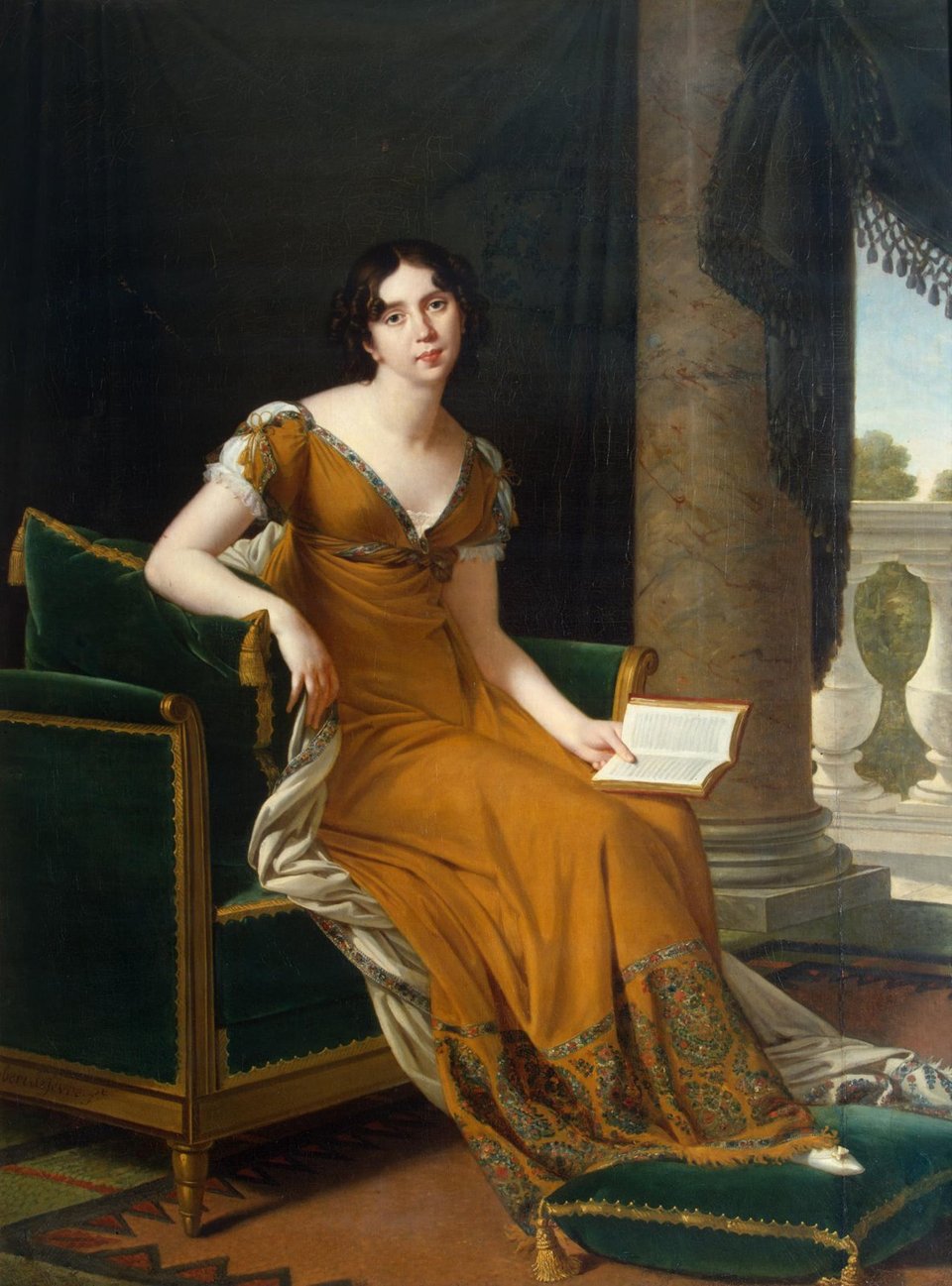
This portrait of Yelizaveta Demidova shows the sitter in a gown made of a cashmere shawl, a fashion that arose in the later 1800s. (You can see an example in a fashion plate in this blog post of mine.) These gowns were cut with the gallery of botehs (the designs that would eventually be called “paisley”) placed around the hem of the skirt, often making use of the narrower borders around the neckline or sleeves. Yelizaveta is sitting on top of another shawl, one not cut up. These were prized, expensive accessories, so being able to make one up into a gown was quite a show of wealth.
A single shoe can be seen protruding from the hemline. It’s made of white silk satin and has a pointed toe decorated with a small bow.
Her hair is simply arranged, with curls falling to either side from a center part. It’s impossible to see what’s happening in the back: it might be what we now call a bun, or a chignon held up with a small comb.
That’s all for this time! You can always find me sharing interesting things on BlueSky, or going on about history at AskHistorians.


