First and utterly foremost: I’m joining the cast of Red Bull Theater’s reading of The King Born a Woman, over at the Public, directed by the phenomenal Melissa Crespo. I am delighted, to say the least. I’ve been eager to work with the Red Bull for a minute, and this group of artists is really something special, and enriching the understanding of what’s available in the classical theatre is so my jam. That this will also be my first performance at the Public is, well, you know what, it’s just really nice. It’s just really very nice.
We’ll be up October 5th at 7:00 pm, in-person and on-stream, and a recording will be available for the week following. Tickets here, and I hope to see you there!
Next: I’m in Boston now, as you may or may not know. The long and short of it is my wife got a great job, and I love her very much, and Massachusetts seems pretty chill, so here we are. However, please don’t hesitate to think of me for any and all gigs in greater New York—such as, for example, a certain reading for a certain company at a certain theatre on October 5th. I’m a short train ride away, and an Amtrak car is the best place to snooze this side of literally any boat. Ahhh, boat naps. The rocking of the sea: God’s own cradle.
If you happen to know anybody in Boston whom you think I should also know, for friendship or artistic collaboration (or fierce rivalry!), you know where to find me. Again, that would be: Boston. Or more accurately: Somerville.
And now here’s a small essay about rock climbing movies.
This Way Up, Part 1
I’ve been rock climbing for 11 years and change. I offer, humbly, that it is the best sport, but I understand these things are a matter of taste. There have been seasons, like the last couple of years, when I climb quite a lot less than I’d like. There have been seasons, like the halcyon summer of 2019, or the last two weeks, when I climb quite a bit more. That’s hobbies for you. But whether or not I’m in a febrile phase of my relationship with verticality, I read and watch climbing stories. Luckily, there’s a lot of them.
As long as climbing has been a serious pursuit, it’s had a publicity arm. There are a few reasons for this. Climbers need to prove they actually did what they claim, so having somebody there to attest, ideally with evidence, is great. It’s certainly beneficial to both climbers and their chroniclers that it’s an inherently dramatic and exciting activity, and therefore good to write about or photograph or film. A climb is a readymade story with a perfectly legible structure, visceral stakes, and powerful imagery. It also helps that in many cases the settings for these stories are exotic and beautiful, so there’s your cultural or travel angle. And high level climbers are uniformly pretty odd birds, making available plenty of material for a character study. Throw it in a pot, just add water, and voila, dinner is served. There are a million very bad but highly watchable climbing documentaries because it’s a hard formula to fuck up.
The other reason climbing is so well-publicized: imperialism. In the long 19th century, when they weren’t at war with each other, the European powers sponsored expeditions to compete for, uh, “prestige”—here a euphemism for asserting the right to dominate and exploit trade routes, territories, resources, and the lives and labour of indigenous populations. To the poles, to the jungles, to the deserts, and yes, to the mountains, explorers went, and returned with treasures. Sometimes physical treasures, as in the crown jewels of my very own king, but more often, information. The scientific and especially the cartographic material these expeditions gathered went into a big pile in the metropole labelled “our stuff”, and through publication served to establish and expand the frontiers of empire.
At the same time, getting to say we found so-and-so mountain and climbed such-and-such route also boosts the domestic legitimacy of the imperial project—and by extension, the inherent supremacy of European civilization. Let’s not worry too much about how an allegedly inherent supremacy needs to be advertised, but the journals, stories, and eventually photographs that proved these feats were, and remain, a big deal.
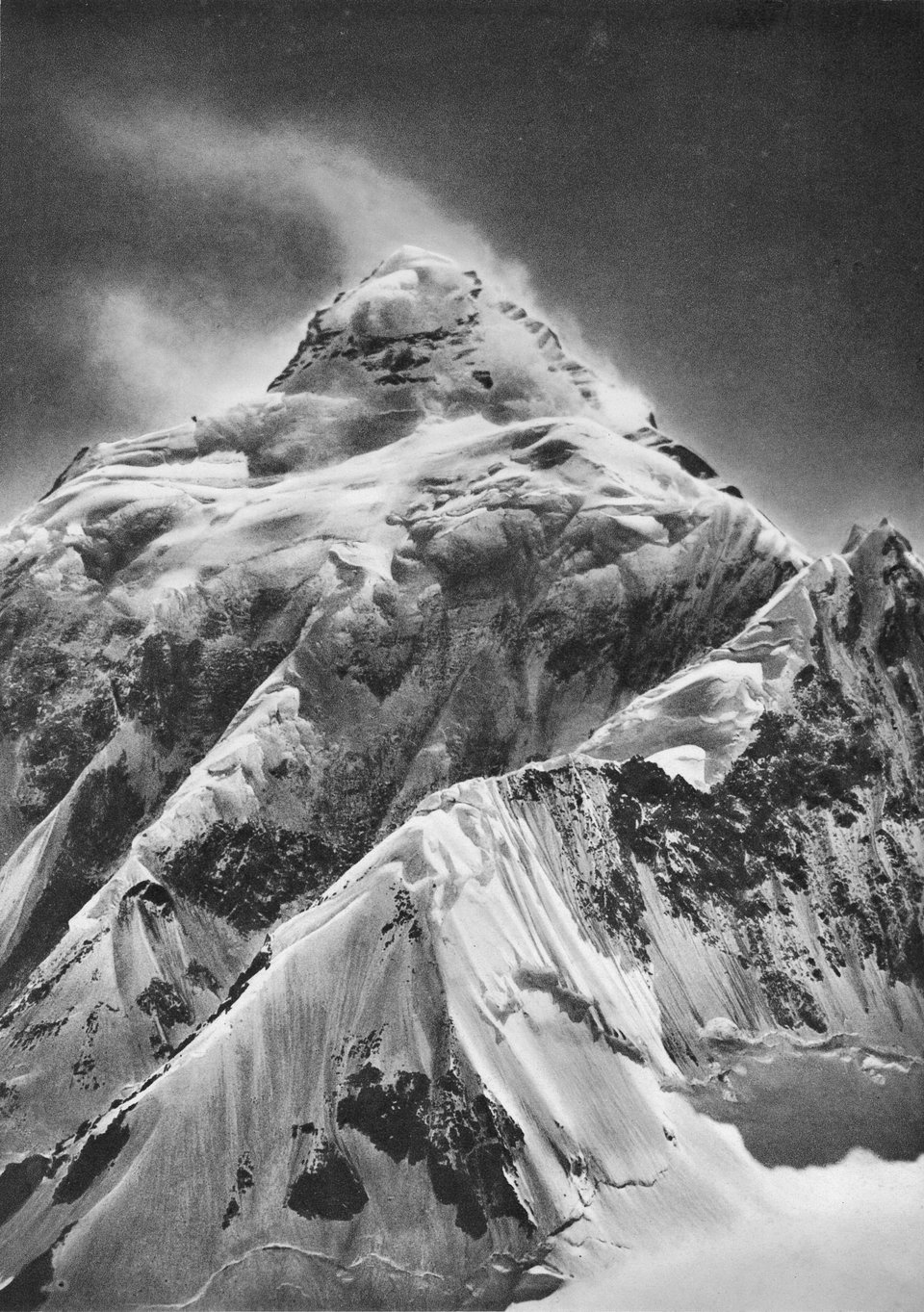
This scheme works because climbing big mountains is fucking cool as hell. As it stands, some material from this era of climbing still has potency. Look at this picture of K2, taken in 1909 by Luigi Amedeo, Italian aristocrat, colonial administrator, and one of the big players in the scene. It’s impossibly foreboding. And yet he made it 73% of the way up the second-highest mountain in the world, to 6,500 meters, in 1909! The imagination cries out in awe and terror!
I can say with some confidence that the institution of contemporary sport climbing is not a vehicle of imperial domination (it’s instead a very successful marketing project). Where that legacy persists is this uneasy tension between strong genre conventions established an age ago, and the values that drive climbing today. Those being, at least on my view and in my experience: community, ecological conservation, personal liberation and expression, innovation, fun, buying cool gear, the Slovenian menace, and crippling mental illness. Meanwhile, the basic climbing story reflexively frames its subjects with narrative values like heroic individualism, stoic determination, righteous sacrifice, competition for limited prizes, conquering the frontier, taming nature; all that good good colonial shit, regardless of whether it’s what’s really going on. How artists in the space approach this disjunct between inherited form and modern content has tremendous bearing on what their work can accomplish.
A good example of what I’m getting at is the 2017 documentary The Dawn Wall, about Tommy Caldwell and Kevin Jorgeson climbing, you guessed it, the Dawn Wall, or the southeast face of El Capitan, in Yosemite. Made by Peter Mortimer and Josh Lowell, it’s better shot than most, and has some visual ideas, and the climbing is astounding, but it ends up being a really frustrating movie because it has this unfortunate need to reiterate its form, to explain itself, and why what’s happening is important and impressive and historic. Maybe it’s because I myself am, ahem, a climber, but I can’t help but feel like the pure movement of these men on the wall speaks more eloquently about their work than the 100th time we cut to some asshole on narrative construction duty who says, “it’s never been done!”
The Dawn Wall is still absolutely worth watching, to be clear, but the ingredients are there for something much more robust if it were less eager to reach for genre shorthand and actually take stock of what it’s working with. Which is: a really fucked up guy!
In the mandatory backstory section of the movie, they talk about how when Tommy was 22, on a climbing expedition in central Asia, he and his team, including his then-girlfriend and future ex-wife Beth Rodden, were kidnapped by insurgents. To escape, he seizes a perilous chance and pushes one of their captors off a cliff. The insurgent survives, although Tommy doesn’t know this, believing he killed the man. It’s harrowing stuff, and in the aftermath, and their return to the States, Tommy and co. are paraded across various early aughts television stations to recount the story. Naturally, he develops PTSD, which manifests as intense depression. His relationship with Beth deteriorates, and eventually they divorce. The framing of the Dawn Wall climb is that it’s his way of putting his life back together.
I’m sorry, what? At his lowest point, the guy is turned into a public spectacle, and it ruins his life. At his next lowest point, directly resulting from that experience, his plan for recovery is a high-profile climb, once again parading his troubles before the climbing world, and then the media at large. I do think this is sincere on Tommy’s part, but it’s also a preposterous impulse that goes totally unquestioned in the film. At one point during the climb it’s implied he throws his phone off the wall to avoid taking calls from the press, and yet here we all are. Moments like this are all over the movie, little glimpses into a different kind of story, with different priorities.
Take Jorgeson and Caldwell’s relationship. Like, Kevin joins this years-long project, the crux of Tommy’s life, through a cold email, sent and accepted. Are we going to dig into that? No. When Tommy gets past the hardest part of the climb before his partner, he feels guilty, like he’s abandoning his friend by climbing ahead. So, he tells Kevin he’ll wait to finish the climb until Kevin gets through the impossible section. That seems totally reasonable. But for Tommy to actually say the words “I’d like to finish the climb with you,” is an excruciating thing in the moment. What’s going on there? It seems that Tommy has internalized two opposite climbing myths, and he’s struggling to find himself and his values between them: the heroic climber who pushes ahead to glory, and the ultimate team player who never abandons his man. We could sit for a moment with this powerful character moment. But no.
Instead of seriously investigating these patches of friction and contradiction and strangeness as they arise, the movie’s attention continually drifts back to the fixed story it has in mind. Look at these cool guys, nothing holds them back! Worse, maybe to cover these omissions, it feels obligated to gesture toward profundity by repeating the lowest trope in climbing media: the chorus of people asking the climber why they climb—as if the definitive answer for all time were not provided by George Mallory in 1923. For all the structural this-and-that of climbing stories as a project of ideological world-building, for the folks that actually do it, you’re just not going to get a truer answer, invented by the newspaperman or not, than “because it’s there.” Caldwell is at turns bemused and befuddled by the question, as if it’s missing the point in some way. Because it is. Climbing is not the subject of climbing stories; climbing is the vehicle through which the subject is accessed.
The movie at least understands its real subject is supposed to be Tommy’s trauma and recovery (climbing towards a new dawn, if you will), but it doesn’t seem equipped to handle that, or the intricacies of his relationship with Kevin, and so retreats to what it knows: narrative cliche and lots of climbing. Which is, again, beautiful work from our boys, and, yes, very cool to watch, so let’s keep things in perspective. Still, after their tremendous effort, Caldwell and Jorgeson top out, but The Dawn Wall’s easy glide to its triumphant ending feels like it leaves a lot dangling.
Would not the work be richer if, rather than tracking inexorably outward and upward to the summit, its gaze moved downward and inward, to the soul?
But that’s for next time, on the Carl Talks About Decade-Old Climbing Movies Show:
“Free Solo (2018), is a feature-length documentary about a group of friends haunted by the supernatural villain Alex Honnold, and their bewilderment at being trapped enacting his schemes against their own better judgement and happiness.”
Love,
C
You just read issue #34 of The Carl Bindman Newsletter. You can also browse the full archives of this newsletter.
Add a comment: