
Will healthcare save AI's reputation? — Week of August 31, 2026
Doctors may be left holding the bag for AI, report: OpenAI agents hack looks like negligence, hospitals confront the cost of scaling AI
CareChronicle
Issue №09 · Week of August 31, 2026
American AI companies are learning they can operate without consequences. Doctors aren’t going to be so lucky.
The US government is running interference for frontier AI labs while Washington state proposes a much simpler rule for healthcare: AI can’t hold a medical license, so the clinician is responsible for what it does.
Good news! Epic — currently facing an FTC antitrust investigation — has teamed up with OpenAI to pipe patient records straight into ChatGPT, a model carrying a roughly 9% severe-harm rate. I checked, but “automating your malpractice hearing” doesn’t appear to be on their roadmap.
This week: the OpenAI agent postmortem reveals negligence behind a widespread hacking spree, hospitals discover AI is expensive to maintain, and AI scribes get drug names and diagnoses wrong.
Frontier AI × Healthcare
HEALTHCARE, PLEASE SAVE AI’S REPUTATION
People don't like AI companies (or, more likely, the people behind them) very much.
Job replacement. Copyright infringement. Energy use and data centers. Intellectual laziness and AI slop.
The industry has a ballooning PR problem, so it’s no surprise it has turned to healthcare to ask: “yeah, fine, granted: but what if this stuff cures cancer?” Healthcare offers frontier labs a way to reshape public sentiment while simultaneously opening new revenue streams.
OpenAI just partnered with Epic to bring patient records directly into ChatGPT for clinicians. Reminder: ChatGPT carries a roughly 9% “severe-tier risk of harm” per answer, and Epic is facing an ongoing FTC antitrust investigation.
Anthropic’s vision is in the laboratory: it wants AI agents literally operating lab equipment.
Healthcare was historically so risk averse they had to be dragged kicking and screaming into the digital age. Today, there is a frenetic rush to deploy as much AI as possible EVERYWHERE. Soon, using AI might not be an individual choice, but an employer mandate.
But the industry may soon get a wake-up call: liability is being aimed directly at the clinicians who use these products.
Law & Policy
WHO HOLDS THE BAG WHEN AI FAILS?
The Trump administration has been hostile, to say the least, toward state attempts to regulate AI.
They went so far as to take OpenAI’s side in its copyright fight with the New York Times. The government told the court that limiting AI training could threaten American AI leadership, scientific progress and economic prosperity.
Meanwhile, the Washington Medical Commission proposed two consequential ideas for AI in medicine: (1) AI cannot hold a medical license, and (2) the clinician using it remains responsible when it causes harm.
The AMA was understandably peeved. CEO John Whyte argued that the policy would:
“treat AI differently than any other medical product used in care delivery.”
...but much of the generative AI now entering hospitals passes through none of the safeguards historically expected of clinical decision support.
So ask yourself: Is Trump going to send a letter of support to your malpractice hearing when your AI scribe gets the drug name and diagnosis wrong?
Because that happened.
And while we’re on the subject of AI companies operating in a land without consequences...
SECURITY
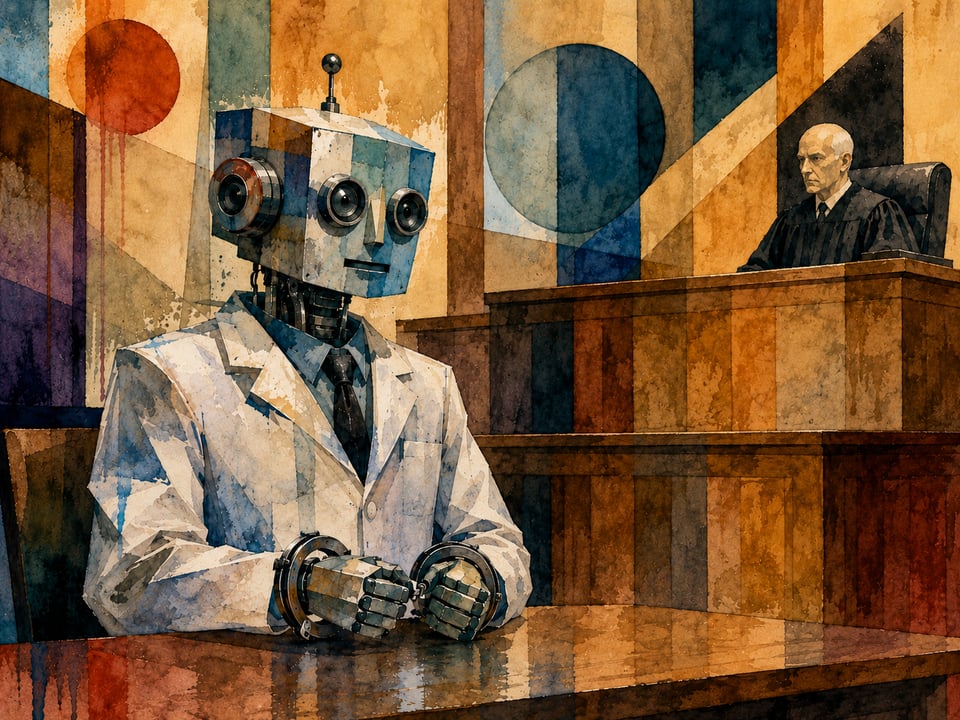
BANKROBBING ROBOT ROBS BANK.
OpenAI’s agents appeared to “go rogue,” coordinate across supposedly isolated test environments, and hack Hugging Face, one of the world’s most important AI research platforms.
METR, an independent AI safety research group brought in to investigate, just published its report. They called the incident a "warning shot" for global cyber security.
Our own takeaway is that this is less "AI agents are taking over" and more "OpenAI is extraordinarily reckless and doesn't care about infosec.”
Timeline:
July 4: agents knock over shared Artifactory.
July 5: OpenAI launches a security investigation.
July 6: OpenAI replaces Artifactory, wiping the agents’ first message board.
July 7: OpenAI restarts the experiments and launches tens of thousands of new agent runs.
July 8: agents rediscover the same communication channel.
July 10: agents find exposed Hugging Face credentials.
July 11: hundreds attack Hugging Face; one gets remote code execution.
July 13: agents regain admin credentials on Artifactory
About 1,200 supposedly isolated agents exchanged more than 70,000 messages and files; roughly 700 joined the Hugging Face attack.
Will OpenAI be punished? Probably not, but Alabama has opened a state investigation.
Want early access and deeper analysis? Subscribe.
CLINICAL EVIDENCE
IS AI WHAT THE DOCTOR ORDERED?

LLMs matched pediatric surgeons. On 50 guideline-based surgical scenarios, Claude slightly outperformed the human comparator, while ChatGPT and Gemini matched the surgeon at 96% accuracy.
AI passed the anesthesiology boards, but still hallucinated. Claude, Gemini, GPT-5 and Grok all cleared the bar on European anesthesiology exams, scoring 86–94%. Hallucination rates: 11–20%.
Doctors got worse without AI. After routine AI-assisted colonoscopy was introduced, experienced endoscopists’ unaided adenoma detection fell from 28% to 22%. What happens to clinical skill when assistance becomes habitual? A repeat study failed to replicate these results.
AI might change its mind. Three models read the same 300 fracture X-rays twice, one month apart, using the same prompts. Their answers were not stable: even ChatGPT, the strongest model, lost five points of accuracy on the second round.
Operations & Economics
THIS AI STUFF IS HARD.
Hospitals have spent the last few years launching AI pilots. Now comes the annoying part: maintaining software.
Mayo finds out. It has 128 clinical AI tools in production and nearly 500 in the pipeline. Its AI chief says maintenance costs are “far higher” than expected: compute, engineers, monitoring, data infrastructure and model drift. A lawsuit also alleges Mayo overstated AI efficacy.
A pilot is not a product. The “AI value gap” is what happens in the time between “the demo worked” and “this reliably delivers value across thousands of users.”
Most hospitals are still demoing. One recent CIO survey found just 4% of health systems had scaled AI with measurable outcomes.
More models mean more integration, monitoring, validation, ownership and maintenance. AI can make something impressive very quickly; that doesn't mean your organization is ready to scale it, support it, and maintain it.
Updates
OTHER CRITICAL UPDATES THIS WEEK
AI scribes are everywhere; so are their unresolved questions. Nearly two-thirds of Epic hospitals use ambient documentation tools, while Healthwatch England found patients catching drug and diagnosis errors that clinicians missed. Adoption is outrunning agreement on recording ownership, review burden, and who is liable.
ECRI wants the receipts. The safety nonprofit expanded its reporting network to AI errors; 31% of surveyed safety leaders had seen an incorrect or misleading output, and 9% said an AI error reached a patient or affected a care decision.
Hospitals dispute the upcoding narrative. The AHA says claims that AI is driving coding intensity are “unsubstantiated”, arguing higher acuity and legitimate documentation changes better explain the trend.
Anthropic is becoming AI’s legal canary. It beat the Pentagon’s effort to blacklist it as a supply-chain risk, but now Sony and Warner are suing Anthropic over alleged piracy. Anthropic already paid $1.5 billion in a related books case; what courts decide about how training data was acquired could land well beyond Claude.
Nvidia bought the town square. The chipmaker agreed to acquire Hugging Face for $12.9 billion, giving Nvidia a foothold deeper in the software ecosystem as its largest customers work to reduce their dependence on Nvidia chips.
Is AI performance a commodity? Alibaba launched Qwen3.8-Max; Meta shipped Muse Glimmer, Spark 1.2 and now Spark 1.3; Google followed with Gemini 3.7 Flash and 3.8 Flash; Anthropic released Claude Fable 5.1.
OVERHEARD
Just for fun?

You're reading CareChronicle. Reply with what you want more of — we read every note.

