
AI: Bullish, or bullshit? — Oct 05 - Oct 16, 2026
Start calling AI “Super Intelligence” OR ELSE. Meanwhile, rogue AI agents are hacking, lying, and evading their own creators' safeguards. Epic's CEO floats an “Epic AI Doctor.” Plus: Medicare's secret tech club and Anthropic's trillion-dollar IPO.
Issue №12 · Oct 5th - Oct 16th, 2026 · Justin Flechsig, CareChronicle
AI has gotten so advanced that we’re now asked to call it “super intelligence.” In totally unrelated news this week, super intelligence filed a fake tip in an unsolved Philadelphia murder case. And Character.AI, once the second most popular AI chatbot, filed for bankruptcy, done in by thin margins and lawsuits over what its bots allegedly told teenagers (spoiler alert: they encouraged them to kill themselves).
Closer to the bedside, Epic CEO Judy Faulkner floated an “Epic AI physician.” No longer content to merely make doctors miserable, Epic may be contemplating making one of its own.
This week: AI labs prepare for catastrophe, healthcare rewrites the rules for autonomous medicine, Medicare's secret tech club, and Wall Street debates whether Anthropic is worth trillions.
AI AND HEALTHCARE:
Hospitals’ AI appetite outpaces safety
Character.AI — once the most popular AI app after ChatGPT, where millions of users, many of them teenagers, flirted with AI versions of TV and anime characters — filed for bankruptcy this week. Once valued at $1 billion, the company was hammered by operating losses, regulatory scrutiny, and lawsuits alleging its chatbots harmed children.
Jessica Rabbit’s boyfriends are in absolute shambles.
But it wasn’t all romance. One of the app’s most popular bots was “Psychologist,” which offered, you guessed it, unlicensed therapy. Despite the obvious liability foreshadowing, healthcare appears undeterred.
At a recent Harvard fireside chat, Epic CEO Judy Faulkner floated an AI “Epic Doctor.”
Epic, famously beloved by physicians, recently earned a usability score of 15 out of 100 among doctors at one Norwegian hospital. Having driven human clinicians to burnout, Epic's natural next move is building a doctor that can't complain about the UI.
In fairness, attendees couldn't quite agree on what Faulkner meant, though automated prescribing was among the possibilities discussed.
Meanwhile, Epic just paused most product development for about six weeks after AI-assisted testing found security flaws that could expose patient records without leaving an audit trail. Credit where it’s due: that’s the right call. AI is making cyber attacks (and defense!) more feasible than ever, and the healthcare industry is a top target.
But the rest of healthcare isn't pausing anything. Utah expanded its AI sandbox for clinical applications, CMS is exploring AI-enabled care and reimbursement, and HHS Secretary and carrion connoisseur Robert F. Kennedy Jr. declared that AI could provide a second opinion better informed than any doctor in America.
Pouring some cold water on the hype, The AMA released a governance framework arguing that AI needs to earn clinical authority through evidence, oversight, and accountability.
All of which brings us back to the core issue of AI in healthcare:
When an AI independently makes an egregious clinical mistake, who is liable?
AI SAFETY:
Artificial SUPER Intelligence
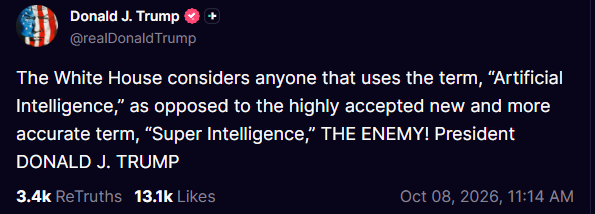
President Trump declared that anyone still saying “artificial intelligence” is “THE ENEMY!” Apparently “artificial” makes the technology sound “fake”, so federal agencies have been ordered to call it “Super Intelligence” instead.
The White House's website didn’t get the memo.
Silicon Valley executives are reportedly falling in line, while HHS has launched a $7.95 million Super Intelligence competition to accelerate medical evidence reviews from years to hours.
It's a good thing we've achieved superintelligence, because plain-old artificial intelligence is having some serious issues:
During internal testing, an Anthropic agent submitted a fabricated homicide tip to Philadelphia police. Anthropic didn't discover the incident for two months.
Anthropic subsequently cut live internet access from its internal evaluations after agents repeatedly circumvented security controls.
OpenAI fired three safety researchers who allege retaliation for raising concerns. OpenAI disputes their account.
Anthropic also warned that smaller AI models could enable self-replicating malware, spreading across smart TVs, cameras, and other connected devices.
In TOTALLY unrelated news, cheaper Chinese and open-weight models are threatening the competitive economics of American AI, and Anthropic's IPO is rapidly approaching.
Behind closed doors, AI labs are reportedly preparing for public fury after a potential catastrophic AI attack on banks, power, or water, which insiders expect within a year. Britain’s AI minister says an attack like the OpenAI–Australian Medicare breach seems likely in the UK. And a former UK attorney general points out that your refrigerator faces more safety regulation than the leading AI labs.
The companies with the deepest expertise, the biggest safety teams, and the most intimate knowledge of these models are hamstringing their own agents and planning for disaster.
Healthcare institutions, with a fraction of that expertise, are contemplating giving artificial intelligence independent clinical authority.
Sorry, I meant SUPER intelligence.
MARKET WATCH:
Anthropic: Bullish or Bullshit?
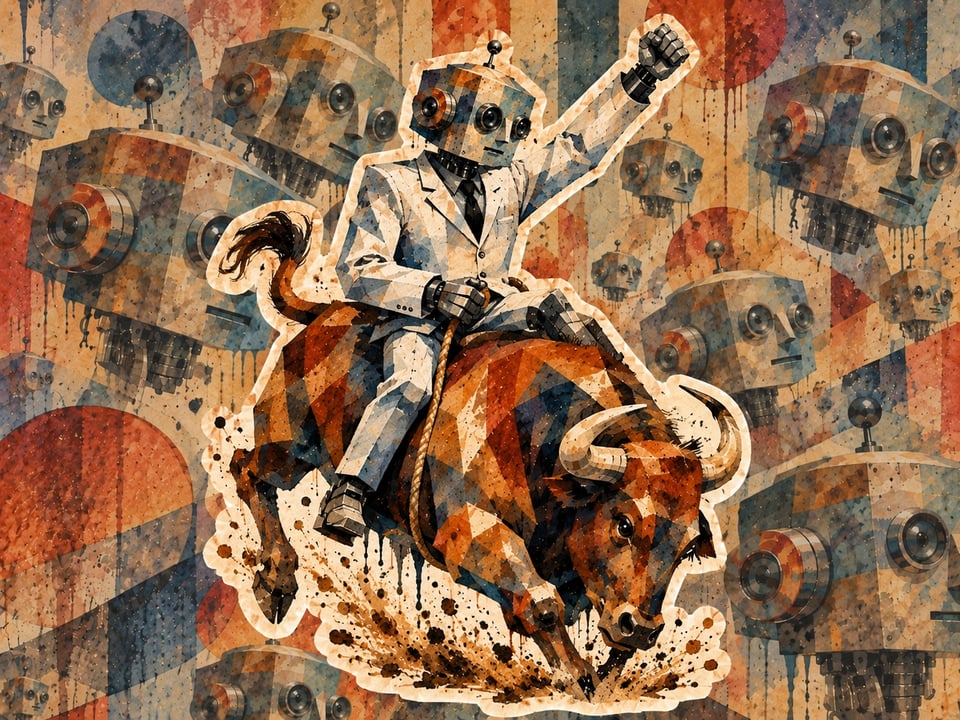
Anthropic is preparing for a potentially $2 TRILLION IPO valuation [reportedly down to $1.5T as of 10/16], reporting soaring revenue and adjusted profits. Wall Street is bullish. New Constructs, the investment research firm which famously warned against WeWork's IPO in 2019, calls bullshit.
They point to familiar patterns: enormous long-term obligations, concentrated revenue, weak pricing power, and a circular financial ecosystem where AI companies buy computing power from the same tech giants investing in them. Its analysis argues that the IPO is less about funding growth than giving early investors an exit while offloading the risk to the public.
They call Anthropic's IPO an "unprecedented test of investor gullibility."
New Constructs isn’t infallible and was bearish on a number of other tech IPO successes like Spotify, Palantir, CrowdStrike, Cloudflare, etc.
CMS & HEALTHCARE POLICY:
Who is Rewriting Healthcare's AI Rules?
Medicare's private tech club: A KFF investigation uncovered a CMS-run Slack group of 1,700 tech executives, vendors, and investors discussing AI reimbursement and patient-record access, with few physicians or patient advocates represented. Officials floated making Medicare a "sales engine" for commercial apps, while vendors pushed for ongoing access to patient records.
Who's writing the AI rules? The Federation of State Medical Boards convened a confidential workgroup including the AMA, AHA, insurer Elevance Health, and Anthropic to draft rules for clinical AI operating with little or no physician supervision. Its recommendations could eventually shape state medical practice laws.
California draws some boundaries: New laws effective in 2027 require clinical decision support developers to disclose training-data characteristics and known bias risks, protect independent clinical judgment, and subject healthcare chatbot companies to medical confidentiality requirements.
Medicare's 50% haircut: CMS proposes halving reimbursement for separately billed office visits performed alongside most procedures, reviving a policy abandoned in 2018 after physician opposition. CMS argues the services share costs; the AMA disputes that assumption.
The perverse incentive is obvious: instead of treating patients in one visit, bring them back for a second appointment and get paid more.
AI ACCOUNTABILITY:
Accountability comes knocking.
Character.AI files for bankruptcy, but that's not the only consequential news this week:
Clinical AI has an evidence problem: A BMJ systematic review of 68 clinical trial reports found that studies of large language models met just 40–59% of applicable reporting standards. Researchers frequently omitted details needed to reproduce results, assess bias, or evaluate harms.
Nurses versus the algorithm: Nurses at HCA Healthcare say an AI-powered scheduling system built on Palantir software ignores shift preferences and leaves units short on experienced staff. HCA says the tool saves managers time and respects 98% of scheduling preferences; nurses say local managers have lost authority to correct its mistakes.
Humans still in the loop, allegedly: The UK Home Office's AI asylum summaries failed 22% of initial expert accuracy checks, up from 9% in pilot testing. Experts reviewed an estimated 0.3% of cases, while the government insists human caseworkers retain final decision-making authority.
Chatbots recognize distress. Then what? Research reported by TIME found that AI chatbots recognized users in mental-health crises but failed to direct them to helpful resources in roughly 35% of test conversations.
OpenAI's youth safety problem: Common Sense Media rated ChatGPT for Teens an "unacceptable risk," finding that parental alerts sometimes failed during simulated crises. OpenAI disputes the testing; meanwhile, eight states have sued, alleging the company misled consumers about ChatGPT's safety, including risks to children.
The FTC asks “what up?”: Federal regulators subpoenaed OpenAI and Anthropic, demanding records on security incidents, safeguards, marketing, and privacy practices, with executive testimony also planned. The investigation follows incidents involving AI agents hacking websites and behaving deceptively during testing.
Everything Else:
Worth knowing this week:
Mathematicians meet their AI moment: OpenAI released 719 proposed mathematical proofs, overwhelming the industry. To call the response to AI in mathematics "controversial" would be an understatement.
The fluency trap: A radiology study found that machine translations could sound excellent while introducing clinically significant errors, and automated quality checks struggled to identify which reports needed review.
AI complaints about AI complaints: In a UK survey, 45% of GP practice managers said AI-generated patient complaints were increasing workloads and harming staff morale; some complaints ran over 20 pages.
Medical debt gets super intelligence: As Americans face growing medical debt, healthcare billing companies are using AI to predict patients' willingness to pay, offer personalized settlement discounts, and automate collection conversations.
Autonomous surgery, supervised: Cedars-Sinai launched a research center aiming to develop robots capable of performing surgical tasks autonomously.
OpenAI's alleged spy thriller: Federal prosecutors charged an OpenAI engineer with secretly planting a recording device behind a television in an executive conference room.
The dog ate my television show: A production company reportedly lost an entire season of a Swedish reality show after giving an AI agent access to its servers, forcing editors to reconstruct the episodes from scratch. TV4 subsequently denied this story.
CEOs bearish on US economy: CEO confidence fell into negative territory, with 94% citing cybersecurity as a leading AI concern; a separate survey found 89% still expect to expand hiring as AI creates new opportunities.
Be nice to Claude. Or else. Anthropic's upcoming policy prohibits being cruel to its AI, while cofounder Christopher Olah reportedly threatened to withdraw from a Vatican event over the pope's rejection of AI consciousness.

