
A more pleasant dream at 35,000 feet
Holiday greetings, plans for 2026, and an acknowledgment of our mutual gremlin.
BumpySkies has been boasting a new look lately, and a new feature or two as well, just in time for this winter's holiday-travel season. I also have updates about an important improvement I have planned for the new year. But first, some thoughts about a story I just read, on a train.
The gremlin
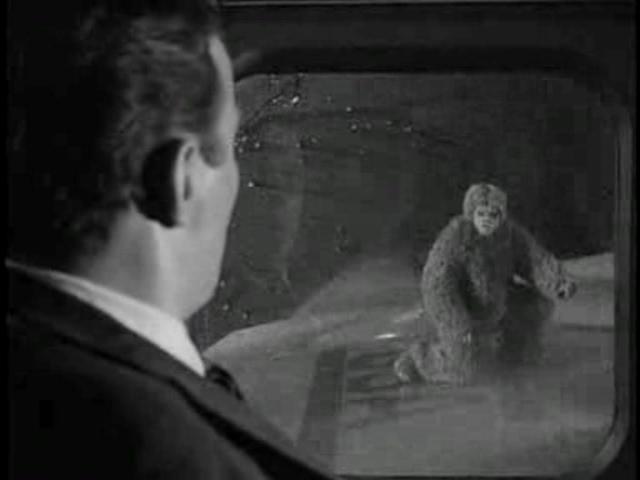
I wrote about my flight to Denver last month, and since then I've gotten to enjoy a couple of much shorter train trips from my NYC home to Philadelphia and Boston. I'm fortunate to live in the northeastern part of the country, where train travel is often a sensible choice for shorter journeys.
On one leg of these overland travels, I read and enjoyed Richard Matheson's "Nightmare at 20,000 Feet", a short story originally published in 1961 that has been adapted to film and television numerous times since—most famously in a 1963 Twilight Zone episode starring William Shatner. While I don't know anything about Matheson's own relationship with flight, I was struck by the deeply sympathetic way that the author described the inner state of the main character, whose particular flight anxiety resonated strongly with my own.
In the story, the main character doesn't so much fear flying as dread it. While on board a mid-century, propeller-driven red-eye flight, he looks around at his fellow passengers and cannot believe how easily they settle into sleep, amidst all the roaring and rattling. He doesn't necessarily fear any particular disaster happening, but his entire nervous system is nevertheless kept on constant alert by every sight, sound, and sensation while he's confined on the plane. He tries to read, or work on a crossword, and can't manage either. He even makes a futile attempt to join his seatmates in dozing off, and gives up after a few minutes, knowing that there's little to do but just wait out the entire flight, in the dark. I recognized this experience, intimately.
When the monster shows up on the wing, a capering gremlin that only he can see, his dread gives way to panic. A flight attendant repeatedly tries to reassure him, and even one of the pilots comes to visit him. But the leering monster scuttles out of sight every time he tries to show them what feels like an imminent danger. In the story's lowest point, the passenger sinks into shame, feeling completely alone and miserable with his fears.
I have seen this gremlin, and I bet that you have, too. Even though travel has become both safer and faster in the decades since the story was written, for some of us it remains a sometimes-nightmarish ordeal, and it always will be—just because of how we happen to be wired up. This is why I made BumpySkies years ago, and why I've returned to actively developing it this year.
My goal with BumpySkies isn't just to assert the safety of air travel—something you and I have been told about our whole lives, I'm sure—but to help nervous flyers feel less alone about it. I hope that a public resource like BumpySkies, made by a lifelong nervous flyer who flies anyway, helps to demystify some of the more stressful aspects of flight, turning turbulence from an unknown terror into a predictable unpleasantness which some of us are simply more sensitive to.
The grinning gremlin is still there tap-dancing on the wing, but at least we can respond by thumbing our noses at it, you and I, denying it any power over us.1
"Ding"
Among various other redesigns I've brought to the website in recent weeks, I rewrote the first answer on the About page's FAQ to note two things I have learned about turbulence since I launched BumpySkies: the phenomenon has caused zero fatalities in the modern aviation era—but it's also caused plenty of injuries. According to the FAA's own page about turbulence, it's far and away the leading cause of accidents on aircraft, where "accident" is defined as at least one person getting seriously hurt.
As I write in the FAQ, this is what the seatbelts are for. When people get hurt during rare severe-turbulence encounters, it's often because they aren't wearing their seatbelt during the brief moment that the plane suddenly shifts position. The plane is always fine—there is literally nothing for it to collide with in the open sky, even when a bout with severe turbulence gives it a thump. Within seconds, the airplane is cruising along again as if nothing had happened. But you, inside the plane and surrounded by all kinds of things to bump into, are a different story.
So, I softened the language that insisted that turbulence is always totally harmless. It poses no danger to the flight, but... please do buckle up when that little light goes on with that pleasant chime, friends.
Delays and bugs (about delays)
I continue to collect excellent feedback from the winter survey. This includes multiple comments on how BumpySkies forecasts tend not to have their times updated if a flight gets delayed. I noticed that myself, during my travels last month, and I have a pretty good idea why it's happening. In short, BumpySkies is a little too picky about the flight data that it accepts, sometimes rejecting perfectly good flight-plan updates for too-strict reasons.
The solution I have in mind requires a certain amount of R&D on my part, and I'm still in the R part of that. I hope to have a solution in place by the time of my next newsletter issue. This might require a very short bit of downtime—if so, I'll be sure to announce it ahead of time on the website itself.
On that note, I have added a Report an issue button to all result screens in BumpySkies. Did you get a forecast, but something looks wrong about it? Did you not get a forecast, even as your plane is rolling towards the runway? Tap that button and let me know about it. It pre-fills an email to me with information about the flight and time you searched for, and gives you room to make additional comments as well.
I value all feedback about BumpySkies—including and especially bug reports. Every bit of information I hear about your experiences with the website helps me make it better for everyone.
Have a warm and cozy December, friends. May you find joy with the friends or family you might fly out to see, and may the gremlins along the way be utterly forgettable.
-
A few notes about "Nightmare at 20,000 Feet", just for the flight-anxious: First, modern meteorological science gives pilots and air-traffic controllers excellent foresight about weather conditions. Pilots of passenger planes prefer to cruise over or around heavier storms in their path rather than simply plow through them—though that does make for a more dramatic story. Second, an airliner's exterior doors are physically impossible to open while the plane is in-flight, thanks to engineering that uses the cabin's higher air pressure to wedge those doors shut. Maybe they built 'em different in 1961, but that sure isn't the case today. ↩