
Volume 1, Issue 5: Divided Spirit
Which American tradition are we actually celebrating?
"What a waste of gunpowder and sky"
Welcome to the fifth issue of the Mostly Invisible newsletter. This is a monthly email to share some timely thoughts and what I've worked on in the last month. I do hope that you enjoy it.
This week, millions of Americans will gather around grills, cluster on blankets to watch fireworks, and drape porches in red, white, and blue. We will celebrate our 250th Independence Day, a holiday explicitly dedicated to the birth of a nation and the ideals that launched it.
But as we pull out the flags, it’s worth asking: Which American tradition are we actually celebrating?
The question isn’t as straightforward as it seems. In a recent review in The Atlantic, writer Gal Beckerman revisits an old, brilliant diagnosis of the American psyche. He highlights the insights of historian Dominic Erdozain and, crucially, the 19th-century author Harriet Beecher Stowe. Stowe once observed that the American Founders suffered from "divided spirits."
Their political orientation, she argued, was pointed toward the European Enlightenment, specifically the universalism of John Locke, which championed equality, rational self-interest, and the messy, necessary work of compromise. Yet their theology and cultural inheritance were deeply rooted in a rigid Puritanism. This older tradition leaned into predestination, inequality, and division, imparting a "hard and heroic element" to the American character.
Stowe’s diagnosis wasn’t just a critique of the men in late-18th-century Philadelphia. It is a roadmap of our current national psychology. Two hundred and fifty years later, we are still living inside that split personality.
When we look at the friction in modern American life, it is easy to view it as a contemporary glitch; the result of algorithms, cable news, or a sudden breakdown in civility. But the "divided spirit" framework suggests something much deeper. Our polarization isn’t a modern invention; it is baked directly into our cultural DNA.
On one side of the ledger is the patriotism of the Declaration of Independence. This is the tradition of "self-evident truths"; the radical, rational, and deeply demanding idea that all people are created equal. Because it is rooted in Enlightenment thinking, this brand of patriotism requires ongoing self-correction. It views the nation as an ongoing experiment. It demands logic, humility, and the willingness to compromise because it acknowledges that a diverse society cannot function without mutual progress.
On the other side is what we might call providential patriotism. This is the inheritance of the Puritans, who viewed themselves as a chosen people building a "city upon a hill." When carried to its extreme, this tradition shifts away from universal ideals and toward absolute certainty. It positions America as a nation uniquely guided by God’s hand, rendering it essentially beyond reproach. In this view, patriotism isn't a commitment to a set of principles; it is an unyielding, tribal loyalty. Compromise is seen not as a civic virtue, but as a moral failure.
We see this second strain everywhere today, from political rhetoric that frames every election as an apocalyptic battle between good and evil, to foreign policy framed as divine destiny. It is a comforting theology for those who hold it because it eliminates doubt. But it also eliminates the possibility of growth. If you believe your side is entirely providential, then the other side isn't just a political opponent; they are an existential threat.
The problem with a divided spirit is that it eventually tears the body apart.
Erdozain argues that this theological, absolute strain of patriotism is a kind of historical baggage that "should have been left behind in 1776." It’s a compelling point. A modern, pluralistic democracy cannot survive on a diet of absolute moral certainty and divine entitlement. It requires the cooler, more durable tools of the Enlightenment: the recognition of shared humanity, the messy art of political compromise, and an unwavering commitment to the idea that mutual progress is the only real progress.
To lean toward the tradition of equality and compromise is not to love the country less. In fact, it requires a much deeper, more resilient kind of affection. It is easy to love a myth; it is much harder to love a reality.
The patriotism of the Declaration asks us to look honestly at the gap between our high-minded rhetoric and our lived reality, and then do the heavy lifting required to close that gap. It asks us to view our neighbors not as theological adversaries, but as partners in a massive, unprecedented experiment in self-governance.
As we approach the Fourth of July, the fireworks will light up the sky regardless of which version of America we carry in our hearts. The flags will wave just the same. But the spirit behind them matters. We are the stewards of a divided inheritance, and every generation has to decide which half of the American soul it wants to feed.
As you look at the landscape of our communities and our country this week, where do you see the quiet work of equality, compromise, and mutual progress winning out over the loud rhetoric of division?
Here is a numerical breakdown of all the things I wrote this month, in order of what I believe to be their quality.
-
Barcelona, Mostly Invisible. A short post on the joy of finding new interests later in life.
-
One word, three strikes, Mostly Invisible. Three ways one little word packs a major punch.
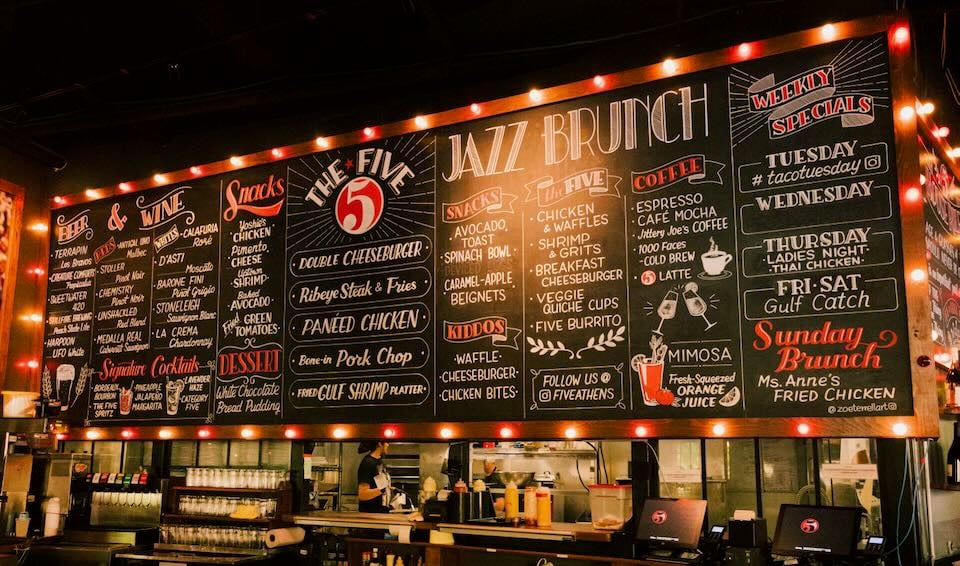
Menu board at The Five Bar in Athens, Georgia. Taken on June 19, 2026. Do you see the theme?
Best,
BK

