
As September Begins
What we heard in Harrisburg, what Pennsylvania’s latest data shows and what’s ahead in Lancaster.
IN THIS EDITION:
What school staff, families, and stakeholders shared with us in Harrisburg
Hope in Action in Lancaster
A Note From Dr. B: Pennsylvania’s latest firearm suicide trends
What We’re Reading: Work, youth, 988, firearm storage and local data
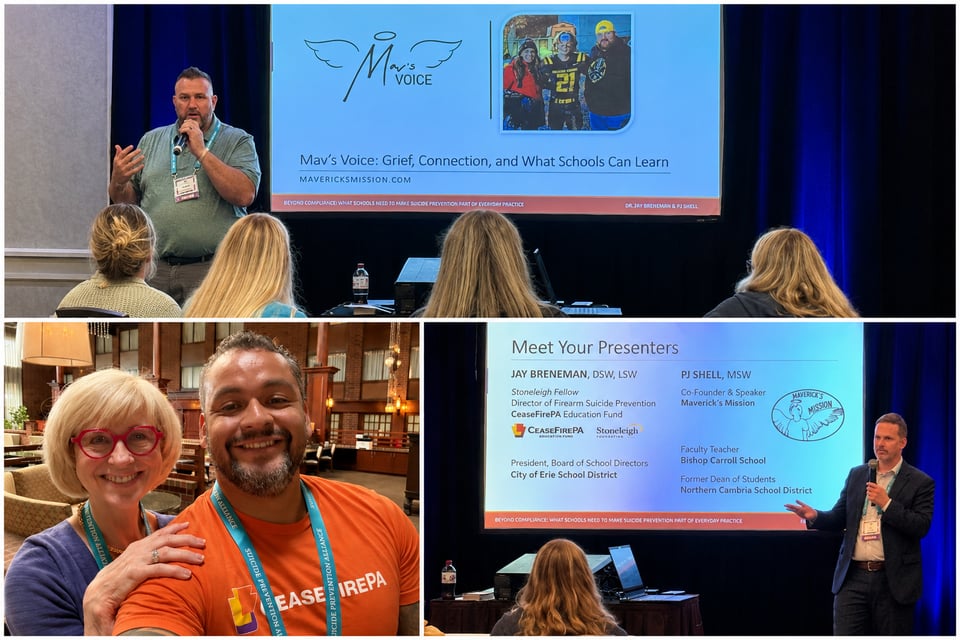
On August 4th, PJ Shell and I had the chance to lead a workshop at the annual Pennsylvania Suicide Prevention Alliance 4th annual conference called Beyond Compliance: What Schools Need to Make Suicide Prevention Part of Everyday Practice, and my colleague Jonathan Gomez joined us for what became a really meaningful morning.
What made it work was how much people were willing to bring into the conversation. Many of the participants worked in schools, many were suicide loss survivors, and quite a few carried both experiences, so this was deeply personal for much of the room.
PJ spoke openly about his own loss, and his experiences as a parent, educator, former school director, and as someone who has spoken at more than 30-schools.
The engagement was better than we could have asked for, and by the end, the room felt full of people genuinely trying to figure out how to do better for the next student, coworker or family.
I’m still thinking about a lot of what people shared that morning.
Hope in Action in Lancaster

On September 17, I’ll be in Lancaster for Hope in Action: A Community Approach to Suicide Prevention, a full-day conference hosted by Mental Health America of Lancaster County.
I’m honored to serve as the keynote speaker and share some of what we have learned through our work to build community-based approaches to suicide prevention across Pennsylvania.
One part of the day I’m especially looking forward to is a panel we assembled called Trust, Stories, and Action: Community Voices on Suicide Prevention.
Jonathan Gomez is an Army combat veteran, longtime youth wrestling coach and our community liaison leading firearm suicide prevention efforts in the Poconos. Maura Condon Umble is a Lancaster mother and loss survivor who has spoken publicly about the firearm suicide death of her son, Alex, and its impact on her family. Ben Pawson is CeaseFirePA’s Chief Storytelling Officer, helping survivors and communities share their stories in ways that can change how people understand and respond to these issues.
I hope you can join us!
Date: Thursday, September 17 | 7:30 a.m.–4:30 p.m.
Location: DoubleTree Resort by Hilton in Lancaster
Learn more about the conference
Register for Hope in Action
A Note From Dr. Jay Breneman
I spend a lot of time looking at Pennsylvania’s suicide data, county by county and year by year. It’s mostly contained in giant spreadsheets, but I never forget that behind every number is someone who belonged to a family and a community. Each death left people wondering what they missed, what they could have done and how they can keep someone else from experiencing the same loss.
One pattern keeps pulling me back: Pennsylvania’s firearm suicide rate rose in every new five-year period I reviewed, just as it has over the past 25 years.
An entire generation of steady increases.
I use five years at a time because it gives us a steadier picture of the way things are going. Due to a number of factors (many of them solvable), we frankly don’t have data reliable enough to show yearly trends for every community and every demographic.
I look at five years at a time, then move the period forward one year: 2018–22, 2019–23, 2020–24 and 2021–25. Each update removes the oldest year and adds the newest. This helps me see whether a change holds over time or quickly disappears.
Once again, unfortunately, the direction held.
Pennsylvania’s firearm suicide rate rose from 7.7 to 7.8 to 7.9 and then to 8.1 deaths per 100,000 people. Between the first and latest periods, firearm suicide deaths increased from 4,965 to 5,274. That is 309 more deaths, or a 6% increase.
That latest total represents more than 1,000 Pennsylvanians dying by firearm suicide each year, and it reaches every age group. Of the 5,274 people who died by firearm suicide in the last five years:
530 were under the age of 25
2,197 were adults between 25 and 54
Nearly half of all such deaths (2,547 people) were 55 or older
While Pennsylvania’s overall suicide rate across all methods began and ended at 14.7, the share of suicides involving a firearm grew from about 53% to 55%. The firearm suicide rate also rose in every five-year update in 11 counties: Berks, Butler, Cambria, Franklin, Lycoming, Monroe, Philadelphia, Somerset, Warren, Westmoreland and Wyoming.
We can’t ignore that, because unlike most other methods, suicide attempts involving a firearm are almost always fatal. Most people who survive an attempt do not later die by suicide, but there is rarely a second chance with a firearm.
In rural Pennsylvania, the latest firearm suicide rate was 11.2 per 100,000 people—about 60% higher than the urban rate of 7.0. But you might not know that from looking only at Pennsylvania’s statewide rate of 8.1.
When we talk about gun deaths in rural Pennsylvania, we are usually talking about suicide, because about 84% of rural gun deaths were suicides.
As Suicide Prevention Awareness Month begins, we can make awareness useful. We can ask directly about suicide. We can talk about access to firearms. We can listen to people who have survived a suicide attempt and to those who have lost someone they love.
And we can act before a crisis becomes a tragedy.
Please share this edition with colleagues, friends and family so they can be part of this change. To connect, share an idea, or become involved in our work, email me anytime at [email protected].
With gratitude,
Dr. B
The recent figures come from CDC WONDER’s provisional mortality data, and 2025 totals may change as records are finalized.
What We’re Reading
Stories and research shaping how we understand firearm suicide.
Occupational Access to Firearms and Firearm-Related Suicide Among U.S. Workers — Among workers who died by suicide, those in jobs involving firearms had more than twice the odds that a firearm was used.
Carrying Firearms and Suicide Risk Among Adolescents — Teens who carried firearms reported suicide attempts far more often than those who did not, 27% compared with 9%.
988 Works. That’s Not Enough. — Ben Miller reviews new research showing that 988 helps people in the moment, while lasting prevention also requires crisis response, follow-up care and community support.
The Impact of Lethal Means Counseling on Openness to Out-of-Home Firearm Storage — One brief counseling session increased National Guard members’ openness to temporarily storing firearms outside the home during periods of distress.
Firearm Injuries and Deaths Might Be Preventable With Better Local Data — Better county-level data can help communities understand where firearm suicides are happening and focus prevention efforts where they are most needed.