We should be talking about media diets way more often
Why we shouldn't always be singing from the same hymn sheet.
One upside of working in more niche or specialist forms of marketing and media is that you are very likely to share an interest in common with your teammates.
Back when I worked on gaming magazines, for instance, it tended to be pretty darn straightforward to round up enough people for a lunchtime game of Towerfall. I can't help but think finding a fourth player might have been harder if I'd been writing for the New York Times.
But there are also notable drawbacks to this kind of close overlapping of interest.
One downside that I've come to think about more and more is the way that homogenous media diets can distort the output of a team of writers and editors. Often without anybody even realising it's happening.
Anxiety of influence
I've seen this play out in a few teams, to differing levels of severity. During the aforementioned period of my life spent working for games magazines, for instance, almost every writer would tell you that they'd 'grown up' on a certain magazine (probably one from a pool of five or six that were either especially successful or dearly departed).
Later in my career, I encountered one memorable team of writers that seemed to only have a single reference point for written media. As best I could tell, every writer had read the exact same magazine from a young age and - on some level - sought to reproduce its style, its quirks, and its format points in every piece of work they published.
To be fair, this kind of shared reference point can be useful. When your entire team is paddling around in the same media pool, it's much easier to feel confident that someone will know what you're describing when you ask them to deliver a review, say, or even to write up a piece of breaking news. Different publications don't just have different beats, after all - they draw on different traditions of writing and operate under different assumptions. If you've all been reading the same handful of publications for a decade or more, you're almost literally on the same page as the rest of your team.
But the downsides of this kind of homogeneity are clear. A narrow pool of influences may help build shared understanding, but it's rubbish for generating new ideas. Worse still, we don't usually acknowledge (or, sometimes, even realise) that our approach to writing and editing is being shaped and limited in this way.
Talk it out
Part of the solution, I believe, is simply to make media diets a routine topic of conversation in editorial and content marketing teams. At their worst, these conversations will make painfully clear that an entire team is reading the same books, listening to the same podcasts, and browsing the same websites. That may make for a yawnful conversation, but at least it brings the issue to light.
At their best, these conversations can be a rich source of ideas and inspiration. If one team member is reading Vanity Fair, another is reading The Verge, a third is reading Private Eye, and a fourth is flicking through What Hi-Fi magazine, you can be pretty certain that each publication will offer something to learn from, something to surprise or challenge you. You might consider how each outlet approaches feature-writing. How does each think about headlines? What regular formats do they return to time and again? And what kind of relationship do they seem to have with their readers?
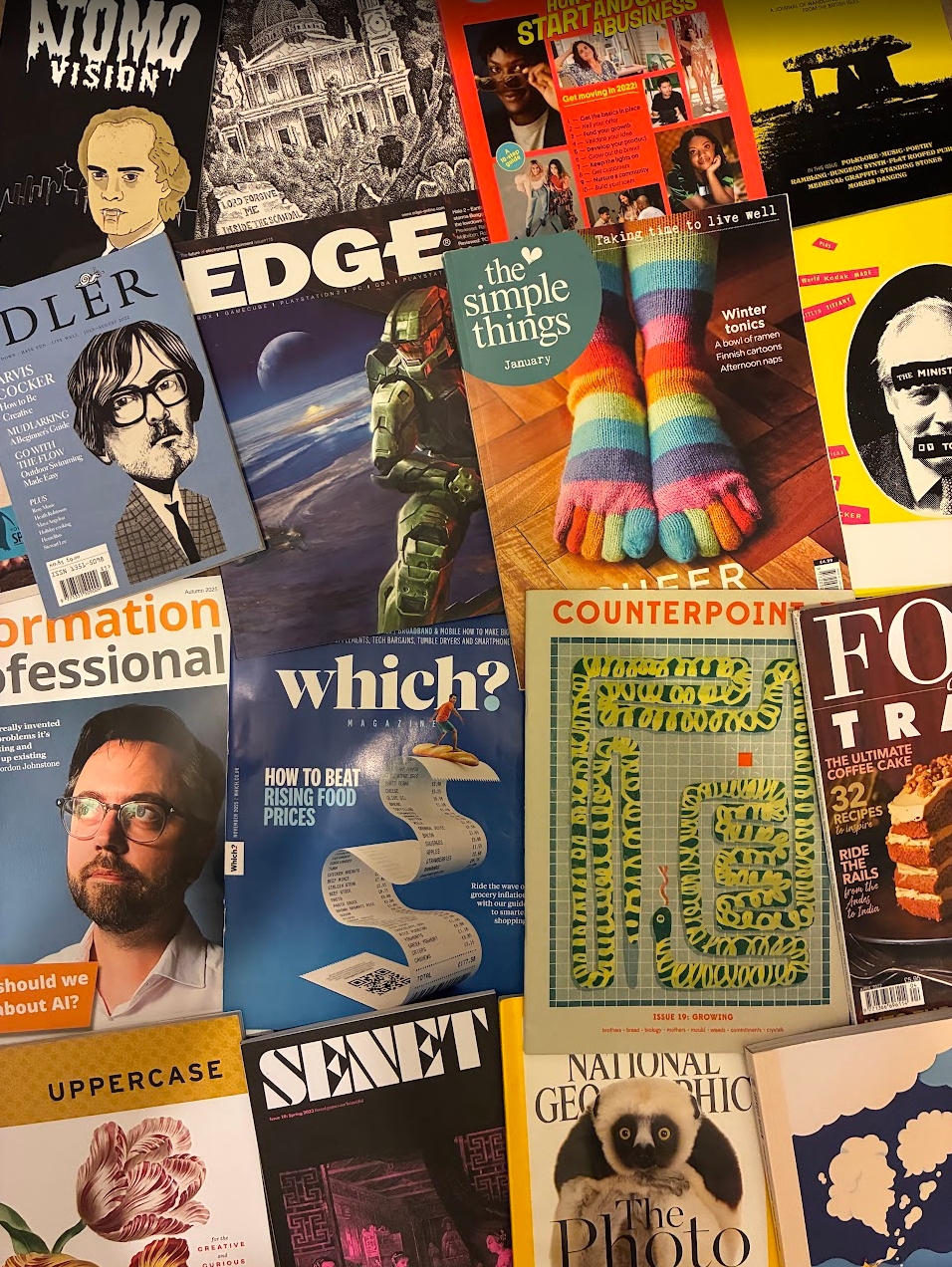
And while this is all invaluable for magpie-eyed editors, it's not just about spotting ideas, angles, and formats to borrow or rework. A broader media diet also helps to make visible the ways of doing things that you and your colleagues stopped noticing long ago.
Clicking around Axios, for example, (and later reading Smart Brevity) was one such moment for me. The site makes heavy use of bolded text, bullet points, and concise summaries to make their news coverage as approachable as possible. Reading the short, to-the-point articles there made me realise that there's nothing 'natural' about the usual approach of 500ish words of flowing body copy. Each is as constructed as the other.
In that instance, I concluded that their approach wouldn't be right for the project I was working on, and it wasn’t really what I was looking for from a news source, either. But it did encourage me to rethink (and to 're-see') some assumptions that I had long ceased to notice or evaluate.
And more importantly, it gave me another opportunity to talk about writing with my team. Chatting about this example may didn’t transform the way that we worked or generate a big new idea. But it did contribute to a shared understanding that our team culture was grounded in a genuine excitement for the craft of writing. It fostered a sense that we all - as a team - could get excited about great words, great formats, and great ideas no matter where we found them.
You just read issue #4 of boxouts. You can also browse the full archives of this newsletter.