
New Format, New Media
What is this then?
Hi! If you’re reading this email, you’ll notice that it’s no longer coming via Substack (unlike the post a few days ago, what a twist) but an alternative newsletter platform called Buttondown.
For a while, I was using Substack because it is free, despite misgivings about the site’s willingness to play ball with pretty gnarly (Nazi) actors. My reason was that nobody reads my newsletter (and even fewer pay for it, namely 0 people; why would they? Would you? I would love it if anyone would; not super optimistic). But for the same reasons I left Twitter a while back, it felt obligatory to jump off the stackwagon. So now we’re here! That’s what this is.
Something different
I used to spend a lot of time seeking out and sharing music and other media with friends and strangers on the internet. I used to review random European movies, like Corneliu Porumboiu’s Police, Adjective for my own enjoyment! (A Romanian friend recently told me his last name means “pigeon”; more on that below.) At some point, the omnipresence of streaming platforms, the dissolution of the blogosphere, and generally being busy in life got the better of me: I stopped doing that. But it also meant that I stopped a certain kind of quotidian writing practice. Did I lose something? Who can say? But we’re back.
Over the last year, I’ve spent a lot of time thinking about what a more ethical engagement with traditional forms of media might look like, especially when it comes to music. One of my teenage favorites, Los Campesinos, posted an analysis of their streaming income in December 2025 and the results were disheartening, to say the least:
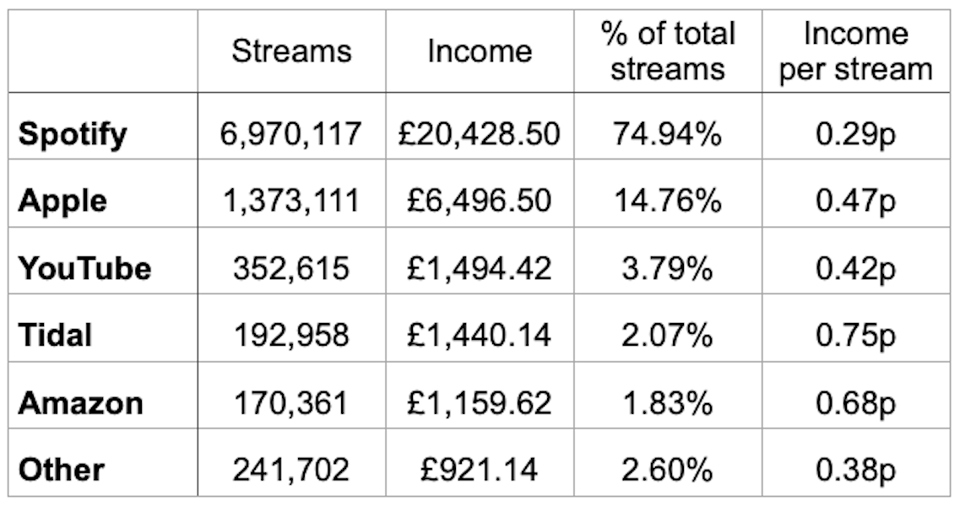
Disheartening both because they’re so low (this is an award-winning group with an admittedly small but dedicated following) and also because it’s clear the band would make so much more if everyone streamed their albums on Tidal, or even Apple Music, rather than Spotify. (Or just bought the actual record.) There’s less money to be made in music than there used to be (one reason, I think, why the only part of the Metacritic website that hasn’t been updated in a long time is the music reviews section, which used to be my favorite), but something has to change!
For a while, I felt that the best way to support a band that I liked was to get a ticket to their live show and then purchase whatever their latest record was directly from them on vinyl. This eliminated the packing waste and marginal C02 emissions from shipping records and meant that a good amount of money went straight into their pockets while lightening the load of the tour vehicle (even less C02). I could imagine that listening directly on vinyl with my not-all-that-impressive sound system was producing a more authentic experience and sleep soundly.
The concert part of that equation still makes a lot of sense, even if I now live in a city that bands mostly avoid (frown). But I began to recognize how weirdly, environmentally incongruous purchasing a new (plastic-wrapped) vinyl record is, given that vinyl is ultimately a petroleum by-product that will outlast even my greatest grandchildren, given my own broader commitment to limiting or eliminating my use of fossil fuels. (There are, finally, some non-fossil-based vinyl materials coming out, including “biovinyl,” which is made with cooking waste, but a lot of greenwashing goes into the marketing of “ecovinyl” which is just recycled vinyl). There’s a difference in buying an old, used record, but how to support the production of new music without contributing to the very processes that have made an area not that far from my house “Cancer Alley”?
I decided to start purchasing digital albums directly from bands on Bandcamp, which paradoxically sends me back almost exactly to the iTunes store experience of the early 2000s. But then again: America is caught in a disastrous and unnecessary war in the Middle East entirely of its own doing. Geopolitically, it’s the early 2000s once more, so why not engage with media that way?
As it turns out, this has been a delightful way to reengage with a process of discovering new artists and new music. So I will send to you, my loyal followers, every so often and likely not very frequently at all, some recommendations of things that I’m enjoying. You can unsubscribe if you’re thinking “I don’t want this at all,” but if you’re still subscribed to this newsletter at all, I have to imagine it won’t be the straw that breaks the camel’s back.
To wit:
Pigeon are a UK band that kind of sound like William Onyeabor starting TV on the Radio after listening to a lot of Kraftwerk. They are, to put it lightly, rad. A guy shouting “I’m the Black James Dean” at the top of his impressive lungs above a throbbing bassline? Sign me up. One reviewer said if this guy had a cult he’s joining, and I don’t disagree. Pigeon (or porumboiu when they perform in Romania, I could imagine) have a new album coming out in May. Who would not want to see these guys live? It won’t be me in New Orleans, that’s for sure, but maybe it will be you.
If I had to select one band and one record that defined the greater part of my life it is WU LYF’s Go Tell Fire to the Mountain (2011). I don’t have an exact estimate, but the total times that I have listened to the entire album all the way through is certainly over 500. I wrote a lot of my undergraduate thesis and then later a lot of my dissertation to endless loops of Go Tell Fire to the Mountain. I saw them live in a dark basement in Cambridge, Massachusetts, in 2011 and I thought: these guys are going to be huge. But then… they just broke up. One single, beautiful, mysterious record! So I was shocked when a friend told me recently that WU LYF announced a new tour and a new record. A Wave That Will Never Break is now out and, in a delightful turn of events, it was almost worth the wait. “Tib St. Tabernacle” might be the best track on the album, but I’m also partial to “The Fool.” New (old) WU LYF is more polished and has lost some of the incomprehensible scratchy shouting that defined the first go-round (other than “We bros” it was always hard to know what on earth the guy was saying), and they’ve toned down the church organ a little, but this is good stuff!
Now: if you have also been on Instagram (frown) and share anything like my particular algorithmic niche, you have seen content about Montreal’s Angine de Poitrine. “Dadaist Math Rock” seems to be the general descriptive sentiment after they went viral for a particularly fun KEXP performance. According to one take I saw: in an age of AI-everything, what could be more irresistible than nouveau-Dada (which was, initially, partly a response to the mechanization of European life) by two dudes in weird costumes making quirky, microtonal music (taking advantage, effectively, of more frets than an average guitar has) and talking like aliens during all their interviews?
People get really mad when bands that make decent music get popular. Take the recent suggestion that Geese are an industry plant because they… advertised themselves well? I understand the impetus (I was also 18 once), but Angine de Poitrine are awesome, and I think it’s a good sign that two quirky fellows from Montreal who dress up in preposterous outfits can go viral making weird music. I love it. Their second album Vol. II just came out and it’s fun. Lead track “Fabienk” is a highlight, and Vol. I might be a little better pound for pound, but the lead guitarist makes all the non-drum sounds by playing a double-neck guitar/bass that he endlessly loops using mostly his toes which are painted white for every performance. Impressive and goofy.
One fun opportunity in exploring the Bandcamp music ecosystem has been surfing the wave of releases from good record labels. Take Constellation, whose subscription I recently signed up for: how else would I have learned about Dwarfs of East Agouza’s new album Sasquatch Landslide or Jessica Moss’s absolutely breathtaking For UNRWA? A Spotify playlist, I suppose, but here we are! What a lot of Constellation artists share is making music that requests a kind of sustained listening attention that so much of our modern world militates against. There’s value, as I keep insisting to my students, in trying to pay attention in different ways.
Last, and in a more minimalist direction, is Green-House which makes “environmental” electronic music. Their new albums Hinterlands is dreamy. When listening, I get the feeling of sitting down in a very pleasant, sunny cafe in a city I’m visiting with no obligations before me. Or the brief moment of total exultation I felt as I watched the Artemis crew “splashdown” into the Pacific Ocean. They went all the way around the moon, farther than any humans had ever traveled, and landed almost exactly where predicted within about 1 minute of the original estimate with gorgeous orange parachutes. It was remarkable!
That’s all for now. Do you like this? Do you want more content of this nature? Maybe, maybe not. Do you have music you like? I would like to know! Are you somehow reading this without being subscribed to the newsletter? Well join up below, wahoo!
-Brad
