
This week: The Other Cherry Blossoms
Hello!
Though less famous than Japanese cherries, our native cherry trees, Prunus serotina, are blooming. The flowers on native Eastern Black Cherry trees are quite different from the celebrated pink blossoms, but no less beautiful.
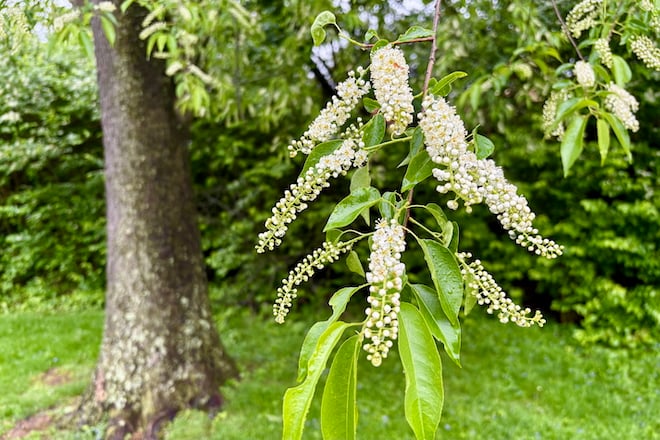
The trouble with viewing Black Cherry blossoms is their height. Black Cherry trees grow to 100 feet tall, making their canopies quite high. But if you encounter a shorter specimen up close, you’ll find clusters of small white flowers called racemes. At the end of the summer, the flowers turn into bunches of small black berries that are gobbled up by birds and mammals, like squirrels, opossums, and even black bears. Per the circle of life, they help distribute the cherry pits that become new trees. In fact, seeds digested by songbirds have a higher germination rate than undigested seeds.
You’ll usually find Black Cherry trees in forest openings and old fields because they are sun-loving. They’re native to the eastern and central U.S., but they’re particularly well-suited to the Appalachian Plateau. That’s where you’ll find some of the tallest trees with the widest trunks.
A Truly Beneficial Tree
The benefits of Black Cherry are legion. First, it is the larval host for a plethora of Lepidoptera (340 and counting), including the Eastern Tiger Swallowtail, Viceroy, Promethea Moth, and the Columbia Silkmoth. In addition to providing food for caterpillars, birds, and mammals, it also provides shelter and serves as a pollen source for beneficial insects (of course).
Humans find Black Cherry trees useful, too. The cherry used for furniture and cabinets? That’s Prunus serotina. And Appalachian pioneers infused their rum and brandy with wild black cherries to make a popular drink called Cherry Bounce (thus the origin of “Rum Cherry,” another common name for the tree). Indigenous Americans used the bark to make cough syrup, a practice still common in natural medicine today.
The next time you encounter our native Black Cherry, look up and appreciate its bounty!
Elsewhere:
The Field Guys podcast recently took a deep dive into Chronic Wasting Disease. It’s a strange, deadly disease spreading through deer herds across North America, including Pennsylvania. Listen and learn more about CWD.
Have a good week,
Julie