
This week: Surprise! It’s Jack/Jill-in-the-Pulpit.
Hello!
The other day, I was browsing the spring-planted roots and bulbs at my local hardware store and spotted Jack-in-the-Pulpit (Arisaema triphyllum) for sale. This green, tropical-looking plant is common in wetland forests across the eastern and central U.S., and it’s always exciting to stumble across it on a hike. It is a rare find in the home shade garden, even though it doesn’t need to be.
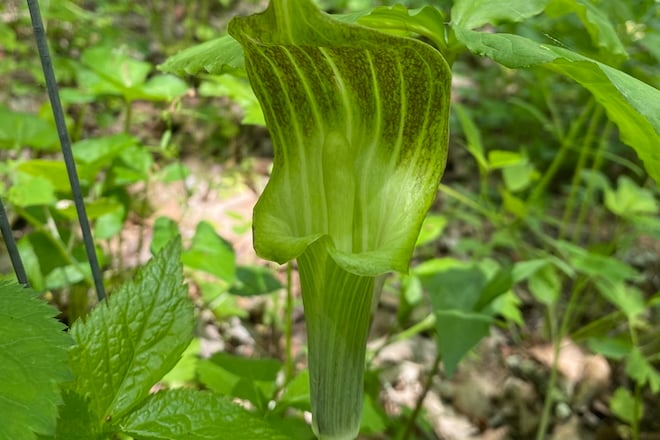
When planted in the right conditions — moist part-shade to shade with a good covering of winter leaf litter — it will grow vigorously and even form a colony. The best way to buy Jack-in-the-Pulpit is to purchase bare-root corms from a reputable source. Skip the seeds—they take two winters to germinate, and after that, you’ll have three more years to go before you’ll see a flower (this is also why you rarely see potted plants for sale; it doesn’t make commercial sense).
Anatomy: It’s Complicated
Jack-in-the-Pulpit has a curious trait: some years, it is male; other years, it is female (aka Jill-in-the-Pulpit). Generally, in year one, the flower is male. Once the plant gathers enough nutrients, it produces female flowers and berries. If the plant is depleted by fruiting, it will retake the male form.
Let’s also talk about the common name. Jack, the figure at the center of the tube, is technically a spadix. The pulpit (the tube and the roof) is the spathe. The spathe is not the flower; those are tucked inside at the base of the spadix. This is the same botanical structure as tropical plants like Peace Lilies and Anthurium (both relatives of Jack-in-the-Pulpit in the Araceae family).
Should You Eat It? No.
Speaking of houseplants, Jack-in-the-Pulpit is pollinated by its scourge: fungus gnats. In the fall, its cluster of red berries is a favorite snack of box turtles. Deer don’t bother it, and it is toxic or inedible to most mammals (including humans). Eating it won’t kill you, but it will be extremely uncomfortable.
Even though you shouldn’t eat Jack-in-the-Pulpit, indigenous North Americans used it medicinally. For example, the Iroquois and Cherokee prepared corms to treat headaches, sores, and colds, among others. Notably, the Meskwaki (originally residing around present-day Wisconsin) took advantage of the discomfort Jack-in-the-Pulpit could bring to those who consumed it. They poisoned meat and tainted their left-behind cooking vessels with it to harm their enemies.
Elsewhere:
If you’re a Pennsylvania resident, the Commonwealth’s Invasive Replace-ive program is back! Remove your Callery Pear, Tree of Heaven, Barberry, Burning Bush, Privet, and more, and trade them in for native plants! Find out more here.
Have a great week,
Julie