
This week: Straight Species vs. Native Cultivars
Hello!
This week, I attended a webinar called "The Cultivar Conundrum" presented by Joseph Tychonievich, a horticulturalist and plant breeder. If you get the opportunity to see one of his presentations, do it! It was easily the most informative and clarifying talk about native plants I’ve been to in a long time, and I attend a lot of talks. Anyway, in this issue I’m going to share the main point that I walked away with.
First, a few definitions.
Native plant people (me) throw around terms like cultivars (or nativars, short for native cultivar), hybrids, and straight species. Straight species refers to an unnamed selection of a native plant that we believe is close to the “wild” form. A cultivar is a named selection — a plant with desirable characteristics that is propagated to maintain these traits (e.g., compact size, flower color, flower abundance, long bloom time). A hybrid is when two related species reproduce. Hybrids are typically sterile and, left alone in nature, will die out; in cultivation, hybrids are reproduced through cuttings or division (clones). Most cultivars and hybrids are indicated by a name in single quotes following the species on the plant tag.

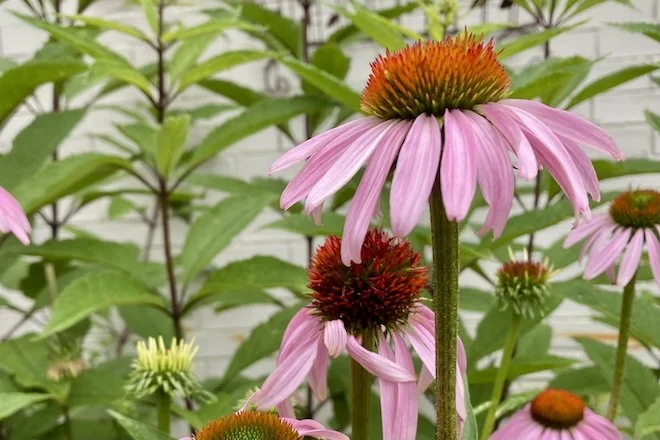
To make this literal, here’s an example using Echinacia purpurea, the ubiquitous Purple Coneflower.
Straight species: Echinacea purpurea grows up to four feet tall, and the flower color varies from light purple to magenta.
Cultivar: ‘Prairie Splendor’ is a named cultivar of Echinacea purpurea that was selected because it only grows to two feet tall and has consistently magenta flowers.
Hybrid: ‘Cheyenne Spirit’ is a hybrid Echinacea that grows to two feet tall and has multi-colored flowers. It is believed to be a cross between Echinacea purpurea and one or more other Echinacea species.
I’ve oversimplified this to an extreme. Just know that in nature, plants have wide variations and are adapting and mutating all the time, with and without human intervention (unintentional or intentional). And, some cultivars might be better than others, or could even be better than the straight species, depending on your goals — but that’s a topic for another day.

Why are you rambling on about this?
If you were to descend into the comment section on social media, for example, you would find some STRONG opinions about cultivars. A common take is that straight species, grown from locally sourced seed, is the “right” way to do native plants, and that native cultivars or hybrids are the “wrong” way (and while you’re at it, you better not plant anything non-native, or your membership in the club will be revoked!). In my opinion, this makes native gardening more daunting than it should be and keeps people out rather than in.
The Takeaway
So, here is the eye-opener from Tychonievich’s talk. If you are participating in an ecological restoration, you need to care about using straight species and sourcing seed regionally because you are creating a space that will have to survive for decades with very little human intervention.
If you have a garden or a lawn conversion in a typical residential setting, your goal is different. To keep your plants in place for generations, they have to be pleasing enough that the next homeowner wants to become a gardener too. If this means you’re choosing more native cultivars because they are compact growers, have more stunning blooms, or are easier to manage, then do what is best for the long-term existence of your garden.
When you plant natives with abundance, you’ll support pollinators, wildlife, and a healthy watershed. The ecosystem will win, even if you planted some cultivars. And, if you garden with an eye for beauty and design, you’ll convert more people into plant lovers.
Elsewhere:
If you’re interested in the plant traditions and science of indigenous Americans, check out the book Iwigara: The Kinship of Plants and People by Enrique Salmon. In it, you’ll find stories and uses for a selection of wildflowers, trees, and shrubs. The book is organized by plant, which makes it a quick reference or a book to dip in and out of.
Have a good week,
Julie