
This week: Redbud Trees, an Early Spring Indicator
Hello!
Some native trees and shrubs are known as spring indicators. One is the Eastern Redbud (Cercis canadensis) tree. It forms maroon-colored buds at this time of year and will soon be covered with small, bright pink flowers. The Kiowa Plains Indians in present-day Oklahoma would traditionally bring flowering Redbud branches inside to “drive winter out.” We can do the same!
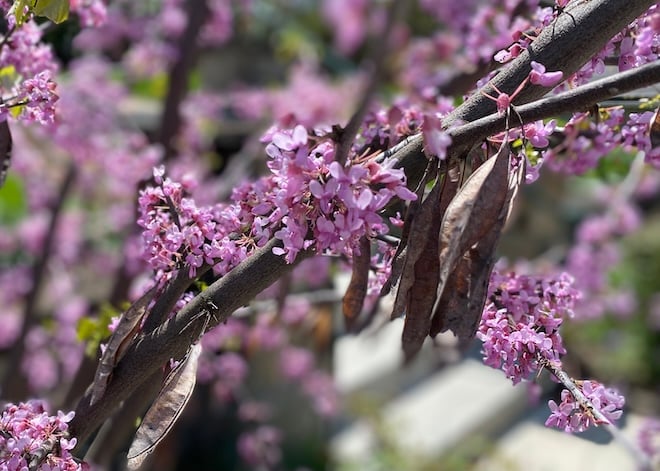
The Eastern Redbud has many cultivars, and the straight species is widely available. It grows 15 to 30 feet tall and wide, and prefers part sun to shade. It is native to the eastern and central U.S. After it flowers, the tree develops large, heart-shaped leaves that turn yellow in the fall. Its seed pods remind me of brown sugar snap peas — proof that it is a member of the legume (Fabaceae) family. Its small size and ornamental value make it an easy choice for a front yard.
Insects Are Big Redbud Fans
Unlike many other flowering trees, Redbud flowers bloom before there are leaves on the trees. The flowers are directly on the branch or trunk, giving it a striking sculptural look. These flowers provide valuable early-season food to native bees and pollinators. And, it’s the larval host plant for at least twelve species of moths and butterflies.
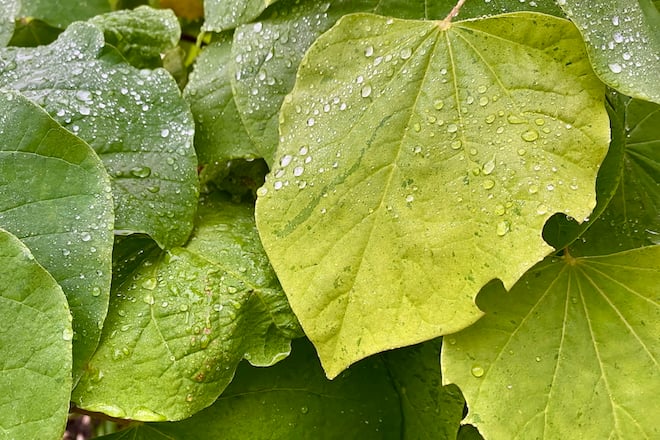
The Redbud isn’t just a food source: it is also critical to the leafcutter bee’s lifecycle. Leafcutter bees (Megachile) use Redbud leaves to line their nests. In late spring or early summer, female bees emerge from their nest, mate, and then begin building a nest where they can lay their eggs. They cut ovals from Redbud leaves and roll them into cylinders that they insert into a found cavity. Then they fill the cylinder with pollen and nectar, and cap it off with another piece of leaf. This serves as food for their bee pupae, who will overwinter and then emerge as the next generation of leafcutter bees the following spring.
The leafcutter bee isn’t the only bee attracted to the redbud. Mining bees, cellophane bees, large carpenter bees, bumble bees, and mason bees are also frequent visitors, per Heather Holm’s book, Bees: An Identification and Native Plant Forage Guide.
Elsewhere:
Is it time to call in the experts to trim the trees on your property? This article from The New York Times (gift link) explains what to expect from a tree service or arborist.
Have a good week,
Julie