
This week: Red Pine Is Hot and Cold
Hello,
’Tis the season to notice evergreens, and one relatively uncommon specimen worth spotting is Red Pine (Pinus resinosa). Red Pine’s native range extends across the northeast, down to Pennsylvania, and around the Great Lakes. It prefers the frigid winters and milder summers of northern climates. It’s a medium-sized tree, growing anywhere from 50 to 80 feet tall, and has a somewhat open habit compared to other pine trees.
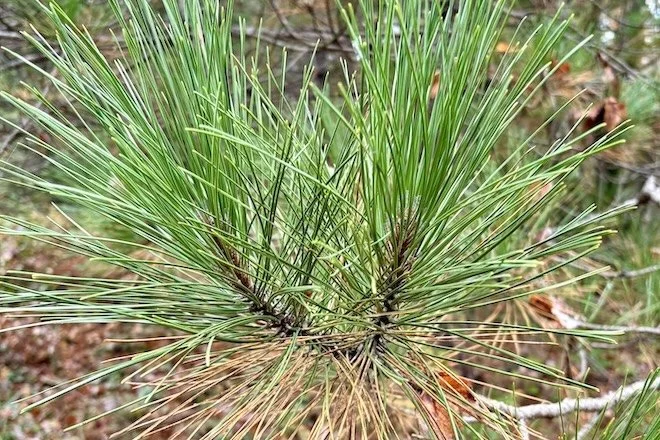
Red Pine is often found in forests alongside White Pine trees, but these cousins have different survival strategies. Red Pine is a pioneer tree — one of the first to move into disturbed areas, especially if the disturbance was a fire. It wants sun and low competition on the ground to grow. White Pine’s role in ecological succession is to move in after the pioneer species, and it is more shade-tolerant. White Pine is also less reliant on fire as a regeneration strategy.
A lower reliance on fire is one reason White Pine is more common than Red Pine. Red Pines were extensively logged for timber in the nineteenth and early twentieth centuries, then a regime of fire suppression by the forestry service smothered their prospects for regrowth. But you can still spot the occasional Red Pine in clearings or at the forest’s edge.
A few other fun facts about Red Pine:
- To identify Red Pine, look for needles that are three to eight inches long in bunches of two (White Pine has bunches of five).
- Red Pine gets its common name from its reddish-colored bark, another identifying factor.
- It was once a popular Christmas tree.
Elsewhere:
Blooms to Bees will be at the Home for the Holidays event in Dormont on Saturday, December 6, from 11 am to 2 pm along Potomac Ave. I’ll be selling how-to guides, garden journals, and calendars, and there will be music, shopping, activities, and even live ice sculpting. See you there!
Have a great week,
Julie