
This week: One Simple Slope Solution
Hello!
In honor of the Winter Olympics, let’s hit the slopes. Plenty of us have slopes in our landscapes and are stuck maintaining them with lawn mower maneuvers that are not recommended by the manufacturer, or by scrambling up and down them like a mountain goat. One simple slope solution to consider is a mass planting of shrubs.
Like many homeowners in Pittsburgh, I have a backyard with a slope leading up to the neighbor’s property. It’s a run that is 30 feet long and 10 feet wide, at an angle of roughly 45 to 65 degrees. The previous homeowner left a weedy mess. Another gardener suggested that I plant three Alegheny Leatherleaf Viburnum (Alegheny Leatherleaf is non-native, don’t let the name fool you!). Fifteen years later, the Viburnums are providing privacy from the neighbor, and they've reduced my weeding efforts.
Not convinced? Here are more reasons to consider planting shrubs on hard-to-maintain hillsides.
Shrubs are cost-effective. I planted three shrubs and covered 300 square feet — this is more cost-effective than using dozens of perennials to fill the space, even though shrubs are higher-priced.
They create shade, which is cooling for us, but also discourages sun-loving weeds.
Their root systems stabilize hillsides and cut down on erosion.
Once established, maintenance is only occasional. You will need to remove shade-tolerant weeds (English Ivy and bindweed, for example) as you notice them, and prune in the spring when needed.
Shrubs create living fences between you and your neighbors and disguise unsightly views.
Native shrubs provide food and habitat for birds, and ample flowers for pollinators.
Design Layouts
A rule of thumb for making a living fence with shrubs is that the more space you have, the greater the diversity of species you can select. My slope wasn’t that large—it was narrow and not terribly long. Because the space could accommodate only three or four shrubs once they matured, I chose three of the same kind to create a uniform, tidy hedge.
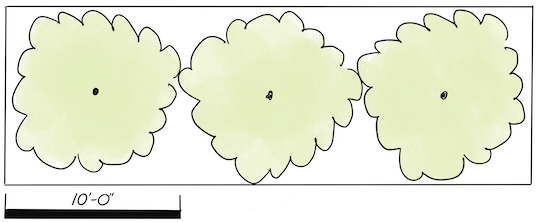
If the space were double the length, I would add one or two more species into the mix, alternating them or using one species at each end and another in the middle.

If the space were twice the width, I’d use several species and lay them out in an offset or zigzag pattern. I’d also mix spring and summer bloomers and consider fall foliage color to enhance seasonal interest.
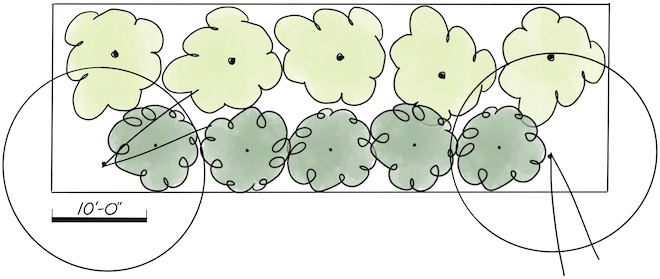
Have even more space? Add more species and expand your plant palette to include small or medium-sized trees for height variation.
So, if you’re faced with a slope, don’t limit your choices to perennials, groundcovers, or inconvenient turfgrass. Try shrubs instead! And, for more inspiration for your slope, check out these native shrubs.
Elsewhere:
On Wednesday, February 16, at 7 pm, tune into a free webinar from Wild Ones led by Basil Camu, a master arborist. I attended a talk by him earlier this year, and he had a lot to say about thickets, pocket forests, and the role of trees and shrubs in our urban and suburban ecosystems. It should be a worthwhile watch!
Have a good week,
Julie