
This week: Golden Ragwort Blooms!
Hello!
If you read all the way to the end of last week’s newsletter, you’re probably already planning to stop by the Blooms to Bees tent at the Mt. Lebanon Earth Day Celebration to say hello. If not, mark your calendar for Sunday, April 26, from 11-3. I’ll be there with free seed packets and garden guides for sale! Now, onto the newsletter.
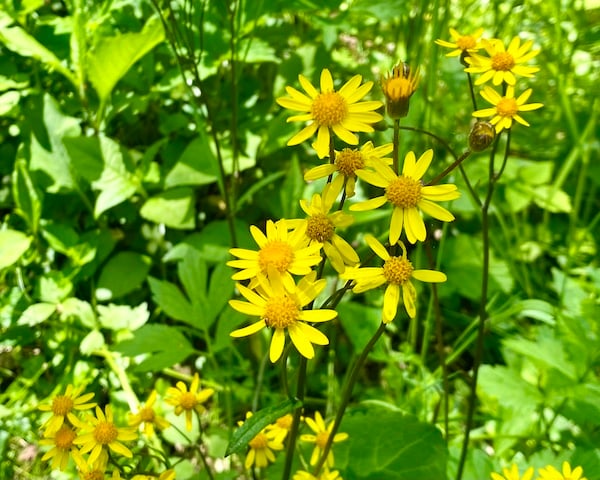
This past week, the Golden Ragwort (Packera aurea) in my garden began to bloom. It’s a rarity in most people’s gardens, but it is not rare in the woods. Of course, I think everyone should have it in their garden because it is incredibly useful. First, it is an early bloomer that feeds emerging insects. Second, once the flowers fade, it forms a lovely ground cover.
Golden Ragwort is primarily a woodland plant—it prefers part sun to full shade. Like many forest-dwelling flowers, it tolerates the most sun in the spring, before the forest canopy emerges, when temperatures are cool and it’s rainy. (It can grow in full sun, as long as the soil is consistently moist.) The plentiful spring sun encourages small yellow flowers to bloom on one- to two-foot-tall stalks. Once summer is underway, the flowers are replaced by thick, glossy, low-growing green foliage that thrives in shade.
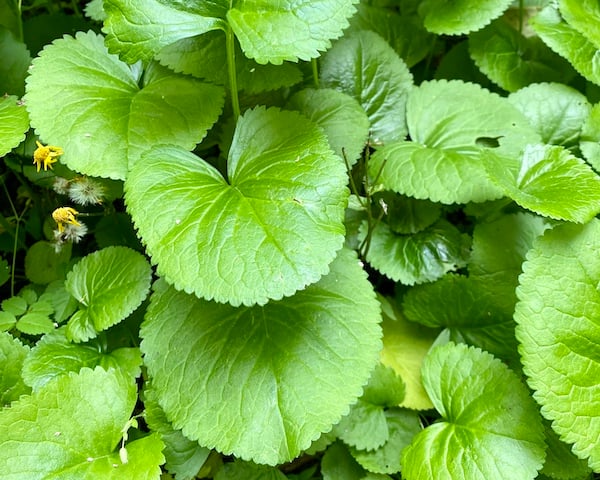
Golden Ragwort as a Soft Landing
Because it loves shade, consider planting Golden Ragwort as a ground cover under trees and shrubs. This creates a “soft landing” for insects. Beneficial insects live in and around trees. By replacing the typical grass or mulch bed under a landscape tree with native shade plants and leaf litter, you’ll provide a home for moths and caterpillars that may start in the tree but complete their life cycle on the forest floor. It’s better for the bugs and better for the tree (no string-trimmer mishaps or mulch volcanoes once you’ve planted a soft landing!).
Botanic Name Trivia
If you have an older field guide, you might know this plant by its former name: Senecio aureus. The word aureus is Latin for “golden.” The new name, Packera, honors John G. Packer, Ph.D., a 20th-century Canadian botanist who studied alpine plants and was a professor at the University of Alberta.
Elsewhere:
Elsewhere in the forest, it’s ramp season! This article from Wellspring Forest Farm discusses the sustainable harvesting of ramps and why the harvest should be much less than the common “take no more than a third” rule of thumb.
Have a great week,
Julie