
This week: Big (Native) Rhododendrons
Hello!
While non-native Rhododendrons can be found in nearly every neighborhood, native Rhododendrons are not a common sight. One eastern native is Rhododendron maximum, called Great Laurel or Rosebay.
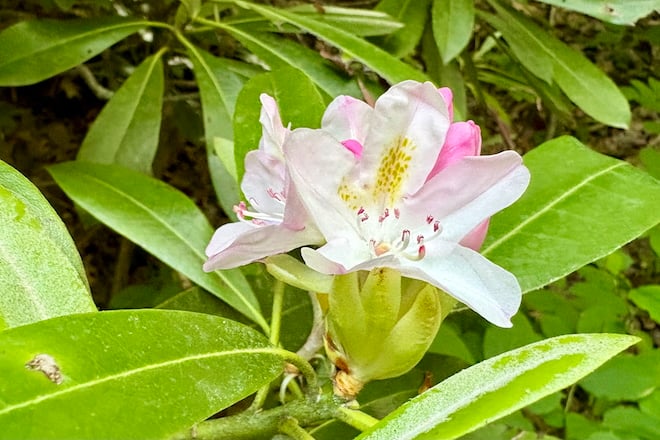
Great Laurel is the kind of native shrub that you can spot from far away, even when it isn’t in bloom — that’s how big it is. Not only is it 15 feet tall or more (some reach 30 to 40 feet), but the evergreen, leathery leaves are enormous. They can measure more than a foot long and one to three inches wide. The shrub spreads via rhizomes and layering, creating dense thickets that can colonize entire slopes. While Great Laurel is large, its flowers are not: they have a diameter of roughly 2 inches. They bloom in June, and are white to pink.
Probably because of its size and sprawl, Great Laurel is uncommon in home gardens and is difficult to find in nurseries. However, you can find plenty of it in Appalachian forests, especially in the deep shade of late-successional forests that have moist, acidic soil. The thicket of Great Laurel I came upon was surrounded by Beech and Yellow Birch trees—hallmarks of a long-lived woods.
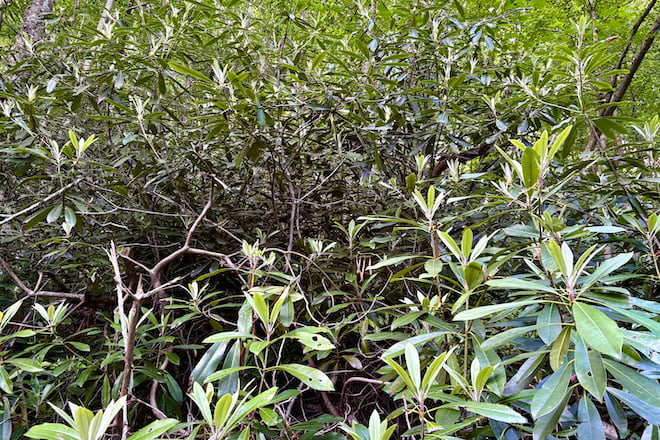
As expected, the early summer flowers attract pollinators, but Great Laurel also provides food for deer, grouse, wild turkeys, beavers, mice, and rabbits. Its dense thickets provide dens for black bears and cover for birds and woodland mammals. These thickets are called laurel hells or slicks, described as “nightmarish tangles of contorted rhododendron shrubs” that are only easily navigated by bears and other forest residents. They were also said to be hiding spots for moonshine operations!
A final fun fact? Rhododendron maximum is the state flower of West Virginia.
Elsewhere:
Traveling this summer? Add a garden to your trip with this interactive map.
Have a great week,
Julie