
When Intelligence Is No Longer Our Advantage
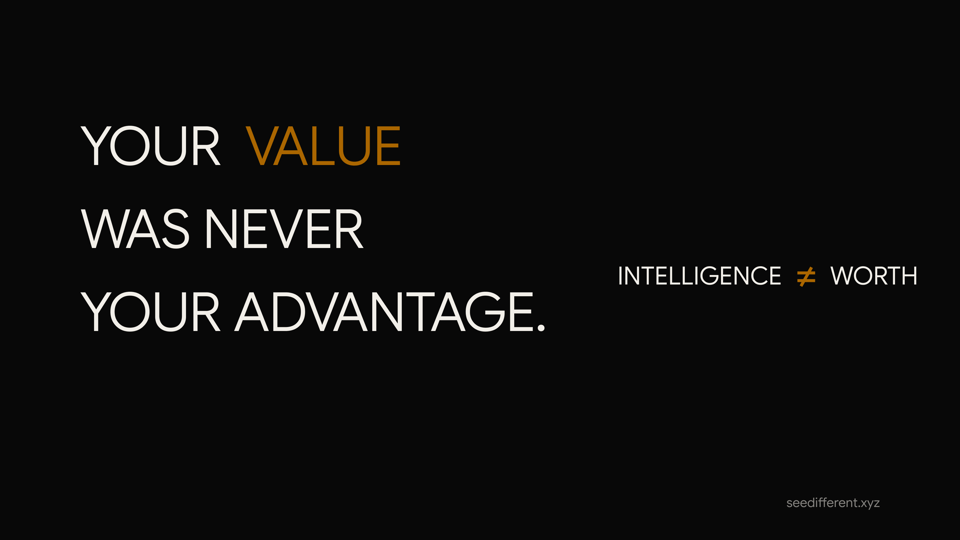
Preview: AI may be revealing what our value, our workplaces, and our future were built upon.
What AI Is Really Revealing
Three conversations came together for me today. One asked what happens to human value when intelligence is no longer our obvious advantage at work. Another questioned whether it is the person or the workplace environment that needs fixing. The third led me to wonder whether AI might be locking us into a past we never questioned.
They appeared to be separate conversations, but each pointed to the beliefs shaping how we see before we act.
For a long time, many of us have located our value in being knowledgeable, capable, productive, useful, or the smartest person in the room. As AI participates in more of that work, we naturally begin searching for the next human advantage: judgment, relationships, creativity, taste, or emotional intelligence.
Those qualities matter. But turning them into new ways of proving our superiority preserves the same underlying belief that our value depends on having an advantage. Human value does not begin where AI’s capability ends.
This pattern also appears in our efforts to transform the workplace. An environment is the visible expression of what we believe about people, work, motivation, trust, and success. Change the environment without questioning those beliefs, and we eventually recreate the same workplace in another form. The language changes. The technology changes. The lens survives.
AI raises the stakes. Before it recommends, decides, or acts, we have already decided what the problem is, which information matters, what success looks like, and what the system should optimize. Those decisions carry assumptions shaped by our experiences, identities, successes, failures, and fears.
We talk often about AI being trained on the past. We rarely notice that we are too. AI takes what we have learned to see and turns it into recommendations, decisions, and actions at machine speed. The tool is new. The lens is not.
This is one reason I wrote The Perception Miracle. For years, I had been noticing the almost invisible moment in which the past enters our seeing and begins shaping what happens next. The book is not about making better decisions from within the same way of seeing. It’s about recognizing what has already shaped the decision before we realize one has been made.
The past still has value. It can inform us without continuing to lead us. When that hold begins to loosen, clarity and judgment no longer governed by the past can emerge from a deeper intelligence.
AI may be bringing us to a more honest inquiry. Who are we when intelligence is no longer our advantage? Can we transform the workplace without examining the beliefs that created it? Can we build a new future without allowing the past to quietly choose it for us?
The work now is not to protect a place where humans remain superior. It’s to see the lens before AI scales it.
Human value was never our advantage. It doesn’t need to be defended from AI. It needs to be remembered.
Above all else, choose to see differently.
— BF
Addendum:
This reflection grew from three conversations on LinkedIn today. If you’d like to follow the threads and add what you’re seeing, you can find them here:
When intelligence is no longer our obvious advantage — Tatyana Mamut
Does the person or the environment need fixing? — David Marquet
What if AI is locking us into a past we never questioned? — Bill Fox
Add a comment: