Energy Edge — Morning Outlook | Thursday, November 5, 2026
Daily Global Energy Market Intelligence

Price snapshot: morning of Nov 5, 2026, roughly 7:00–9:00 AM MT. Intraday quotes are approximate and are not settlements.
Market Bias

Executive Summary
Crude is retracing after its worst day in months. Brent (Jan) settled at $94.62 (−$8.98) and WTI (Dec) at $88.12 (−$7.97) on Wednesday. Both were the lowest settlements since Aug 31. Markets read the Democratic midterm sweep and President Trump’s “no immediate plans to strike Iran” as lowering the odds of escalation. This morning Brent is near $97 and WTI near $89–90.
The war premium is being repriced, not removed. The US-Israeli war with Iran, which began in February, remains unresolved. UBS calls the bounce a “modest recovery” because the situation is “still unresolved.” Eurasia Group sees $110–125 Brent if escalation resumes.
Diesel is the tightest barrel in the US. EIA distillate stocks fell 3.6 MMbbl to 99.3 MMbbl, the lowest since 2003. Consensus expected a 0.1 MMbbl draw. Distillate demand was 4.44 mb/d, with the 4-week average up 8.7% y/y.
The EIA crude draw was softer than it looks. The headline was −0.865 MMbbl (vs. a ~+0.9 MMbbl build expected), the fifth straight draw. But a −704 kb/d adjustment factor means measured flows implied a build of about 4 MMbbl. Refinery utilization is 94.5%.
European gas is deflating from crisis highs, but storage is thin. TTF has fallen about 17% from last week’s €102–104 peak. EU storage is about 74%, against a five-year norm near 90%. Qatari LNG remains under force majeure through end-December.
The US/EU gas divergence is extreme. Henry Hub is under $3, while TTF is about $34 equivalent and JKM about $31.7. US export arbitrage is fully open, so feedgas and Freeport outages matter more than usual.
Henry Hub positioning is crowded short. The CME managed-money net short is about 205k contracts. Today’s EIA storage report and weather model shifts are the triggers to watch.
Bias: Crude is neutral with high volatility (resistance $93.95/$96.06/$97.15 WTI, support $87.13/$86.00). Distillate cracks lean bullish. HH leans mildly bearish. TTF/JKM stay headline-driven.
Market Dashboard — Crude Oil & Refined Products
Prices (approx., Nov 5 morning MT):
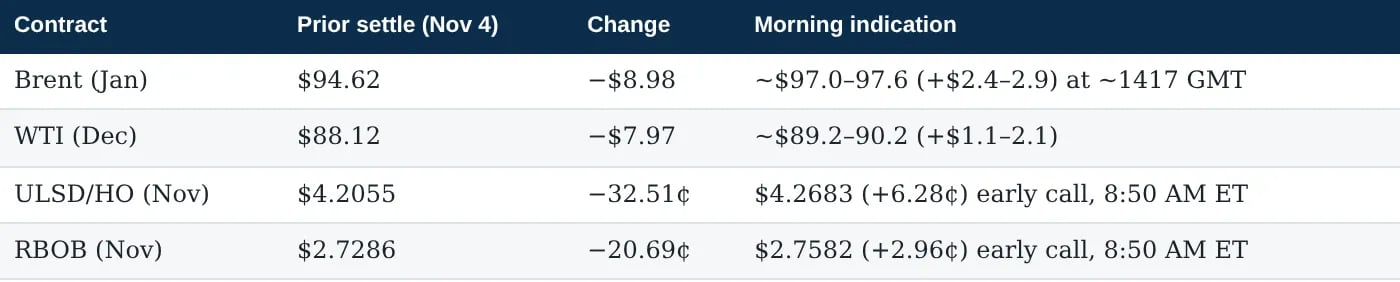
Wednesday’s session ran from an overnight high of $97.15 down to a $87.13 low in WTI. That roughly $10 range shows how much of the price is geopolitical optionality rather than balance-sheet value. Asian trade extended the slide early Thursday (Brent $93.82, WTI $86.92 at 0426 GMT, per Reuters via 5paisa). Prices then reversed higher in London hours. Treat the quotes above as indicative. Feeds diverged by more than $1 during the morning.
Fundamentals (EIA WPSR, week ending Oct 30):
Crude: −0.865 MMbbl to 409.8 MMbbl, about 4% below the 5-yr average and the fifth straight draw. Total draws over five weeks are about 17.6 MMbbl. Cushing rose 0.28 MMbbl to 27.25 MMbbl. SPR fell 0.4 MMbbl to 282.2 MMbbl.
Quality of the draw: the adjustment factor was −704 kb/d. Crude exports fell about 1.18 mb/d to 3.68 mb/d. Excluding the adjustment, flows imply a build. Read this as neutral, not bullish.
Refining: runs rose 199 kb/d to 16.73 mb/d, and utilization rose 1.7 pts to 94.5%.
Distillate: −3.6 MMbbl to 99.3 MMbbl. ULSD was −2.9 MMbbl. Production was flat at 5.15 mb/d, so the draw came from demand. Stocks are 11% below last year.
Gasoline: −0.22 MMbbl to 209.0 MMbbl, about 2% below the 5-yr average. Demand was 8.81 mb/d (+450 kb/d).
Total products supplied: 21.96 mb/d (+1.75 mb/d w/w). Total commercial stocks fell 8.2 MMbbl.
Read-through: high runs plus lowest-since-2003 distillate inventories mean refiners cannot easily build diesel ahead of heating season. ULSD should outperform crude on any stabilization. We do not have a verified 3-2-1 or HO-crack level this morning. Gasoline has less support as driving season ends.
Geopolitical Risk Assessment
Premium assessment: elevated but compressing. Wednesday’s move of about $9 in Brent was mostly premium coming out, not fundamentals changing. On our judgment, a meaningful premium (likely high single digits to low teens $/bbl) remains while the conflict and Hormuz flows stay unresolved. This is an estimate, not a measured figure.
Drivers:
US politics. Democrats swept the Nov 3 midterms. The market reads tighter congressional constraints on Middle East military spending and better odds of a negotiated settlement (Sprague; Reuters via CNA/CNBC).
White House signalling. Trump said Tuesday he had no immediate plans to strike Iran. That lowers the near-term odds of escalation without eliminating them.
Strait of Hormuz / Qatar LNG. QatarEnergy extended force majeure on deliveries through at least end-December. LNG flows through Hormuz are “barely a trickle” (OilPrice). Even a full reopening implies weeks of delayed cargoes (Saxo).
Tail risk. Escalation scenarios put Brent at $110–125 (Eurasia Group).
Net: the risk is skewed. Diplomatic progress could take another $5–8 off, while a breakdown could add $15–30. Expect continued headline-driven volatility.
Natural Gas
Henry Hub: December futures are about $2.95–2.96/MMBtu. Spot was $2.63 on Nov 3 (EIA). Storage was 3,724 Bcf as of Oct 23, +80 Bcf w/w, 1.0% above the 5-yr average and 3.8% below last year. Now that the market has moved off its post-holiday lows, the drivers are mild weather forecasts tied to a strong El Niño, robust production, and LNG feedgas. The Freeport LNG train shutdown reported last week reduces feedgas demand. Positioning is the swing factor: the largest managed-money net short since 2020 (~205k CME contracts) leaves the market exposed to a squeeze on a colder forecast.
TTF: Dec is about €86.6/MWh (ICE, 10:50 EET), after an €84.68 open. It closed at €88.08 on Nov 4 and €91.60 on Nov 3, against a peak above €102 last week, the highest since 2022. EU storage is about 74.3–74.7%, 16.8% below the 5-yr average. The Oseberg outage in Norway was extended last week.
JKM: about $31.7–31.8/MMBtu, down about 1% w/w and about 22% m/m. Spot LNG in Southwest Europe is about $30.5.
Spread: TTF/JKM trades roughly $28–29 over HH. US LNG export economics are maximal, so the spread is constrained by export capacity, not price.
Macro & Investment Outlook
Fuel inflation channel: the 8% crude drop and the declines in RBOB and HO should ease headline inflation expectations if they last. Retail diesel will lag because distillate is physically tight.
Political economy: fuel prices from the Iran war were a central voter grievance. That raises the odds of policy aimed at lower pump prices, such as diplomacy and SPR management (SPR is at 282 MMbbl, 31% below last year).
Dollar/rates: not verified this morning. We have no confirmed DXY, UST yield, or Fed-path data for Nov 5.
Demand: US total product demand rebounded to about 22 mb/d (4-wk average +4.2% y/y). That shows no demand destruction at ~$90–100 crude.
Sector Watch
Refining: supportive diesel fundamentals (lowest-since-2003 stocks, 94.5% runs) set against falling flat price. Margin capture depends on the distillate crack holding up.
Upstream E&P: most sensitive to the lower war premium. Volatility will likely dominate near-term sentiment.
LNG exporters / midstream gas: a wide international spread supports utilization. Outages such as Freeport are the key operational variable.
European utilities and gas-intensive industry: relief from the TTF retreat, but storage deficits keep winter risk high.
Airlines and transport/logistics: benefit from lower crude. Diesel tightness limits relief for trucking.
Tankers: sensitive to Hormuz normalization. Reopening would reshape routes and rates.
Note: Sector Watch discusses sectors only and does not cover or recommend individual securities.
Key Risks
Iran talks break down or military escalation resumes (Brent $110–125 scenario).
Hormuz/Qatar LNG force majeure runs past December.
An early cold snap in Europe with storage about 16–17% below normal.
A US weather shift colder, triggering a short squeeze in a record-crowded HH short.
Further distillate draws pushing ULSD sharply higher, independent of crude.
Downside: a rapid peace deal flushes the remaining premium, putting WTI support at $86/$83 in play.
EIA data noise: a large adjustment factor makes weekly crude prints unreliable.
Market Outlook

What We’re Watching Today
(Times MT, with ET in parentheses)
8:30 AM MT (10:30 AM ET): EIA Weekly Natural Gas Storage Report (week ending Oct 30). Consensus was not verified.
Iran diplomacy headlines and any White House/Congress statements on the war.
QatarEnergy and Hormuz shipping updates. TTF/JKM reaction.
12:30 PM MT (2:30 PM ET): NYMEX crude settlement. Check whether WTI holds above $88.12.
Weather model updates (US Lower 48, NW Europe).
Freeport LNG restart status and US LNG feedgas.
Disclaimer
Energy Edge is independent market commentary provided for informational and educational purposes only. It is not investment advice, and nothing herein is a recommendation or solicitation to buy, sell, or hold any security, commodity, or financial instrument. Readers should do their own research and consult a qualified financial professional before making any investment decision. Past performance is no guarantee of future results. Opinions expressed are those of the author, are based on publicly available information believed to be reliable, and are subject to change without notice.