
Your Body Has a Clock. Are You Eating Against It?
You've been told what to eat. You've been told the order to eat it.
But nobody talks about when during the day your body actually handles carbs best.
Turns out, timing matters more than most people realize. And most of us are eating our biggest, carb-heaviest meals at exactly the wrong time.
🕐 Your Body Runs on a Clock — Literally
Every cell in your body follows a 24-hour cycle called the circadian rhythm. You've heard of it for sleep. But it governs a lot more than that.
Your metabolism runs on the same clock.
In the morning, your body is primed for action. Insulin sensitivity is at its peak — meaning your cells are most receptive to glucose, your pancreas responds efficiently, and blood sugar clears quickly after a meal.
By evening, that efficiency drops. Your cells become less responsive to insulin. The same plate of pasta that your body handles fine at noon can cause a significantly bigger glucose spike at 8pm.
Same food. Different clock position. Different blood sugar outcome.
⚙️ What the Research Actually Shows
A few things that consistently show up in the data:
Eating larger meals earlier is linked to better weight outcomes, lower fasting glucose, and improved insulin sensitivity over time
Late night eating — even the same calories — produces higher glucose spikes and slower clearance
Breakfast skippers often compensate with larger evening meals, which hits the body at its metabolically weakest point
A phenomenon called the "dawn effect" — your body naturally releases cortisol in the early morning to wake you up, which slightly raises blood sugar before you even eat. Add a carb-heavy breakfast on top and the spike is sharper than it would be mid-morning
The sweet spot for carb-heavy meals? Mid-morning to early afternoon. Your body's insulin response is strongest, digestion is efficient, and glucose clears before your circadian clock starts winding down.
🍳 Meet Ryan and Jess
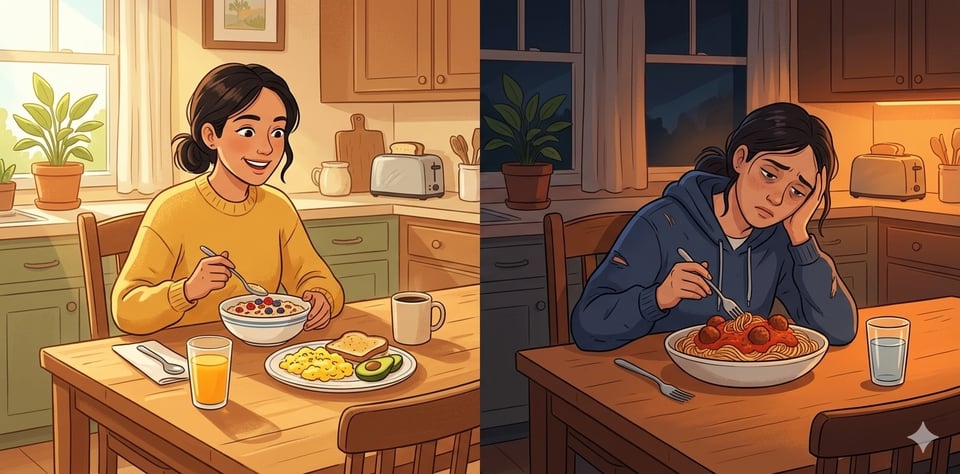
Ryan skips breakfast, eats a light lunch at his desk, and then unwinds at dinner — a big bowl of pasta, garlic bread, a glass of wine. It's his reward after a long day. He's in bed two hours later.
Jess front-loads her day. Oatmeal and eggs in the morning, a solid lunch with a mix of protein, greens, and some brown rice. Dinner is lighter — grilled fish, roasted vegetables, maybe a small portion of sweet potato.
By 9pm, Ryan's blood sugar is still elevated and slowly working its way down while he sleeps. His body never fully gets the rest it needs because it's still processing.
Jess's glucose has been steady most of the day. By evening her body is genuinely winding down — and her sleep quality shows it.
Same total food. Completely different metabolic story.
📲 From GlucoSpike
Take the next step. Great health starts with everyday choices. GlucoSpike is your AI food coach — snap your meal, get quick insights, and learn how to balance what you eat with how you feel.
Check out the all-new GlucoSpike AI app — now faster and smarter than ever:
⚡ 2x Faster Food Recognition
🎯 Meal Scores
📈 Better Spike Prediction
🚶 Post-Meal Walk Timers and Reminders
🥗 Nutrition Tracking
📊 Weekly Coaching Reports
Available on the App Store and Play Store.
❌ The Twist: The Crash Is a Clue
Here's something worth paying attention to.
That 3pm slump you blame on your workload? The brain fog that rolls in after lunch? The sudden sleepiness after dinner that has you reaching for coffee or something sweet?
Those aren't random. They're your body signaling that a glucose spike just happened — and now it's crashing.
When blood sugar rises fast and then drops sharply, your brain — which runs almost entirely on glucose — suddenly feels the dip. Energy tanks. Focus blurs. Mood dips. You feel like you need a nap or a sugar hit to get through the next hour.
Most people treat the crash. They grab a snack, another coffee, something sweet. And the cycle starts again.
The real fix is upstream — flatten the spike and the crash never comes.
Timing your bigger carb meals earlier in the day is one of the most underrated ways to do that. Your metabolism handles it better, the glucose clears properly, and you're not sending your brain on a rollercoaster at 3pm or lying awake at midnight with your body still processing dinner.
✌️ Your Takeaway
Try front-loading just once this week. Make lunch your biggest meal — include your carbs there. Keep dinner lighter, protein and vegetable heavy.
Notice how your afternoon energy feels. Notice if the 3pm crash is softer. Notice how you sleep.
Your body will tell you everything you need to know.
📲 From GlucoSpike
Take the next step. Great health starts with everyday choices. GlucoSpike is your AI food coach — snap your meal, get quick insights, and learn how to balance what you eat with how you feel.
Check out the all-new GlucoSpike AI app — now faster and smarter than ever:
⚡ 2x Faster Food Recognition
🎯 Meal Scores
📈 Better Spike Prediction
🚶 Post-Meal Walk Timers and Reminders
🥗 Nutrition Tracking
📊 Weekly Coaching Reports
Available on the App Store and Play Store.
🔜 Coming Up Next Week...
You just learned about the crash. But what's actually happening inside your brain when blood sugar drops? Next week we're unpacking post-meal brain fog — why it happens, what it feels like, and the simple habits that keep your mind sharp all day.
Still feeling like food and glucose are a mystery? Don't stress — stress doesn't help your sugar, anyway. Leave it to GlucoSpike AI to decode the patterns. No sensors. No manual tracking. Just smart insights based on what you eat. Progress doesn't need to be complicated. Just simple and consistent.
See you next week,
— Team GS