
You didn't overeat. You were overtrained.
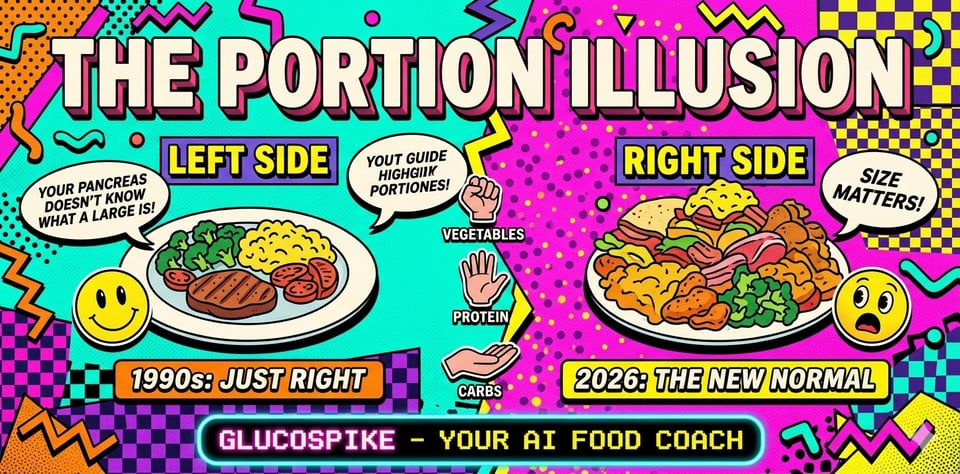
The Portion Illusion
Cast your mind back to the 1990s.
A McDonald's regular Coke was 12 ounces. A movie theater popcorn was something you finished before the previews ended. A muffin at the bakery was roughly the size of your fist — not your face. Dinner plates were smaller. Restaurant portions were smaller. Even the packaging at the grocery store was smaller.
Nobody was talking about portions back then. You just... ate. And somehow, it felt like enough.
Fast forward to today. That same regular Coke is now a small. The muffin has tripled in size. A plate of pasta at most restaurants has grown to nearly five times what a single serving should be — and we've quietly accepted all of it as normal.
This is how portion distortion works. Not through one dramatic change, but through a slow, decades-long creep that recalibrated what "a serving" even means. By the time most of us noticed, oversized had already become the default.
And your blood sugar? It noticed every step of the way.
Your pancreas doesn't know what a "large" is
Here's what nobody tells you: your body wasn't built for 2026 portion sizes. It was built for something much closer to what your grandmother served.
When you eat more carbohydrates than your body can process in one sitting, blood glucose rises sharply — not necessarily because you chose the wrong food, but because you had too much of it at once. The speed and height of that spike matter enormously. A large portion of even a "healthy" carb — brown rice, whole wheat roti, oats — can send your glucose soaring just as dramatically as a smaller portion of something processed.
Your insulin response was calibrated for a different era. The portions weren't.
Over time, repeated high spikes quietly accumulate into:
Insulin resistance — your cells start ignoring insulin's signals
Energy crashes and intense cravings an hour after eating
Fat accumulation around the abdomen
A slow drift in blood sugar averages toward pre-diabetes territory
And the crueler part? The more often you eat oversized portions, the more a normal portion starts to feel like deprivation. Your hunger cues recalibrate upward. What used to be satisfying no longer registers. You're not greedy — you've just been trained.
How the food industry quietly upsized your world
Think back to the 1990s again. "Supersize" was a novelty, a marketing gimmick that felt slightly scandalous. People talked about it. There were jokes. It felt like a choice you were consciously opting into.
Today, supersizing is invisible. It's just... the menu.
"Value" in the food industry almost always means more food per dollar. Bigger plates, heaped servings, bottomless baskets of bread — these aren't generous. They're engineered to feel generous while keeping your order size — and the bill — as large as possible. Research consistently shows that people eat more when given larger portions, without feeling proportionally fuller. The plate empties. That's how it works.
The original 1990s sizes aren't coming back. But you can quietly opt out, once you know what you're looking at.
A simple reset — no calorie counting required
You don't need a food scale, a nutrition degree, or a complicated app to fix this. The plate method has been around since before the obesity epidemic started and it still works:
✅ Half the plate — non-starchy vegetables: salads, cucumber, leafy greens, broccoli, cooked sabzi
✅ Quarter plate — lean protein: eggs, chicken, fish, dal, paneer, legumes
✅ Quarter plate — complex carbs: brown rice, one or two rotis, sweet potato, oats
If you're eating at a restaurant — where the plate is already twice the size it should be — mentally halve the carb section before you pick up your fork. Box the rest before you start, not after.
Your hand is also a surprisingly reliable guide:
Fist = vegetables
Palm = protein
Cupped handful = carbs
Unlike a kitchen scale, your hand travels with you.
One more thing that actually works: eat in sequence
Vegetables first. Protein next. Carbs last.
This sequence — not just the portions — changes how your body responds. Fiber and protein slow digestion, meaning the carbs you eat afterward enter your bloodstream more gradually. The same meal, in a different order, produces a meaningfully lower glucose spike.
It sounds almost too simple to be real. But the research backs it up, and your GlucoSpike Score will show you the difference within a week of trying it.
The number your 1990s self never had
Here's something your grandmother didn't have, and neither did anyone eating those smaller portions in 1990: real-time feedback on how a meal actually landed.
Back then, you ate and hoped for the best. You wouldn't know if something was spiking your glucose until a doctor's visit years later — usually after the damage had quietly accumulated.
That's exactly the gap GlucoSpike was built to close. Snap your meal. See your score. Learn which portions — of which foods — your body actually handles well. Over time, you stop guessing and start knowing.
The goal was never to eat less. It was to eat right-sized. There's a difference, and once you feel it, the 2026 portion looks less like value and more like what it actually is.
Bottom line
Somewhere between 1990 and now, a serving became a statement. Bigger meant better. More meant value. And a generation of hunger cues got quietly recalibrated in the wrong direction.
You can't undo thirty years of food industry decisions. But you can opt out, one plate at a time. Once you know what a real portion looks like, you'll start seeing the distortion everywhere — at restaurants, in packaged foods, on other people's plates.
Your glucose doesn't spike because you eat badly. Sometimes it spikes because you eat 1990s food in 2026 quantities.
The difference between a 70-minute spike and a steady two-hour burn? Often, it's just the second scoop.
Take the next step. Great health starts with everyday choices. GlucoSpike is your AI food coach — snap your meal, get quick insights, and learn how to balance what you eat with how you feel. Available on the App Store and Play Store.