I had a lot of opportunities to ponder the nature of baseball fandom sitting in the stands for three straight Phillies-Orioles games in Baltimore. The Phillies had the worst record in baseball since the All-Star break coming into the weekend; they’d gone from contending for the NL East lead to clinging to a wild card spot, and it was hard not to wonder whether they were already off the cliff and in the air, Wile E. Coyote-style.
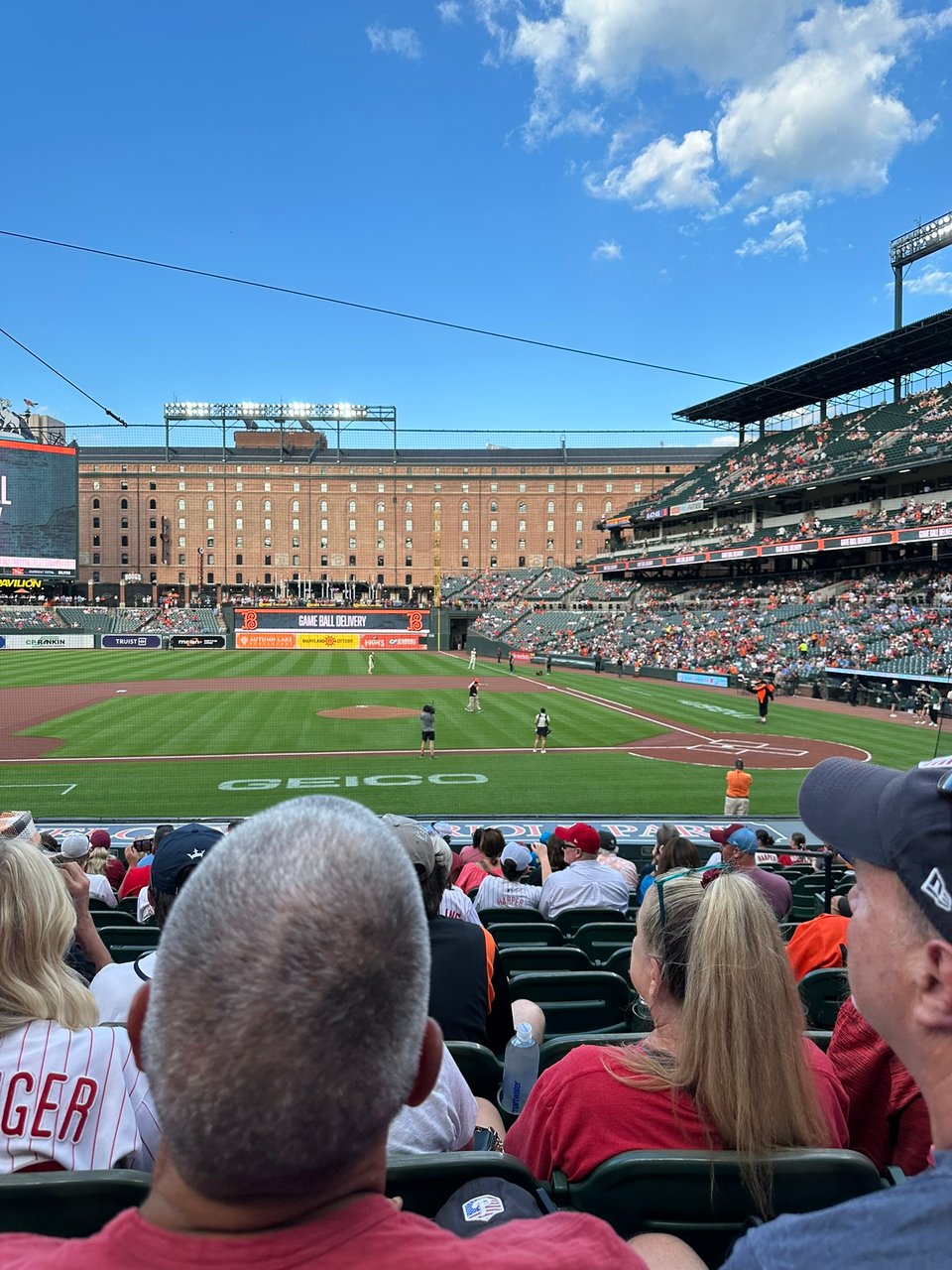
During the game on Friday, which the Phillies lost 6-4, I spent a lot of time thinking about why I wasn’t angry. Wasn’t everything going wrong? Wasn’t the season, and perhaps the whole era, kind of slipping away? Don’t I see people every day condemning their own teams as bums and losers, wanting them all traded? Why did I mostly feel a possibly perverse desire to big-sister this bunch of professional athletes, like, “You got this, I believe in you.” I tend to be disappointed for them, not in them. I certainly know the cause is not optimism, because I am not optimistic. In fact, I inherited a certain tendency to conclude my team is going to lose the minute anything bad happens.
Searching my soul, I concluded that it’s because, at heart, I deeply believe that baseball fandom requires, and always will require, the warm embrace of massive quantities of pain. It’s not just that even a great team will lose, what, 60 games in a season? (The celebrated Dodgers have already lost 43 times this year, including their last three games.) It’s not just that in an imagined world of perfect competitive parity, your team would win the World Series once every 30 years, and every other season would end in one of two ways: (1) missing the playoffs or (2) losing.
It’s that I foundationally believe in, and am convinced of, how freaking hard it is to play professional baseball.
The very idea of trying to swing a bat and hit a ball that is moving at 95 miles an hour, and doing so in a way that will keep it away from the nine players who could potentially retrieve it and throw me out, sounds comically difficult. The way major league pitching is now, it amazes me that people get hits at all. You struck out? Makes sense! You hit a ground ball to the shortstop? Congratulations on connecting meaningfully! You flew out to the warning track? What a stud.
Similarly, the very idea of trying to throw a baseball at 95 miles an hour and put it in one particular spot rather than two inches to the left of that spot is something that, again, I am utterly baffled anybody can do. It happens all the time that the pitcher will park the pitch squarely on the actual corner of the white box on TV that indicates the strike zone, and it is far more shocking to me that they do this than it will ever be that they sometimes cannot do it.
The timing of catches in the outfield astonishes me. The speed of catching up with ground balls in the infield floors me.
Add to this the fact that this is all done with tens of thousands of people right there in person to watch you try to do it, plus additional millions of people at home, plus good sports journalists, plus bad sports journalists, plus various know-nothing social media dopes.
Regarding said dopes: In the last two games of the series, both of which the Phillies won, the bullpen pitched six innings and gave up no runs. Nevertheless, when the game on Sunday was called early after 5.5 innings because of rain (more on that in a minute), there were fans—not Orioles fans, but Phillies fans—grumping that the team just got lucky, because if the bullpen had needed to finish the game, obviously they would have given up the eight-run lead they had.
This in a game in which the bullpen, in the real world in which we live, pitched three innings (the third through the fifth) and gave up no runs, which, in a normal game, is all you would likely need your bullpen to do. In other words, people were blasting the bullpen for being hypothetically incapable of doing something they had, at the time these little comments were being typed out, already done.
I would not be able to tolerate it. A friend once told me that my Kryptonite is people who do not know what they’re talking about who talk down to me, and it is extremely true, and professional athletes experience a supercharged version of this every single day. The very idea.
And then, of course, there are gamblers.
Fans are much better, and much more forgiving, than a tour of your favorite team’s Instagram comments, for instance, would suggest, and gamblers are the reason. After the game on Sunday, which was rained out after 5.5 innings (as stated) and which the Phillies won 8-0, there was a deluge of internet comments excoriating the Phillies for taking out starter Zack Wheeler after a rain delay of almost two hours that came in the middle of the third inning. What, he could only pitch two innings? What a loser. They pulled him after two innings? What complete fools.
Of course, the Orioles didn’t use their starter after the rain delay either, because once a pitcher is iced for two hours, he’s not going to come back. How would you keep him warmed up for two hours without wearing him out? Would you let him get entirely cold and then try to start from scratch? No, it makes no sense, that’s not how pitchers are handled. A two-hour delay is going to knock out your starter. (Even if that weren’t the case, it was a badly handled rain delay that included taking way too long to halt the game until there were large puddles all over the infield, then removing the tarp after it stopped raining, then working on the infield for like half an hour, and then putting the tarp back on, only to remove it again shortly thereafter. A mess.)
But the problem wasn’t just that these angry people hadn’t thought through the particulars of pitching; the problem was that they had placed bets. Not just bets on the game, but bets on how many innings Wheeler would pitch or how many strikeouts he would get. Often, they don’t admit this is what’s driving them, but sometimes they do. The guy who said “I’m done with Schwarber,” a comment truly suggesting you are a vintage clown suit of a person, did not admit that he’s lost money betting recently that Kyle Schwarber would hit home runs, but I would (perhaps ironically!) bet that he has.
I’m not sure you can watch a game and function as both a fan and a gambler. I’m not talking about the office March Madness pool; I’m talking about habitually betting your own money in a way where you are actually bothered when you lose. When you are trying to profit from the performance of a team, it interferes with what fandom is, which is a kind of joining—not joining a team, obviously, but joining with a team. When you join with a team, you get a million little stories, and you can believe they are all important, and they can all give you pleasure and alleviate some of that pain. You get not just that (probably disappointing) story of whether your team won the World Series, and not just the story of whether they won the three-game series or the individual game. You get the stories of everything else, and you get them pure and simple, and they don’t have profits or losses.
On Saturday, Bryson Stott had a 15-pitch at-bat in the seventh inning that included ten foul balls. He battled, battled, battled, and then he hit a hard ground ball at the shortstop. Shortstop couldn’t quite handle it, and Stott reached first base on an infield hit. All it will say in the scoring is that Stott hit a single, stole second, got to third, and then did not score. But what I know in my heart is that he survived not only hitting ten foul balls, but also knocking one of them hard off his foot, which looked like it hurt in that very particular way that hitting a ball off your foot that was just recently traveling at 90 miles an hour always looks like it hurts. He helped knock out the starting pitcher, who the Phillies were having trouble hitting, leading to a four-run eighth against a bullpen they did not have trouble hitting.
Although I’m sure you can bet on foul balls or long at-bats, because you can bet on anything, the pure pleasure of an unexpected little mini-story like that, a story from which I had nothing to gain, delighted me. Same with Trea Turner rebounding from a miserable stretch in July in which he suddenly couldn’t seem to field ground balls. Every time he confidently made a terrific play, it made up for one run I have watched them give up.
All this to say: Whether they’re winning or losing, I generally exist in a state of stunned admiration that any of them can do any of this.
I just cannot bring myself to decide from pitch to pitch, at-bat to at-bat, game to game, series to series, whether I still like my team or my guys. Those are my guys. It’s my team. Even after they get swept by the Marlins. Unless I see an obvious lack of effort (of which losing is not evidence) or I hear them talking in some way that annoys me (or one of them, perhaps possibly maybe while drinking, drives a scooter into a fire truck), I assume that as much as I want them to do well, it’s not as much as they want to do well, so what am I going to be mad at them for?
That’s my team.
You just read issue #1 of Baseball Romantic. You can also browse the full archives of this newsletter.