Z Is for Zeppelin
They’ve managed to sneak their way into just about every entry thus far, it’s finally time for Led Zeppelin to receive their own yap and a half.
Are they really the greatest rock band of all time? Well about a year ago I reviewed “Led Zeppelin IV”, and I told you all with great confidence, “no.” Now I’m pretty sure I stand by that, although I’ll admit I’m less sure than I was originally. But I just don’t think there’s any topping The Beatles there, you just can’t do it. I mean let me remind you, just once, that The Beatles’ best selling record is their compilation album, “1”, made entirely of number 1 hits. The album is a whopping 1 hour and 18 minutes long, that’s 27 songs right there. Trivia time, can anyone tell me how many number one hits Led Zeppelin was able to score? It’s 0, they had 0 number one hits. (“Whole Lotta Love” was their highest charting single; it peaked at #3) Honest to God, I think that alone must surely mean The Beatles take the “greatest rock band” title. Best? Different question.
After all that it might surprise you to learn that I actually do prefer Led Zeppelin to The Beatles, I know, real fan behavior I just displayed. But I won’t waste any more time, let’s get into some music.
Part 1: “Led Zeppelin” (1969)
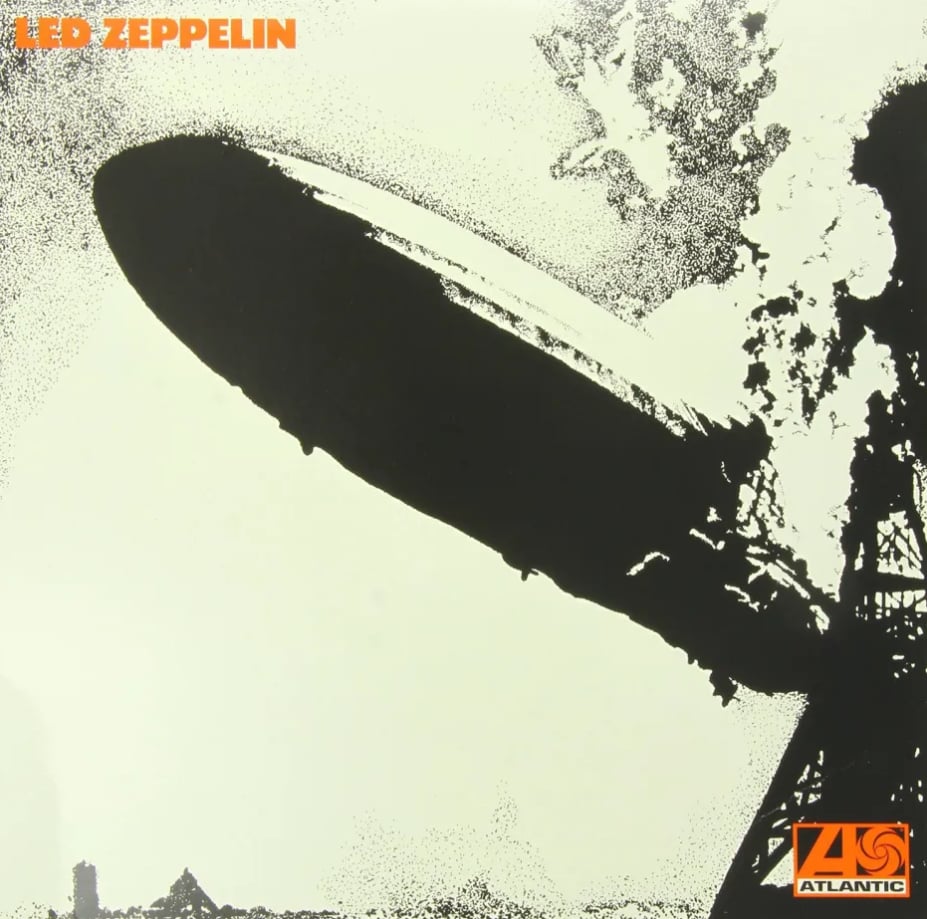
It’s sort of funny to think that this wildly successful band was such a hassle to actually put together. The initial idea was to form a super group consisting of Jeff Beck and Jimmy Page (sharing the lead guitar limelight), The Who’s Keith Moon and John Entwistle on drums and bass guitar respectively, and Steve Marriot or possibly Steve Winwood as vocalists. Well the group never formed, with Keith Moon himself being quoted as saying a group consisting of both Jimmy and Jeff would “go down like a lead balloon.” And he wasn’t wrong per se; we all know how that went the first time around.
But forget the super group, if they weren’t going to cooperate, a far less critically acclaimed lineup would have to do. Jimmy, along with former Yardbirds bassist Chris Dreja began to scout for singers. They eventually landed on Terry Reid, an up and coming vocalist that everyone and their mother was just dying to get their hands on. This of course meant that he had very little time for their silly dream. Heck, he didn’t even have time for Deep Purple. He was far too busy touring with The Rolling Stones and Cream.
Initially he had told Jimmy to give Keith Richards a call and essentially tell him, “Hey, I know you already hate me, but I’m gonna have to snatch your opening act now. Good luck!” But rather than risking a smack to the face, it was decided that he would have to look elseware. Terry was of no use. Well, almost no use. He was of use because he absolutely adored The Band of Joy, a small Birmingham-based group that had previously opened for him.
Within a few short months, Jimmy and Chris had stripped The Band of Joy of their most valuable members, those being their drummer John Bonham, and their vocalist Robert Plant. Finally, a full band. Or so they thought … Unfortunately the roaring crowds of a rock n’ roll concert just didn’t call to Chris, and he left the group the peruse his true passion, photography. Luckily, bassist John Paul Jones was there to save the day, and Led Zeppelin was formed.
Chris actually ended up photographing Led Zeppelin a few times; the most notable of them being for this very record. You can find his photo on the back side of the vinyl. (it’s also pictured below)
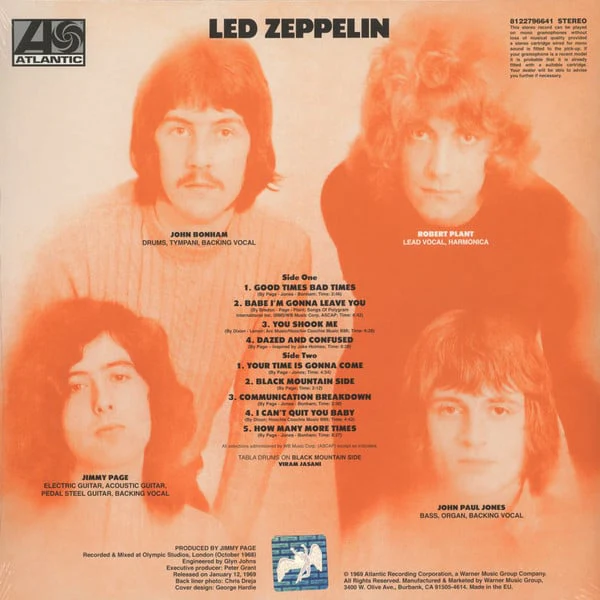
Not trying to shade on Chris, but I kind of hate the way they’re all looking at me here. I have this record on vinyl, and it used to sit at the very end of the stack in my cabinet, but I had to move it back because it genuinely started to creep me out. Okay, this is already too long; let’s get into some music.
We begin with the first of two singles, “Good Times, Bad Times.” I remember having a conversation with a live musician working on a train between a neighboring town and the Grand Canyon about this song. He was carrying an acoustic guitar, but I guess he taught the drums as well. He mentioned that this intro is one of the first he gives to new students. I can’t blame him; it’s a fabulous drum part. No hate to Neil Peart, but when I’m having the “best rock drummer” conversation, John Bonham will forever have my vote.
This works well as an opener; I think it tells you basically everything you need to know about the kind of music Led Zeppelin makes. Well, sort of, is it even really Zeppelin if they didn’t steal it?
Track 2 is a personal favorite, it’s Led Zeppelin’s take on the traditional folk song, “Babe, I’m Gonna Leave You.” I once heard this described as “the most Led Zeppelin song.” I have to say I agree; this has nearly every calling card.
Didn’t give credit to the original songwriter
Both acoustic & electric guitar
REALLY LOUD AND INTENSE VOCALS and then really quiet vocals you have to strain to hear
A whopping THIRTY uses of the word “babe/baby”
Correct me if I’m wrong, but I don’t think it gets more Zeppelin than that. You’ve reached peak Zeppelin.
But really, it’s a beautiful song. It’s not a perfect song; I think this is a great example of a young Led Zeppelin that’s onto something good, but they haven’t quite found their groove yet. You can acknowledge that all four members are exhibiting great talent, but they haven’t learned to harness it yet. They have no restraint, they’re getting so lost in it.
It’s common knowledge that Robert Plant had the voice of a generation, I don’t need to tell you that. But the ugly truth is that his vocals here sound, well, juvenile. I’m sorry, but they do. He never quite sounds like he knows where he’s going, just 0 to 100 whenever it feels right. But as true as that might be; it doesn’t ruin the song. My point is that he hasn’t really figured it out just yet, but he’s got enough charisma to excel anyway.
It was interesting to read what critics thought of him around the time of this album’s release. To summarize, he was not popular with everyone, and especially not with Rolling Stone magazine. While I wholeheartedly disagree, I’ll admit that I was amused to read “as foppish as Rod Stewart.” I guess it just goes to show that you never know what’ll be classic in the moment.
I think track 3, “You Shook Me” is criminally overlooked. The last bit is sort of hard to take seriously, that “sparring” that Jimmy and Robert were always doing both on stage and in the studio. They always called it “sparring”, I don’t know if I’d go that far. Then again, what else do you call that? But as silly as it sounds, it’s uniquely them and I think that’s what gives “You Shook Me” its charm.
Oh track 4, this one’s a doozy. It’s the legendary “Dazed and Confused.” I was delighted to learn just a few months ago that after fifty years, the original composer Jake Holmes is still fighting long and hard for sufficient credit. Jake had opened for the Yardbirds in … 1967? Don’t quote me on that, but I’m pretty sure it ‘67. Regardless, this was how, as Jake put it, “Dazed and Confused fell into the loving arms and hands of Jimmy Page." Jake has filed multiple lawsuits against Jimmy specifically regarding this song; the most recent of them coming to a close in August of this year. Beef concerning “Dazed and Confused” in the big ‘25? I just have to respect his dedication.
The original is hardly recognizable; the song has been altered so many times. It’s probably most famous for its use of the bowed electric guitar, which I’ll admit sounds really nice in this studio recording. But I’ll note that I think all you Jimmy Page supremacists that give him so much credit for this “avant-garde” technique should really give his live performances a listen. While the bow idea sounds good on paper, it’s harder to execute properly in practice. Again, great in the studio, but an offense to the ears in concert.
“Your Time Is Gonna Come” is pretty cool because it might be the only Led Zeppelin song to give all 4 members a vocal credit. It’s also got maybe my favorite John Paul Jones organ part, that first minute or so sounds heavenly. But it does have kind of confusing energy, like it can’t really decide what it’s trying to do. Is this rock n’ roll? Is it folk? What the hell is that organ doing here? Its ending is abrupt, I don’t think they make that work as well as The Beatles did in “I Want You (She’s So Heavy).” Yeah, this is a weird one alright, but I think I like it.
“Black Mountain Side” is entirely instrumental, it features only Jimmy alongside Viram Jasani on the “tabla.” I’d love to know exactly how he came to be there in the studio that day; he never came back. I guess this song was actually far more influential than I’d initially thought; it found its way to author William S. Burroughs in the early 70’s who suggested that Jimmy make a trip to Morocco and take a listen to the kind of music they were playing there. And I won’t get into that now, but his decision to do so would prove to be very important.
All that aside, this is a beautiful song. Not my favorite of their instrumentals, that will always go to “Bron-Yr-Aur”, but it might just be number 2.
Skipping forward a bit, they close with “How Many More Times.” Now listen, I like this song, but this just isn’t closer material. It’s got some nice bits, that bass line is nice and the bow is back. But it’s also 8 and a half minutes long, and it definitely didn’t need to be doing all that. However I will note that Robert name dropping himself will never not be funny to me. If it wasn’t already clear to you that this is a freshly 20 year old writing; it should be now.
So that wraps up Led Zeppelin’s thunderous, unforgettable debut. Like I said, it’s far from perfect. Its production isn’t nearly as good as what was to come, but it was early. It’s clear as day that if no one is there to pull Jimmy out of his trance, he’ll just keep going, getting messier and messier. There are moments that drag, and maybe some moments that could’ve been more. Let’s just say it would be a little while before they could really perfect this formula. But the formula is there, the talent is there, and it’s what makes this record enjoyable despite its many flaws.
Highlights:
Dazed And Confused
Babe, I’m Gonna Leave You
Black Mountain Side
Final Score: 8.5/10 (Great)
Part 2: “Untitled” / “Led Zeppelin IV” (1971)
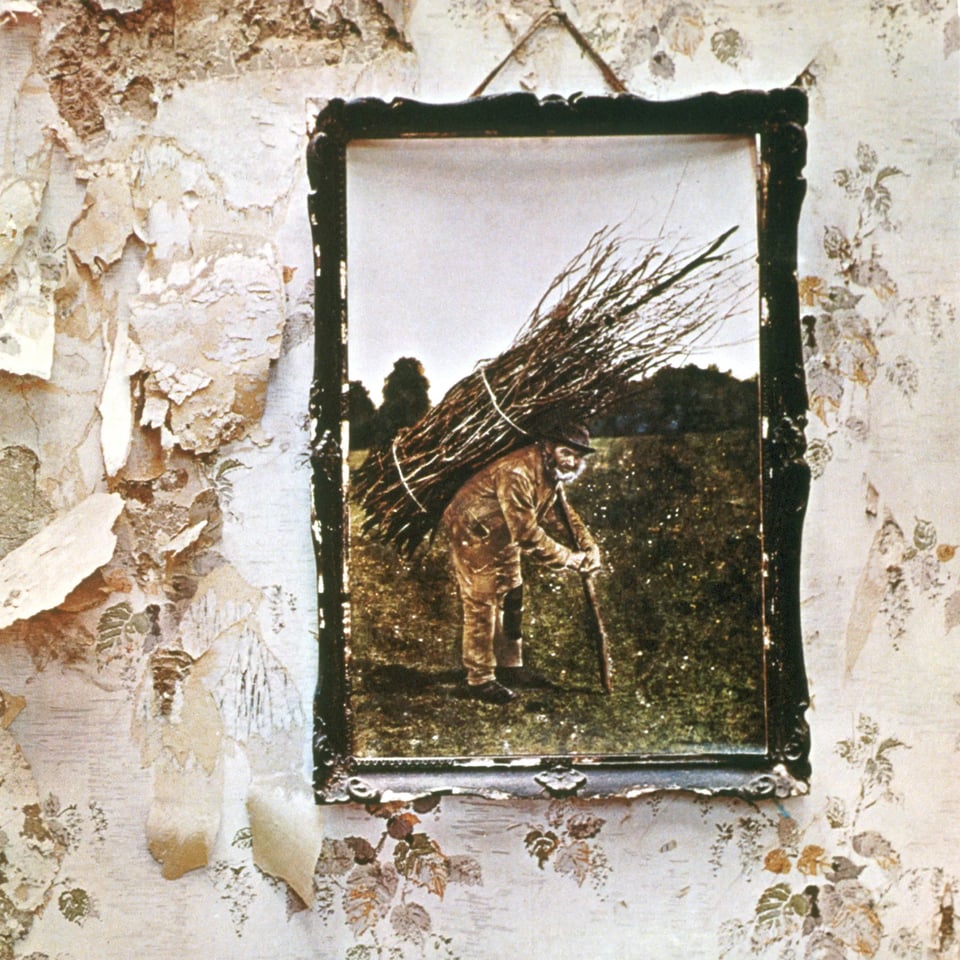
It’s just now come to my attention that this album was actually never called “Led Zeppelin IV.” It is completely without title; it has no name. How did I not know that?
Anyway, the year is 1971 (quite possibly the best year for music in my opinion), and Led Zeppelin has just released their 4th studio album. After a folky side quest with their previous record, “Led Zeppelin III”; it was time to find their roots again. Which is to say, it’s been a long time since they rock n’ rolled.
They open with “Black Dog”, an absolute classic. It’s a bit strange really, how the vocals and the instrumental (with the exception of the “chorus”) don’t overlap. You don’t hear that a lot, I think it’s pretty cool. I was more than a little disappointed to see that my search for “Black Dog” returned Taylor Swift’s “The Black Dog” before Led Zeppelin’s “Black Dog.” It’s a cruel world we live in. Robert tells a story about this song in which his daughter’s boyfriend came to dinner, just to inform him that there was an “accidental” 5/4 measure in “Black Dog.” He felt so wronged that he was compelled to unearth the record in hopes of proving the kid wrong. There really is a singular 5/4 measure; I suppose whether it was accidental is the question.

Track 2, “Rock And Roll” has a similar vibe. It was the product of a jam session, meaning it only took about 15 minutes to come together. That’s pretty amazing if you ask me. Last time I think I made an offhand comment about Rolling Stones co-founder Ian Stewart recording with Led Zeppelin a few times; well here he is. His part is simple, but I like it. Despite not knowing what he’s actually saying most of the time; I do enjoy Robert’s vocal performance. I struggle to wrap my head around a man hitting those kinds of notes. Well, hitting them most of the time, This melody is so high that he would often take it down the octave live.
When I last reviewed this record in October of last year, I confused this next track, “The Battle of Evermore”, with “Misty Mountain Hop.” This made it awkward when I was alluding to this “female singer”, whilst presumably meaning “Misty Mountain Hop.” I received a comment on that review asking if I was simply mistaken or if I was trying to imply that Robert Plant sounds like a woman. I was of course mistaken, I don’t have to imply that Robert Plant sounds like a woman, I can just say that. And he does.
Regardless, this time around I am not mistaken. I am indeed talking about track 3, “The Battle of Evermore”, featuring a female singer, Sandy Denny. I absolutely love Sandy’s voice; it’s a real shame she died so young. I think she was the perfect choice for this song, I actually find her voice rather similar to Robert’s. I love that “The Battle of Evermore” essentially only exists because Jimmy stole a mandolin from John Paul Jones. These guys must’ve loved stealing so much, they even stole from each other! All jokes aside, I think John’s the better mandolin player, but I do really like this riff. And here’s a little something to brighten your day; this was Sandy’s first and last collaboration with Led Zeppelin, but they gave her a matching symbol to say thank you.

Okay, it’s time for the big one; it’s track 4, “Stairway to Heaven.” This remains their biggest hit, although not their highest charting. That’s most likely because their manager Peter Grant refused time and time again to release it as a single. Now this is a perfect song; everybody loves “Stairway to Heaven.” Well, everybody but the man that wrote it of course. I will never understand Robert’s disdain for this song. You have to have a special kind of hatred in your heart to pay your favorite radio station 10,000 dollars not to play your song.
I suppose he isn’t the only one, those in cahoots with “Praise the Lord” probably aren’t huge fans either. If that story has somehow not reached you; “Praise the Lord” was a television program hosted by Evangelist christian Paul Crouch. Paul was very adamant in his belief that “Stairway to Heaven” was one of many popular rock songs to contain hidden satanic messages that would reveal themselves when played backwards; this is called “back-masking.”
The Original Segment:
“If there’s a bustle in your hedgerow, don’t be alarmed now;
it’s just a spring clean for the May queen.
Yes, there are two paths you can go by, but in the long run,
there’s still time to change the road you’re on.”
The Segment Played Backwards:
“Here's to my sweet Satan;
the one whose little path would make me sad,
whose power is Satan.
He'll give you, he'll give you 666
There was a little tool shed where he made us suffer,
sad Satan.”
The whole thing is completely ridiculous obviously, but it’s kind of funny to hear anyway. Like I said, it’s a perfect song, and I’m sure I don’t have to convince you of that. I know because even my friends that refuse to touch anything that didn’t come out of Korea in the last five years like this song. It’s a full 8 minutes long and they don’t even mind.
Fast forwarding just a little, I’d like to talk about track 7, “Going to California.” I’ll tell you this much; the youths just love this song. Dare I say they love it more than “Stairway to Heaven?” I do dare; because they definitely do. And I can’t really blame them; it’s a beautiful song. It’s a wonderful tribute to possibly the only artist that all of Led Zeppelin can agree to liking, that being Joni Mitchell. “Going to California” was is first Led Zeppelin song I can remember hearing. I thought it was great, but I’m a little ashamed to admit that I wasn’t paying all that much attention, and I whole heartedly believed for many years that the band who made “Going to California” and Led Zeppelin had nothing to do with each other.
I might love this instrumental that you can find isolated on the deluxe edition of this album more than the original. As great as the original may be; I just love that mandolin, and you can hear it so clearly when you remove those vocals.
And finally, let’s talk about that closer, track 8, “When the Levee Breaks.” This might be my favorite Zeppelin tune, although calling it a Zeppelin tune might be disingenuous because it’s a very blatant rip off of an old Memphis Minnie song. But it very well may be the best cover I’ve heard, neck and neck with Johnny Cash’s “Hurt” of course. They’ve reworked it wonderfully, it’s truly the perfect way to end this record. As simple as that drum part may sound, it’s so effective; I love it. I remember having a conversation with a similarly music obsessed friend, but not this kind of music, about what producers and engineers really do. She didn’t really get it, so I gave her this song as an example. The way they recorded and produced this song is so fascinating to me, and I think it really changed the final product in a noticeable way, which isn’t always the case. So here are my favorite details about the recording and production of “When the Levee Breaks.”
We were only about 10 seconds into the song before my friend said to me “that sounds nothing like a harmonica.” And she was right; it really doesn’t. And that’s because during mixing, they added what’s called a “reverse echo effect.” So what you’re hearing first is the echo of the harmonica rather than the source of the sound.
Those drums sound the way they do because they were recorded using two microphones that were suspended above a flight of stairs.
The song’s got that sludgy sort of feeling because various segments were recorded at a higher speed and slowed during production; I think you can really hear it in that harmonica part.
They used panning, a production technique that gives the illusion of hearing various sounds to the left, right, or center, towards the end of the song, which gives the impression that the vocals are stationary while the instrumental is moving around them.
For as much credit as Jimmy Page is given concerning his work as a guitarist; I don’t think he’s given nearly enough for his work as a producer. I love reading about the process of creating this song specifically; I find it so endlessly interesting.
So that’s it; after an unforgettable 42 minutes, Led Zeppelin’s magnum opus comes to a close. If you were to ask me, I’d probably say this is their best work, but I think you could make an argument for this next album, so I’ll try.
Highlights:
When the Levee Breaks
Stairway to Heaven
Going to California
Final Score: 10/10 (Perfect)
Part 3: “Physical Graffiti” (1975)
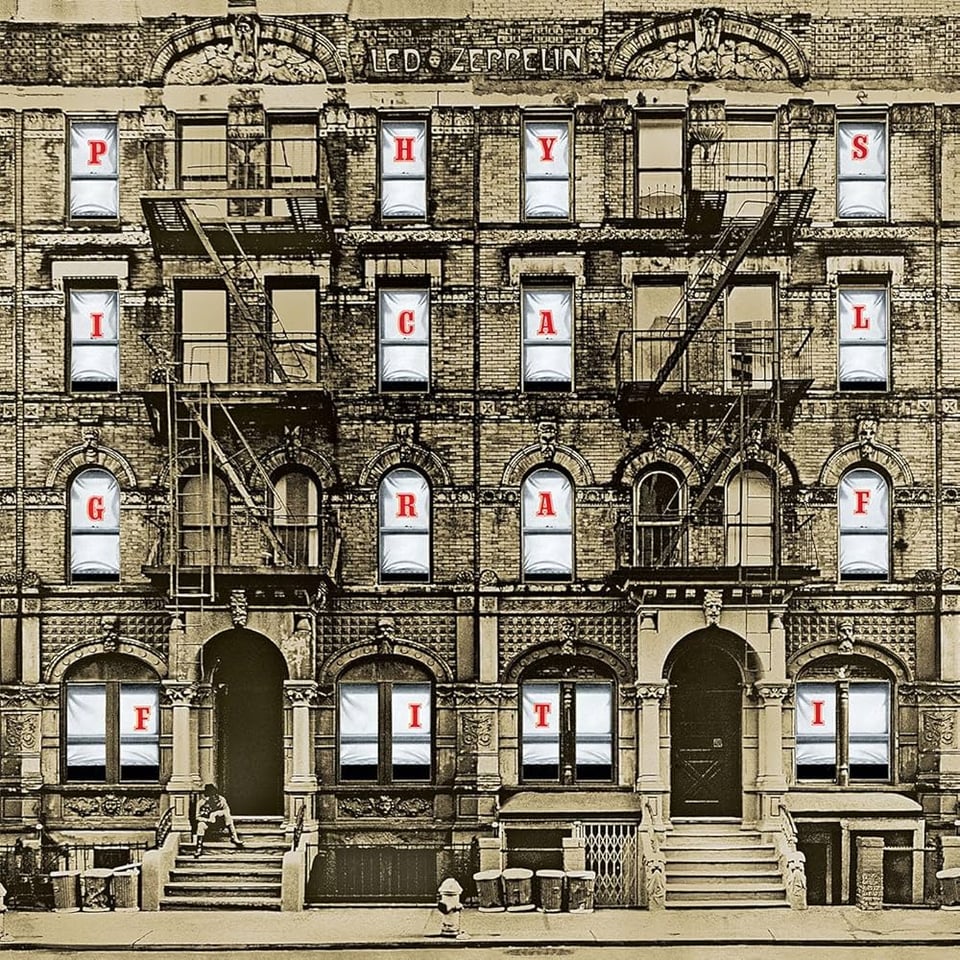
I never thought I’d see the day they finally put their heads together and thought of a title that didn’t include “Led Zeppelin.” (their previous record also had a real name, but we aren’t here to talk about “Houses of the Holy”) But here it is; the year is 1975 and Led Zeppelin has released their sixth studio album, “Physical Graffiti.”
Was this the last good Zeppelin album? Some would say yes; I would say no. But I would say that it’s the last great Zeppelin album. So why waste any more time; let’s talk about it, shall we?
This is a double album, and side one begins with “Custard Pie.” As frankly disgusting as its lyrics are, I really enjoy this one. It sets the energy nicely; that harmonica is back which I like. It features something called a “clavinet”, which I don’t think I’d heard of until now, but it sounds great.
Track 3, “In My Time of Dying” is by far the longest of Led Zeppelin’s catalogue (excluding live recordings like their 30 minute rendition of “Dazed and Confused”), coming in at just over 11 minutes. I love this song, it does take concentration to give it your full attention for its lengthy runtime, but it’s worth it. There’s a documentary called “It Might Get Loud” that gets three famous guitarists together to talk about their most successful songs, those guitarists being The Edge (U2), Jack White (The White Stripes), and of course Jimmy Page. One of my favorite scenes from that documentary is essentially just 3 minutes of those three messing around with the slide guitar portion of “In My Time of Dying.” Here’s the link to that scene if I’ve managed to pique your interest.
Seeing clips from that documentary, or really just modern clips of classic guitarists period is always so funny to me. Jimmy especially has such distinct mannerisms while on stage that made him look pretty cool at 20-something, and it’s amusing to see that those mannerisms never really went away, just now look very out of place on a pushing-82-year-old. I guess you’re never too old to rock n’ roll, but I can’t help but smile every time.
Back to “In My Time of Dying” though; this was the last song Chris Cornell sang before his death in 2017, if you haven’t given that performance a listen; I’d encourage you to do so. That one hits hard knowing it was his last.
Despite its streaming numbers, I don’t think I hear nearly enough about track 5, “Trampled Under Foot.” This might just be my number 1 pick for “Physical Graffiti.” It’s super catchy, it’s far easier to digest than something like “In My Time of Dying”, and it’s got a funky vibe to it whilst staying true to the Zeppelin feel. Can I understand a word Robert is saying? Absolutely not! But whoever said that was necessary? Not me, I can tell you that for free.
“Kashmir” is the obvious highlight, but I’ll have you know this one took a good while to grow on me. I came across it on my own knowing it was a fan favorite, but it was unlike anything I’d heard before at the time, and maybe that’s why I didn’t initially love it. Remember when I told you that William S. Burroughs telling Jimmy to go to Morocco would be important? Here’s where that comes in. He did in fact go to Morocco, and he took Robert with him. (why spend your breaks between tours with your family that you never see, when you could spend it traveling tent to tent through the middle of no where with your bandmate?) Well they ended up liking it so much that they were inspired to create this eight and a half minute musical epic. And they didn’t bother stopping there, because they would write yet another musical epic about their journeys (“Achilles Last Stand”, 1976), that one exceeding ten minutes.
But they call it an epic for good reason; it is indeed epic. Everything about this song is epic, that heavy riff (who knew strings could be heavy?), the horns (since when does Led Zeppelin use horns?), those wailing vocals that I really hated the first time around, those drums holding it all together, it’s all epic. It was risky, being a very guitar-centric band and mixing just about everything, horns and all, above your guitarist. But it totally worked, and I don’t think even the most accurate of Zeppelin copycats (*cough* *cough* Greta Van Fleet) have ever come close to replicating it.
Side 2’s got another personal favorite that I’m pretty sure I’ve mentioned, it’s “Bron-Yr-Aur.” Never before have I been so captivated by a single acoustic guitar. I will sit through these 2 minutes regardless of what I’ve got going on; I am never too busy for “Bron-Yr-Aur.” That final chord with all that reverb just kills me every time.
I really enjoy track 9, “Down By the Seaside.” The tremolo effect is quite cool. I have no idea why it doesn’t get more attention, it’s definitely a highlight for me.
And look who’s back on track 13, it’s Ian Stewart! The song is so appropriately named “Boogie with Stu.” Again, I feel this one is overlooked; maybe I’m just a sucker for a mandolin solo. It’s also another very blatant rip off, I don’t even think they’re trying to hide it this time around.
They close this album with quite possibly my least favorite of their songs, it’s “Sick Again.” And that’s not because I think it’s bad; its lyrics are just very … of their time. I’ve done my research; I know logically that the song was written as more of a critique of what was happening at the time. But those words are just so disgusting; I really can’t bear to listen to it. So instead I choose to pretend it doesn’t exist; in my head “Black Country Woman” is “Physical Graffiti”’s final track. The suggestions box is closed, I will not be taking criticism at this time, I am perfectly happy living in my delusion.
I could’ve made this last section a whole lot longer, but this is already my longest entry, it’s time to wrap it up. In conclusion, this is a phenomenal album. It’s Led Zeppelin at their creative peak; they have perfected their sound; there is nothing to improve on here. (I’m not looking at you “Sick Again”; I do not see you)
Highlights:
Trampled Under Foot
Kashmir
Bron-Yr-Aur
Final Score: 9.5/10 (Amazing)
Wow, are you really still here? If you just read all of that; thank you for listening. Like I said, this is my longest entry yet; I guess I had a lot to say. And hopefully I have a lot more to say when I’m back here next time to talk about … okay this is usually when I tell you what I’m doing next, but I’ll be honest, I have actually no idea what I’m doing next. I have so many ideas; it’s just a matter of picking one. Well, this is awkward. See you next time I guess. :)
-
Love your final score
-
I don't care how long your pieces are, so long as they are entertaining and informative reads, I will keep reading.
Loved this entry into your series. I love Led Zeppelin and of course have all of their studio releases. The funny thing is, I don't tend to listen to them nearly as much as my love for the band might suggest.
"Runes", "Untitled" or "Led Zeppelin IV" or whatever way you choose to identify it is my favorite from their discography and the one I listen to in full most often. And yes, "Stairway to Heaven" is the perfect song. And the cover that Ann and Nancy Wilson from Heart did at the Kennedy Center Honors is probably the most stunning cover of the song as well. Everything works with both the song and with the album as a whole.
And I love "Going to California" as well. While I can't carry a tune in a bucket, the opening part of the lyrics/vocals of that song always find me singing along (so long as nobody is around to her the off-key bleating).
I need to go back and listen to the songs you found the lyrics so disgusting to deal with. Maybe from all the times I have listened to the songs I just don't hear it anymore. Be fun to see if I say, "WHAT THE HELL?" or just shrug and move past it. Given time, I may even go ahead and do a re-listen to the whole studio catalog with a critical ear towards what I'm hearing.
I never saw Led Zeppelin in concert. I was just 9 when they broke up after John Bonham's death. But I did see Robert Plant in a solo show. But I tell you, I would have loved to see them live at the peak of their powers.
-
↳ In reply to Jay
I saw Heart do "Going to California" and "The Ocean" live a few months back; there's truly no group that can do a Led Zeppelin cover better than they can.
-
I just wanted to conform that I have done the research, and you are factually correct that John Bonham is the greatest rock drummer ever. That is all.
Oh, and that even the mighty Led Zep had trouble with the squirrely John Paul Jones lick that propels Black Dog.
https://www.youtube.com/watch?v=KoTUuEPPvRM
-
↳ In reply to Jonathan Feinberg
Of course I'm factually correct. He was obviously the greatest; there was never any question.
-
Wow, what a write-up! Look at you using semi-colons. weeps with joy
I think this may be your best essay illustrating a group's progression over time. Really fascinating stuff. I agree with the consensus that John Bonham is an ace drummer. Tell me, though, did he ever throw anyone in a pool?
I am the person who doesn't love "Stairway to Heaven." I like "Stairway to Heaven," but I do not loooove it. "Going to California" is probably my favorite, but I also love "Kashmir," "Black Dog" and "When the Levee Breaks." I also like "Fool in the Rain" a lot more than you do. And wasn't there some lemon song? ;)
I tee-hee'd at your joke about them even stealing from each other. They certainly did rip off a lot of earlier musicans, but they stole some really great stuff.
-
↳ In reply to Joanna
John Bonham would NEVER throw someone in a pool. ESPECIALLY not a former Beatle. And ESPECIALLY not his band-mates. Well, not unless someone came for his birthday cake. Then maybe he would.
Add a comment: