022326 / REHEARSING OTHERWISE
REHEARSING OTHERWISE is a series where I share experiments in writing rooted in black study1. These are dispatches from the rituals of play I facilitate in my own writing practice, embodying disobedience (or, dis-embodying obedience)2 through methods of reading and writing Otherwise34. I publish these tangential5 drafts with commentary as a gesture toward the revision process.
For this rehearsal, I’ll be focused on reading Otherwise, using prompts6 to respond to the text chosen below.
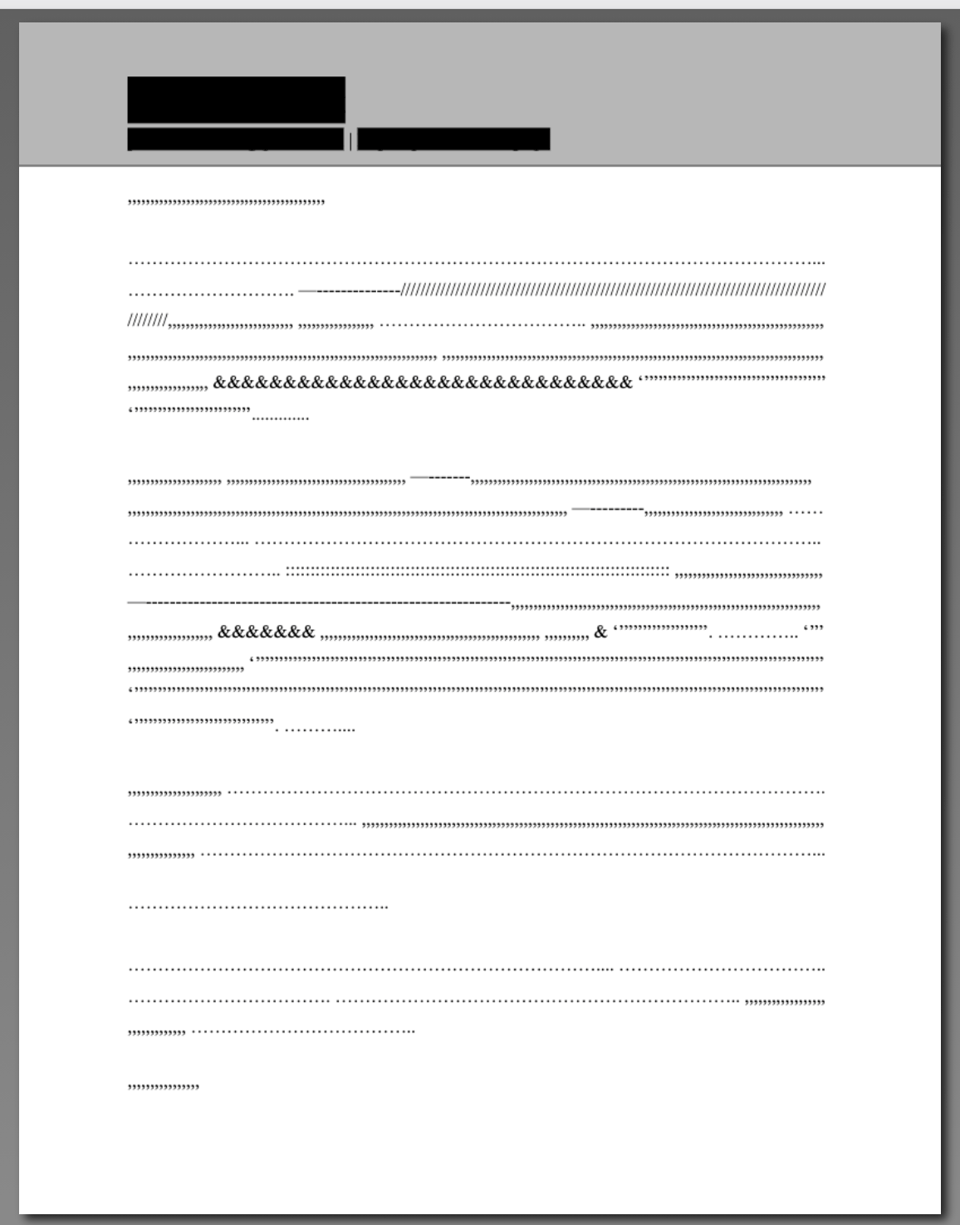
[The text: A digital photo of a job application cover letter with redactions and revisions to the words. Black boxes cover name and contact information, while the words in the letter are replaced with long strings of punctuation. The spacing of the letter remains intact, as if you could read it as it was originally written.]
How do you write non-readability into the text?
As someone who writes in their art practice, formal writing for the audience of “person at an organization that I’m trying to convince to give me money but I might never hear from” can feel in competition with y’know, just writing what I want to and sharing it anyway. As if my creative expression, through writing, is some scarce resource. But that is, in fact, a tension to lean into. What if that competitive insecurity was not truly mine? What if there is enough of my creative energy to go around? Some for you, but definitely enough for me. In this case, I considered that I may want to document having gone through this tense writing process, to use what was left as a source material. After rounds of finishing applications and cover letters for them, I was curious how much space punctuation would take up if the legible words weren’t there. What if the words were covering up an abundant layer of connections underneath? How might I reveal that?
How do we read a text without seeking ourselves? What does it mean to go into a text seeking Other things versus only a reflection of Self?
I actually see so much of myself in this text. I’m sure this comes from the fact that I’m interacting with my own material, though it’s interesting to consider how I read a maintenance of Self in the before (legible writing) as well as the after (illegible documentation). The clear language I originally wrote had its purpose: I needed to be understood, I needed to quote-unquote be myself. And yet, something more generous has happened when choosing to push beyond that formality. There actually might be more of my Self waiting on the Other side of clarity.
In the reading process what brings you pleasure?
Something about the repetition of the ampersand is appealing to me. Um, and texture—gorgeous textures!
Thanks for rehearsing & studying alongside me,
— Paris
“…there is a distinction to be made between black studies and black study. Despite its radical origins, Black Studies as an academic discipline is now assimilated into the corporate university and too often reduced to performative reform. Alternatively, study is ‘a mode of thinking with others separate from the thinking that the institution requires of you.’ As a mode of practice, as Stefano Harney puts it, study is happening with and against the university and, most importantly, outside the university…I would posit that black study is the practice of refusal of Western civilization.“ — djones, Black Study as Practice: Claiming the B-Side as Black Study. (2023). ↩
“There remains some aspect of my speaking that expects a different mode of expression than English provides…This comes from a desire to resist assimilation, but equally, it arises out of a sense of exploration or adventure, a sense of puzzlement: as if something has happened to my occupation of the language, where a kind of split occurs. I move through it and see myself moving at the same time. It’s a double consciousness, a questioning that simultanates my rendering of experience.“ — Renee Gladman, The Sentence as a Space for Living: Prose Architecture ↩
I came into the concept and praxis of ‘Reading Otherwise’ through Kameelah Janan Rasheed’s Keynote on Visibility for Center of Book Arts 2022 Conference. ↩
“I think these ideas of world building really gives this freedom of also trusting what you already know and what you're already carrying, but also try to imagine other ways of being together, or other ways of encountering something. …thinking about alternative histories that is not through the lens of colonialism…there’s always a possibility to think of other ways of being together.” — Sandra Mujinga, “"I cheer for the monsters." | Artist Sandra Mujinga | Louisiana Channel.“ (2023). ↩
“A tangent can be a generative digression that invites learning or an abrupt change in course that introduces you to new ideas. Tangents are not mistakes rather, they are offerings…A tangent is a form of waywardness…” — Kameelah Janan Rasheed for Orange Tangent Study ↩
see footnote 3 ↩