
Artefact 261

Attention please
Mr Stephen P. Anderson, fellow Cardstock wrangler, writes a mean newsletter. They are always full to the brim with things. This was his latest edition.

One item in particular drew my attention. I have duplicated it here fully, for context:
—
Excerpt from Mighty Minds Club No 117
Whatever your thoughts on Jonathan Haidt, I think we can all agree with the one thing he asks us to remember from his graduation speech at NYU 2026 [LI]:
« Treasure your attention »
Bonus points for the shout out to poet Mary Oliver and her poem Instructions for living a life:
Pay attention.
Be astonished.
Tell about it.That’s it. That’s the poem.
Pretty cool, huh?
—
I was struck in particular by the bravery and panache of writing a three-line poem. And given the topic, I’m not surprised it has garnered attention, especially in the spring where if you mention AI as a positive future for students, you should expect booing.

Now (perhaps ironically) I’ve never really paid much attention to Jonathan Haidt. He was not a wholly popular choice of speaker with students it would seem.
But to learn more about the poem in context, I followed Stephen’s link over to the video.
There Jonathan Haidt is, giving the graduation speech at Yankee Stadium for NYU’s 2026 commencement. The 2024 ceremony had a crowd of around 40,000 at the same venue, so I’m guessing this would be of a comparable size.
It’s a big crowd. It’s being filmed. You would do the work, I’m sure, thinking about tone, content, invitation, checking sources. That kind of thing.
Here’s what he says about the poem:
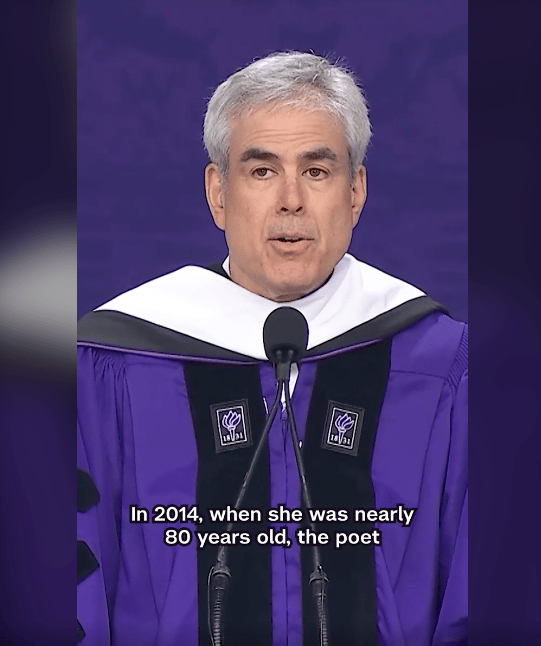
“In 2014, when she was nearly 80 years old, the poet Mary Oliver wrote a short poem titled “Instructions for Living a Life”. It goes like this:
“Pay Attention.
Be Astonished.
Tell about it.”It sounds simple, but paying attention is in fact one of the most challenging and meaningful things you can do.”
—
There it is, confirmed again. A complete poem.
Three lines, seven words, titled “Instructions for Living a Life”, about the importance of paying attention.
Like a Buddy Holly pop song, it is hard to believe something with such weight of meaning and clarity of thought can be over so briefly. Perhaps we are witnessing to benefits of age and experience; when we get to 80 years old, we have the confidence in our writing to say so little yet mean so much.
Yet, I found myself with a familiar, useful question I’ve employed for the last five years or so; Where did that come from?
I knew nothing of this poem, nor Mary Oliver. I decided to follow Jonathan and Stephen down the rabbit hole.
Just imagine what else she might have written if this short masterpiece is one of her famous poems.
Except, of course, it isn’t.
When you go looking, you find out something different.
What is being described as a poem in its own right is actually a stanza from one of Mary Oliver’s poems called Sometimes. It was included in her 2017 book called Devotions.
Here’s a copy of the full thing:
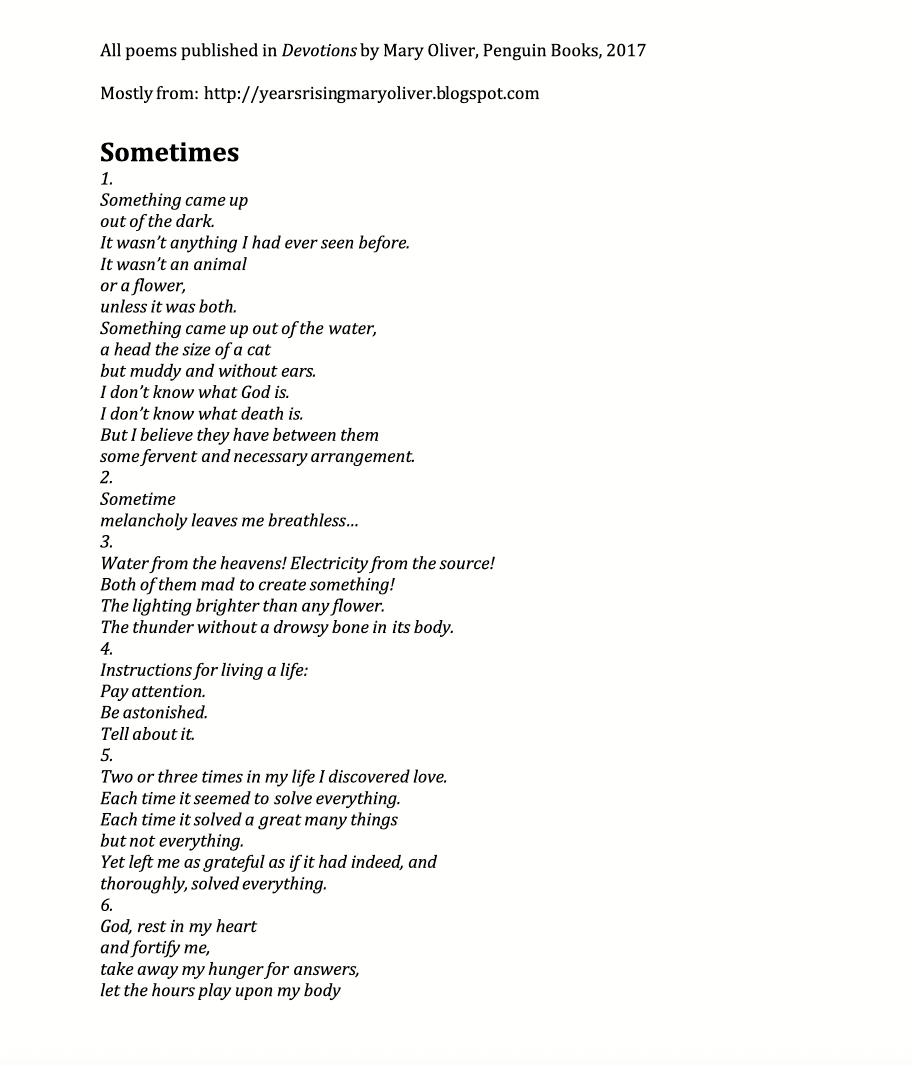
The so-called title of the poem isn’t “Instructions for living a life”, that’s just the first line of the stanza.
The lines themselves hide away in the undergrowth of the poem, discovered eventually in the way that one might find a rare moth caterpillar on the underside of a leaf. Mary Oliver makes you hunt hard for this truth, camouflaged amongst the mystery and religion, love and regret.
The poem, Sometimes, might be your kind of thing, or it might not. And that’s ok. This is not a poetry club.
But her poem is the whole thing. The excerpt is just that, and the context it is robbed of by pretending otherwise matters.
Where did that come from?
Pay attention.
In the first step, I can clearly see where Stephen got the idea that the poem was just these three lines; If Jonathan chooses to stand up in front of 40,000 people to lecture them on the importance of paying attention, then it’s a fair assumption he might have fact-checked his own speech.
The second step - where Jonathan got this information - is harder to ascertain. But by working a little with what we still have of the free and interesting internet, we can make some reasonable leaps.
We start to get to an interesting root cause of this case of the shortenings from when Oprah Winfrey featured Devotions for her book club in November 2020.
One of the promotional Facebook posts at this time is here:
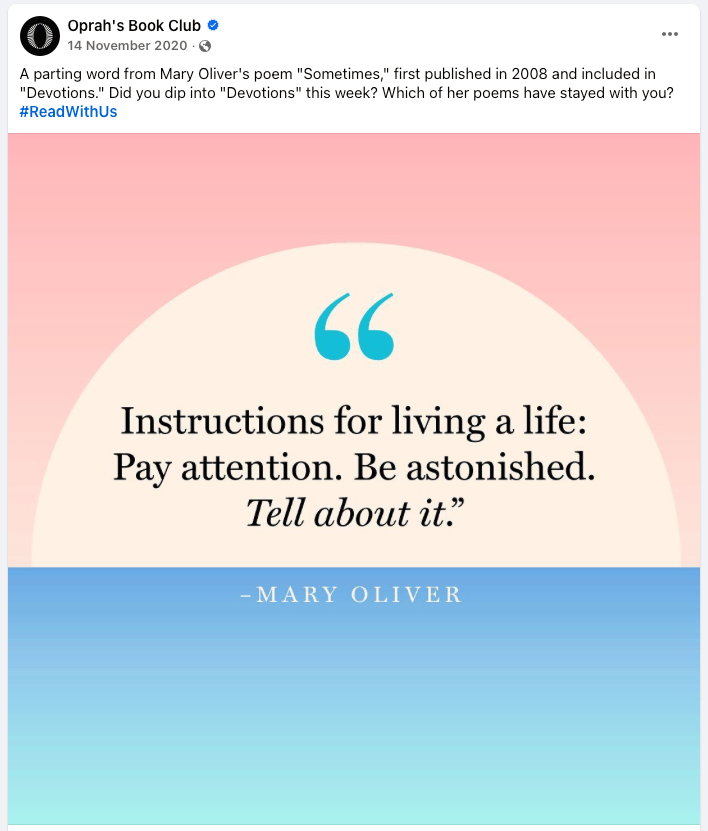
So it’s a ‘parting word from’ the whole poem, not saying that the poem is complete in this form.
Of course where Oprah goes, millions follow.
The endless imitations available when you look for “Mary Oliver - Pay Attention“ in an image search brings us this:
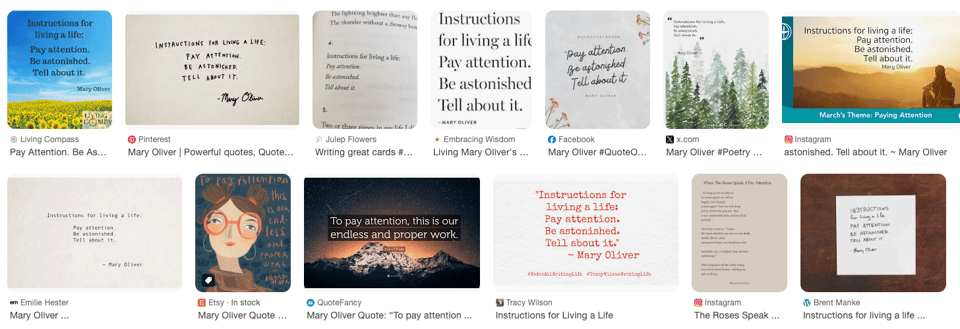
You could probably fill your house with Etsy versions of the three-line poem should you want. And you’d still be none the wiser that it was part of a larger poem.
This has a meaningful effect on the perception of the poem most specifically in the age of LLMs.
In text, and in the image descriptions and alt-text, a pattern starts to build up where the three lines are divorced from the larger work, and the title itself. They take on a new form, shaping reality differently.
Today, on the 27th May 2026, if I search for “mary oliver instructions for living a life”, this appears at the top of Google:
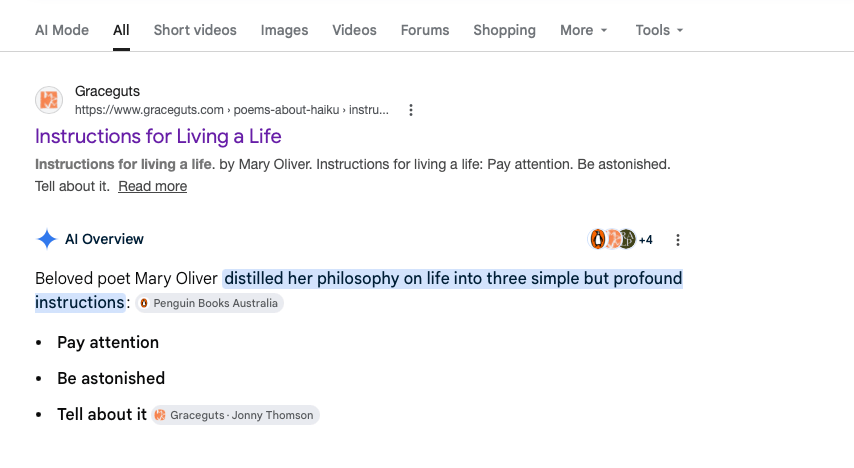
What is our investigation telling us, then? That even if you do a cursory check on google - the majority’s search engine of choice - depending on what you type you will get back a link to a page, and an AI summary, that indicates that this is a complete poem in its own right.
Where did that come from?
We need to ask this more than ever, about everything.
Here’s something that might help.
A while back now, I started working on a general principle of thinking about information as light, not liquid. A millions pixels on a screen, not a million drops in a barrel. Endlessly recombinant.
One of frameworks that helps bring this to life for individuals, teams or businesses is something I called ‘Moments of Enlightenment’.
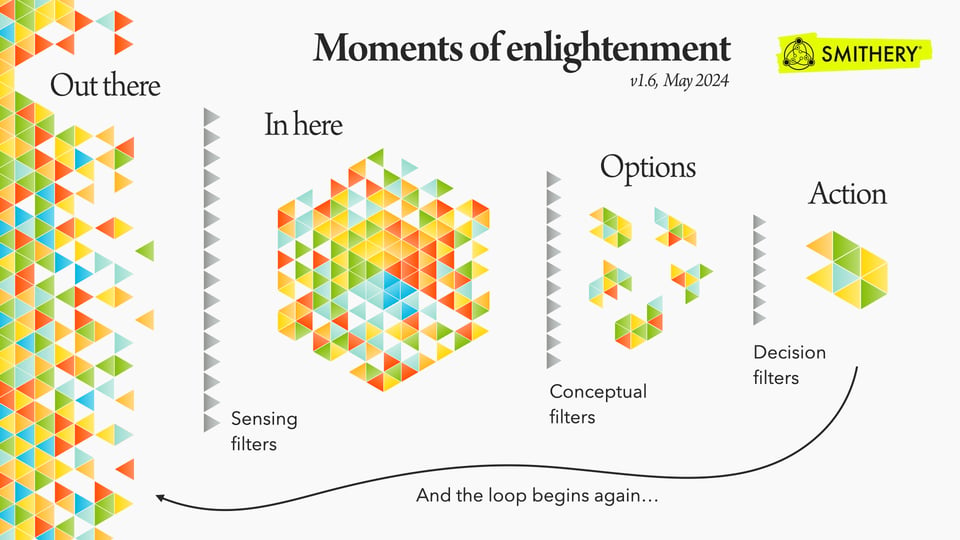
Essentially, you have all these potential pieces of information ‘out there’ in the world. You can’t hope to collect them all. It is an impossible task.
So – and with varying degrees of intentionality – we all have a series of sensing filters. You will pay attention to particular things, but ignore everything else. These come together ‘in here’ - your internal model of how the world works.
Given that version of reality, you then also have a set of conceptual filters. What options would we typically have in a given context? Some things could work, others won’t. Lots you will have never thought of.
Finally, which action will you choose to take? Well, experience, understanding, gut feeling and more can shape your decision filters. What will work round here?
Then of course all this goes back around to the beginning, and the process starts again. If you’re making something new in the world, it’s really important to think about if your sensing filters are being tuned to pick it up.
This is a general framework for everything that requires teams to be joking with information, of course.
But more recently, it became a useful way of asking people the key question in LLMS - Where did that come from?
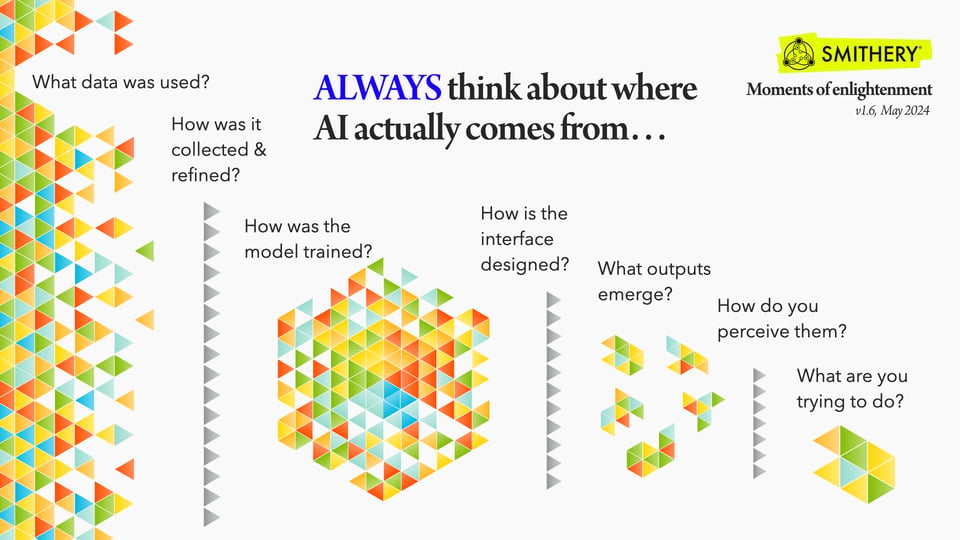
Let’s take the example of Mary Oliver’s poem.
What data was used? Well, likely lots of things that exist on the internet, which is we have seen to be not the most reliable data set imaginable.
How was it collected and refined? Well, it was all done at scale - whilst larger data sets can be cleaned for more problematic issues, the ‘misattribution of a poem’ seems to be really low stakes to be bothering with. Anything that links the tokens of these words, the three lines and the authors name, are probably in the training data - and with a much greater frequency that the original poem.
How was the model trained? Well, to put it simply, by analysing how often words appear next to each other in different contexts, and creating a probabilistic model than can guess what the most likely words around each other will be. Whatever you point that LLM at in future, it always bears the hallmarks of its training data, whether that’s an overbearing love of owls or political ideologies.
How is the interface designed? This gets us into really interesting territory, and I want to break out two things.
Generally, when we are thinking about direct interfaces with a Claude or ChatGPT, the ‘chatbot’ interface feels qualitative in nature, pulling at our most human qualities. When it represents a type of quantitative data that we’ve never had a way of working with before. That’s a topic for another day though. But the AI chatbot has a form, and there’s a general understanding of what might be going on as time passes.
In the terms of a Google search, though, we are mapping a new interface into the place that an old one used to be. Most people ask a question in a search bar, and expect a series of links that a better match for the answer we are looking for the higher up they appear.
A search interface that returns an LLM answer breaks the understand most people have. And you have to keep remembering this, every time you search for information.
Because it is very easy to glance past the ‘AI Overview’ message and just think ‘well, this is probably a good enough answer, isn’t it?’.
You have an answer, but not the thinking. Cognitive Debt, etc.
It’s not your fault the information sources you used to rely on so readily have broken. But it is your responsibility to navigate this with care.
Always ask; where did that come from?
Go looking.
And as Mary Oliver said:
Pay Attention.
Epilogue
I wanted to send this newsletter across to Stephen before it went out, just to check he was fine with it all. He has kindly shared the process he went through to, which is super useful for our detective work:
I usually do some cursory fact checking, which I did here. I know enough to not trust the AI summaries, but I still have some trust in web pages from a seemingly reputable source.
To verify that this was, in fact, only 3 lines—something I was curious about and wanted to confirm—I clicked through to one of the top search results.
Based on Haidt’s speech, I used “Instructions for Living a Life” as the title of the poem, which is incorrect as “Sometimes” is the actual title. This incorrect title of course led me to a page where the ‘entirety’ of the poem is presented as only those three lines. I guess a cursory check wasn’t enough in this case!
Stephen also said this - “you can characterise me as being embarrassed 😉”.
But I don’t think there is anything for any of us to feel embarrassed about.
The tools, methods and mindsets we have collective developed over the last two decades to navigate the greatest information network ever made are no longer entirely first for purpose.
Only by experimenting and sharing successful new approaches as well as the failures can we successfully shape new practices.
If you can successfully answer the question ‘where did that come from?’, it will help you better see where you might be going…
John V Willshire
27.05.26