
Artefact 258
Estates of the Nation
Today I’m wanted to talk about two estates.
One is the housing estate where we live. The other is an industrial estate where I ended up, unexpectedly, for a large part of Monday.
I wrote about the latter after I got home that afternoon. The rage and disbelief has subsided somewhat, you’ll be pleased to know. First though, the happier, homelier story.
Our Nature Watch
I don’t know when we are meant to stop referring to the place we live as a ‘new build’ housing estate. When is a new car not a new car anymore? Or when does your new jacket just become ‘my jacket’? Perhaps it is at the point where you have enough stories about it to make it definably yours?
Anyway, we have lots of stories about it now, having lived here for ten years this spring. Most specifically, we have lots of stories about the garden and green spaces around us.
I first started talking about our garden rewilding project as part of my 2024 talk at UX London (the 2026 edition is coming up June). It was as an example of where anyone who works in design might apply themselves to bigger, more local problems with the skills they have learned over the years.
But I never really considered that I might one day give a talk wholly about the garden project, and the local nature group that came from it. But that’s what happened in January this year at Wilding Gardens - my talk’s now up online too:
This comes to mind because yesterday was our annual estate AGM. We have an AGM because our estate is one of the new kinds of developments that have emerged in the last 15 years where the local council do not adopt the maintenance of roads, lighting and sewers. Instead a group of volunteer directors are charged with appointing a management company to collect fees from all residents, and carry out maintenance and repairs to the local infrastructure.
Broadly, these types of schemes seem terrible. Reform of the system seems imminent.
Specifically, where we live, the volunteer board does a terrific job. We’re beginning to learn that there are interesting local things we can do that other communities might not be able to.
I think of the Nature Watch group as a vehicle for experiments and designs that help people support the natural world in different ways - design as a demonstrator, showing people a change, and helping them think through the implications - e.g. drilling a hole through a garden wall and tracking how quickly it brings hedgehogs in.
Thinking about design in this really small way also lets others think about what small experiments they might try, and what it could lead to.
Overall, working locally like this also makes for a fairly simply introduction to the regenerative entanglement of the social, economic and environmental that every place is faced with reconciling to some extent. Given a fixed annual budget, what might we be able to do together as stewards of a place to support nature more.
At the moment, all this is still a local project, but I’m keen to extend what we’re learning here into some project work that can help scale up the effects of the work. If you know hear of anything that could help us do this, do drop me a note.
Dartford, Crossly*
Note; I’m leaving written in the original tense of when I wrote it on Monday this week.
Well, good day to you.
And I hope your day has been better than mine.
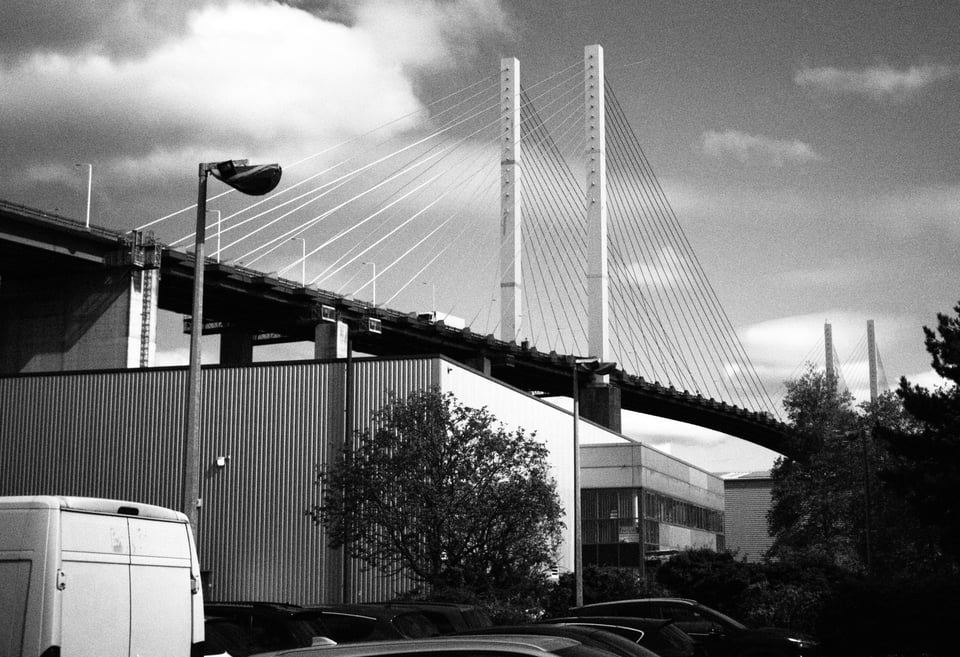
Because this morning, at 9:37am, I was in the middle of an industrial estate beneath the Dartford Crossing flyover, struggling to get a thing that wasn’t there to a place where it should have been.
This is not a newsletter I was planning to write today. Nor is it necessarily the kind of newsletter that is easy to pull off without sounding like a jerk, woven as it is from a day of complaints, exasperation and disbelief.
Yet I have had some time since the lows of the day to reflect on what happened, and what it might imply more widely about the moment we’re in.
In short, I’m trying to see what good I might be able to maximise from the events of this unexpected foray into Kent of all places…
Making the easy difficult
As a few of you may know, we make custom runs of Artefact Cards for people for use in their events, workshops etc.
Gemma and Dan over at nuture are big fans, and asked if we could help them sort some branded cards for a client event they had today. This shouldn’t have been a problem, and the Artefact Cards were all printed and ready for last week, packed in Axminster for DHL to pick up on Thursday.
Which DHL didn’t do. We still haven’t heard why.
They did come and collect them on Friday, however, promising a Saturday delivery to an easy to find central London hotel.
You might forgive me for assuming that the thing they said would happen, would then happen. But events thereafter remain… unclear.
The hotel say that nobody came to the front door, nor delivery door with the package. Whilst DHL say that their driver did try to deliver it, but it was rejected because the name on the package was not a guest at the hotel. This despite the delivery being addressed to an employ at the hotel who was expecting it.
We will never know the truth, but it certainly feels that someone’s version has drifted significantly from reality.
This all happened just before DHL’s UK customer service closed up for the weekend on Saturday afternoon. We didn’t know where the package was. We couldn’t find anyone to talk to at DHL. And after bouncing around a few chatbots on Sunday to see if there was a secret unlock combination (Theory; the design of every modern customer service is based on a Shrine challenge from BOTW), we decided that all we could do was call at 8am today.
This morning, bright and early, I called up DHL.
Initially, I get the ‘well, it must the fault of your label’ treatment. Then we get onto the crux of the matter; where is the parcel now, and how can it be where it needs to be by 11am.
The advisor reliably tells me it is in Dartford.
That’s only an hour from me.
Maybe this can work. Maybe.
Meeting reality halfway
I have driven over the Dartford Crossing bridge a fair few times, and on occasion will peer over and think ‘hmmmm, I wonder what’s down there’.
Well, now I know.
Sitting across the site of the old Littlebrook Power Station and some reclaimed marshes lies a shiny new logistics and distribution centre. It is largely a collection of windowless metal sheds, with the occasional curious-looking partially-finished office project that you suspect the team from The Big Short might come and investigate at any moment.

It has the air of a place that isn’t really anywhere. Yet it is the backbone of a new kind of economy, where layer upon layer of digital services have abstracted away the requirement for face-to-face contact. Instead, frantic fingers on both sides of a transaction skit across glass to make sense of commercial entanglements.
It is here that I find the building where our undelivered parcels ended up. This is where I was told by the DHL advisor, only ninety minutes earlier, I would find the parcel.

Immediately, you see that this is not a place designed with the expectation that many customers will ever show up. There isn’t a formal reception area, more of a shelf with a doorbell on it. If you ring the bell, someone from the warehouse will come out and see if they can help you.
I ask about my parcel.
“Because the customer service agent has clicked ‘being collected by customer’, we’ve sent it out on a van again”explains the man who has appeared.
He watches as I pick my jaw back off the floor. I get the sense this isn’t the first time this has happened. I ask if I can call the driver. No, but I can pass my details along to him. That will have to do.
I return to the car, and call the hotel; there’s a parcel coming in; please don’t reject it. Matt, the concierge, is very helpful. He’s on duty all day, and he’ll speak to the team at the delivery bay, and the events team.
I go back inside, ring the bell, speak to the DHL man - David - again. The hotel knows. Get your driver to ask for Matt. David helpfully adds these notes to the next text he sends the driver. I go back to the car. There’s not a lot more I can do, but sit in the car for a bit anyway, just in case.
David comes up to the window. “If you fancy a coffee, there’s a Costa just up the road…” I thank him, and get on my way.
Whilst I’m sipping the coffee, the parcel is delivered.
It’s the best news of the day. But I can’t help but feel that if I hadn’t driven to Dartford, it wouldn’t have happened.
DHL is a very, very hard company to find a person to talk to about a problem. And that’s not a problem that’s unique to them.
Surface area
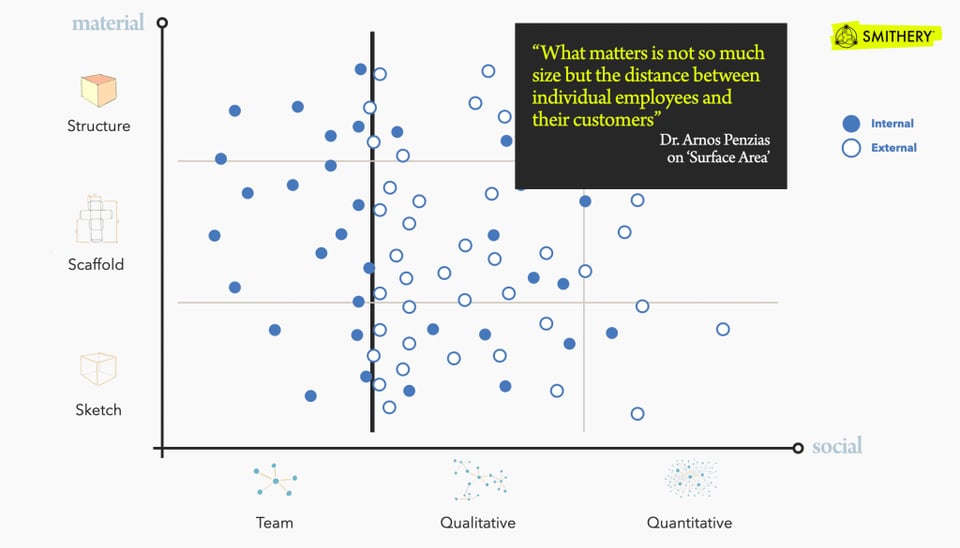
I wrote about Arnos Penzias’ concept of Surface Area in organisations last year. Short version - maximise the area within your business where your people can meet your customers. It’s where problems are spotted early, and solved.
At the time, I was despairing of EE’s terrible customer service. This time it’s DHL. Tomorrow, or next week, it will be something else, I’m sure.
And automation in customer service is nothing new. What’s more surprising is how much worse it seems to be getting. What looks like a great money-saving idea to the city on the surface ends up washing away customer trust and brand value over time.
The rise of AI hasn’t proved transformational, says the Institute of Customer Services, merely offering incremental change.
And yet, if you can work out how to find people in organisations - Matt at the Hotel, David at DHL - they are extremely helpful.
They can think outside the box, use judgement to get around protocols, solve a customer’s problem.
Technology shouldn’t be an increasingly complex labyrinth that keeps customers out, but a platform on which employees can stand to increase their effectiveness. How might companies redesign customer service with automation in a supporting role, to drop employees in to customer problems as quickly as possible?
Epilogue
By now, it was lunchtime. The closest nearby stop was Bluewater, a place I’d never been. But I had my camera in my bag, and thought I’d have a wander around there for a bit.

And I found one of the halls was called ‘Guildhall’, and all along the top there were 100 different sculptures representing the livery companies of London. And of course, right there in the middle… the makers of playing cards.

It felt like a fitting sign, given the day I’d had.
If you fancy coming to hang out with some ‘makers of playing cards’, we have our monthly Cardstock meet-up tomorrow. Sign up below.

Cardstock Monthly Meetup · Zoom · Luma
Cardstock is a monthly meetup for anyone who uses cards in their work, whether working with their own ideas, facilitating for others, making connections in…
And if not, well, I’ll see you in the verges and undergrowth of the internet garden.
Until next time.
John