The only way to silence a mosaic is to take a hammer to it
Carrie Reichardt: Thirty Years of Cementing Resistance to the Wall

Carrie Reichardt's mosaic memorial to Luis Ramirez (1963–2005) on the Treatment Rooms, her mosaic-covered house in Chiswick, London. Ramirez was Carrie's pen pal on death row in Texas, executed by the state on the sole testimony of a paid informer. She mosaicked the house for eight months after his death. The ceramics have been there ever since. The only way to remove them is with a hammer. Hear the whole story in episode 8!
Hello friend,
First: one favour. If Art Against Empire has meant something to you, could you leave us a 5 star rating or leave just a few words as a review wherever you listen to the podcast.
Provocateur artist Carrie Reichardt often says “the revolution will be ceramicized”, and I have come to understand her phrase not as a slogan but as a thesis for how resistance should work.
It will be ceramicized because ceramics persist, because every civilization on earth has independently discovered how to use clay, because the only way to silence a mosaic is to take a hammer to it, and because when you take broken pieces — broken lives, broken histories, broken systems of belief — and press them into cement and fire them in a kiln, you are making something permanent out of what the world decided was disposable.
I work in textiles and my medium will fray and fade. Carrie's work cannot be folded, cannot be stored, cannot be ignored. She has cemented it to the wall and dared the world to try to remove it. Textiles ask to be remembered. Ceramics refuse to be forgotten. And both of them, in their own way, refuse to let Empire have the last word.
❝Textiles ask to be remembered. Ceramics refuse to be forgotten. And both of them, in their own way, refuse to let Empire have the last word.
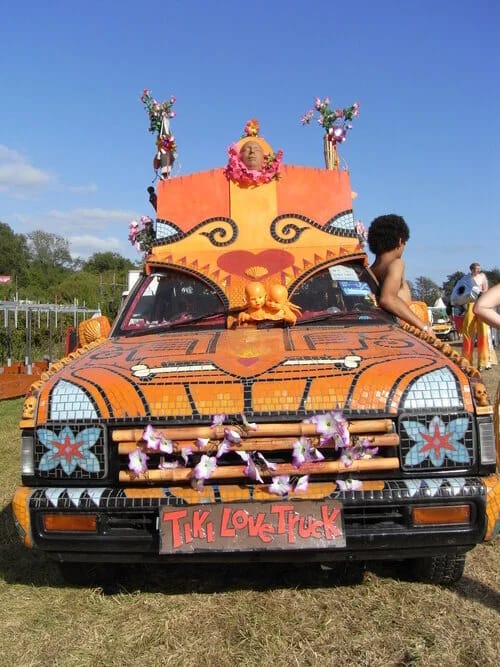
Carrie Reichardt's Tiki Love Truck (2007) — a decommissioned vehicle covered in ceramic mosaic, dedicated to Luis Ramirez and carrying the death mask of executed prisoner John Joe "Ash" Amador, cast while his body was still warm. The truck toured internationally before entering the V&A's Disobedient Objects exhibition in 2014, where it became one of the most celebrated objects on show. It was the piece that cemented Carrie's reputation as one of the most important activist artists working today.
Episode 8 — Carrie Reichardt: The Politics of Permanence — is out now. This one's different. It's less interview, more argument — about an artist, her material, and why permanence is a political strategy. Carrie's story starts with a letter from death row and ends in the mountains of Mexico on the Day of the Dead. I have more to say in this episode than any other. I needed to.
Listen now wherever you get your podcasts →
What you can do: Make something permanent
I learned that you don't need a kiln or studio to make ceramic mosaics. This summer Shawn and I are going to do this with a hammer, some broken dishes, and a willingness to experiment! We have a big eco-garden taking shape, and this seems like a great way to put some politics into it. Here’s how we’re going to do it:
Gather your materials. Raid your cupboard for chipped plates and mugs. Hit up a thrift store — discontinued ceramics cost almost nothing. Ask your neighbours for their cracked crockery. Carrie uses vintage floral china, religious kitsch, and tiles she re-fires with her own ceramic decals. You can start with whatever's already broken in your life.
Get your basics. A flat surface to work on (plywood, cement board, an old table, a garden stepping stone). Tile nippers for shaping pieces — about $15 at any hardware store. Weldbond or thinset mortar for adhesive. Premixed grout in whatever colour you like (black makes colours pop; white softens everything). Safety glasses and heavy gloves — broken ceramic is razor-sharp.


TILE NIPPERS FOR MOSAICS | How to Use, Materials to Cut, 5 Tips on Safety, + Maintenance
Break and place. Wrap plates in a towel, hit with a hammer. Cut shapes with nippers. Draw or trace your design onto the surface. Glue pieces down one at a time, starting with the focal point and filling background last. Leave small, consistent gaps between pieces for grout. Let dry 24 hours. Step-by-step with photos here.
Grout it. Mix grout to a toothpaste consistency, spread diagonally across the tiles with a spatula or your gloved hands, push into every gap. Wait 20 minutes, then wipe the surface clean with a damp sponge. Let cure overnight. What was broken is now permanent. Full grouting walkthrough here.
I might event just skip the fancy supplies entirely. You can make a concrete mosaic with literally just cement and thrift store plates — no grout, no special adhesive. Pour concrete into a mould, press your pieces in while wet, let cure. Kids could even do this at the kitchen table?
Go public. A mosaic with a message in your garden or your front step could be a political act. You could even go a step further and install the mosaic on a community wall as a monument. If Carrie can cement a death row prisoner's memorial to the side of a house in Chiswick and dare the world to remove it, maybe you can put something permanent on your porch that says what you believe?
Go deeper:
Free mosaic beginner's guide — covers tools, adhesives, cutting, grouting, and finishing in detail
Carrie Reichardt's work and shop — portfolio, prints, tiles, and the Treatment Rooms Collective
craftivism.com — where the term was coined; Betsy Greer's resources on craft as activism
V&A Disobedient Objects archive — the 2014 exhibition that put Carrie's Tiki Love Truck in front of 417,000 people
Monument Lab — nonprofit reimagining monuments; Re:Generation grants ($100K each) open for 2026
SPLC "Whose Heritage?" — every Confederate symbol still standing, mapped
1000 Voices Altadena Mosaic — volunteer sessions through Side Street Projects
NCECA 2026 — Detroit, March 25–28, ceramic events open to the public
Thank you for listening. Again, if Art Against Empire has meant something to you, Please leave us a 5 star rating or leave just a few words as a review wherever you listen to the podcast. It helps folks find us. Thanks so much y’all! And remember…
❝Our hands know how to build the world we want.
Ian