Art Against Empire: Memory, Grief, and the Politics of Remembering
Sometimes the most radical act is remembering what we've been told to forget
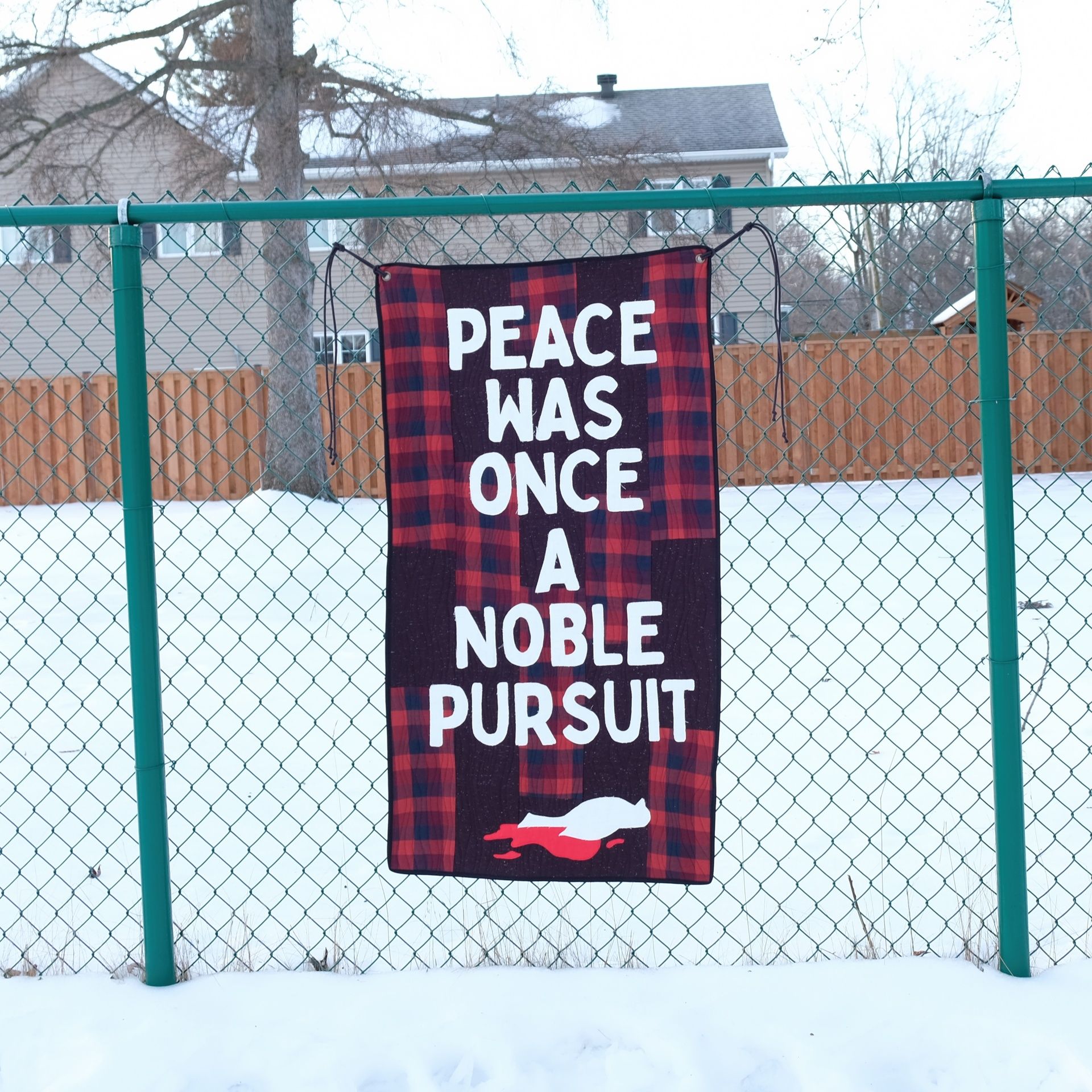
Ian Danger Capstick’s “Nobel Pursuit” 2024 • Repurposed clothing, vintage tablecloth • 55" x 27" / 140cm x 68cm
Hello friend,
I owe you an apology.
When we launched Art Against Empire on January 2nd, I promised you a newsletter. Here we are, nearly a month later, and this is the first one you're getting. The honest truth? Between finishing scripts, coordinating with guests across four countries, and let's be real… the sheer overwhelm of watching the world unfold these past few weeks, something had to give. The newsletter slipped.
Before we get to this weeks episode, I want to pause and acknowledge what's happening right now in Minneapolis feels like everything this show is about, arriving in real time and it’s truly terrible. I may be in Montreal but my heart is in Minneapolis and my thoughts are with the countless families living in fear all over the world as state sponsored violence continues unabated.
First, The Streets of Minneapolis

Downtown Minneapolis demonstration January 23, 2026, Creator:Lorie Shaull
Fifty thousand people marched in Minneapolis last Friday in -29°C weather. On Wednesday, Bruce Springsteen released "Streets of Minneapolis"—a full-band protest song memorializing Renee Macklin Good and Alex Pretti, the two Minneapolis residents killed by federal agents this month. "We'll remember the names of those who died / On the streets of Minneapolis," he sings.
As I write this, outrages knitters across the world are buying out every skein of red yarn they can find to protest ICE actions in Minneapolis and the massive federal overreach ongoing in the United States.
A small yarn shop in St. Louis Park, Minnesota—Needle & Skein—posted a pattern for a simple red pointed hat. The design was inspired by the hats Norwegians wore in the 1940s as silent protest against Nazi occupation. Within two years, the Nazis had made those hats illegal to wear, make, or distribute.
In 2026, the hats have found new meaning. All proceeds go to immigrant aid organizations in Minneapolis. As of yesterday, that little $5 pattern has raised over $250,000.
“In the 1940s, Norwegians made and wore red pointed hats with a tassel as a form of protest against Nazi occupation of their country. Within two years, the Nazis made these protest hats illegal and punishable by law to wear, make, or distribute,” a social media post from the yarn shop explained.
“As purveyors of traditional craft, we felt it appropriate to revisit this design. Our city and many others are currently being swept door to door by a federally funded and supported organization. Sound familiar?”
And as Salon reported yesterday, the quilting forums are protesting ICE with a vengeance. Facebook and Reddit quilting groups are posting "FUCK ICE" quilts. The r/quilting subreddit is filled with works-in-progress in bright red. Yarn shops from Portland to Dallas are directing customers to Minnesota-based businesses and donating portions of sales. And there is also much needed discourse on making sure we don’t stop with making and we undertake other actions as well.
Sometimes the tools of resistance are needles and thread. Sometimes they're whistles and phones. Sometimes they're the act of remembering.
Beyond the Hat
I want to be honest with you about something.
A hat is a symbol. It's a conversation starter. It's a way to signal to your neighbors that you see what's happening and you're not okay with it. But Betsy Greer, author of Knitting for Good!, put it well: the point of craftivism isn't the object, it's whether making that object changes you enough to do the next thing.
If you knit a red hat and that's where it ends, well then you've made a hat. If you knit a red hat and it cracks something open in you: "maybe I am an activist, maybe I can do activist things" Well, then the hat did its job.
Whether you're in Minneapolis, Manitoba, Melbourne, or Manchester, here's how to move from symbol to action:
Give money directly to Minneapolis (vetted by local craft communities):
These resources come from sewing circles and maker communities on the ground—people I trust who are living this:
Stand With Minnesota — A directory of places to give, organized by a local Indigenous activist. Includes organizations like Second Harvest Heartland, CANDO, and Community Aid Network MN.
Families Helping Families — A fundraiser for a public Montessori elementary school where many families are sheltering in place, organized directly by parents at the school.
Isuroon Halal Food Shelf — A halal food shelf currently being supported by a local queer-positive shop that transformed itself into a pantry for the community. Mutual aid in action.
If you're outside the US, you can still help:
Donate — All of the above accept international donations. Money is the most useful thing you can send.
Amplify — Share what's happening with your communities. The Springsteen song, the quilting forums, the 50,000 people who marched in -29°C. Break through the algorithm.
Document — If you're a maker, make something. A quilt block, an embroidered patch, a zine. Add to the collective memory. What we create now becomes the archive future generations will find.
Connect — Reach out to immigrant and refugee support organizations in your own country. This isn't just an American story. The patterns repeat.
If you're in the US:
Call your representatives — Capitol Switchboard: (202) 224-3121. Demand oversight, accountability, and an end to the Minneapolis operation.
Know your rights — And help others know theirs. The ACLU has resources at aclu.org/know-your-rights.
Show up locally — Find out what immigrant support organizations exist in your community. Many need volunteers for legal clinics, food distribution, and rapid response networks.
The hat is a beginning, not an end. As I say at the end of every episode: our hands know how to build the world we want to see. But real talk: hands have to do more than knit and quilt.
Episode 6: Memory, Grief, and the Politics of Remembering
Today, January 30th, we release Episode 6: Memory, Grief, and the Politics of Remembering, featuring Mary Burgess, Michael Sylvan Robinson, Zak Foster, and Grace Rother.
This episode asks: What are we allowed to remember? Who decides which lives get memorialized and which get erased? And how do craft practices—weaving, quilting, stitching—help us process both personal and collective grief?
The timing feels almost unbearable in its relevance.
Mary Burgess creates woven memorials for families who've lost loved ones—transforming clothing into tapestries that hold memory in their threads. Grace Rother, who you'll remember from Episode 2, reflects on how the AIDS Memorial Quilt changed everything about how we understand textile art and collective mourning.
"Grief is a huge part of my work. Repetitive, tedious work like stitching can create this sort of groundwork that moves you through something like grief."
Mary BurgessThis episode is about how we remember. And right now, in the streets of Minneapolis, people are deciding what they'll remember about this moment—and stitching that memory into fabric.
AND! If You Haven't Caught Up: Start Here
If you're new to Art Against Empire or need a refresher, here's what's available now:
Episode 1: Our Hands Know How to Build the World We Want — The series introduction, connecting 600 years of creative resistance from the Luddites to the AIDS Memorial Quilt
Listen wherever you get podcasts: Spotify | Apple Podcasts
Much love to all of you and as always, remember that your hands know how to build the world we want to see.
Xo.
Ian