
The pool is nomadic, too.
Vernal Pool, Walking Water
by Tyna Ontko
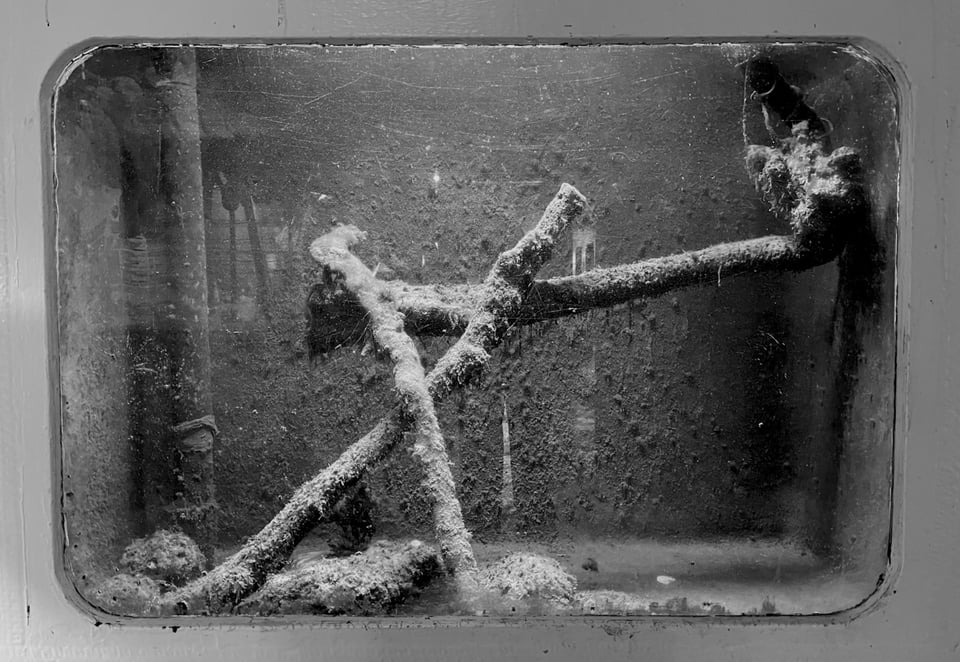
In a pool the size of a living room we find the nomads. Some are nocturnal. Some breathe through their skin. All are encircled by water, which shapes the inverse of their developing limbs. They ebb and flow according to a seasonal tide of time, set into motion by an antediluvian attunement to the annual cycles of their pool. Recoiling toward the underbrush come summer, with the return of spring, they reprise. Wood frogs, several species of salamander, and fairy shrimp comprise this nomadic ensemble. With a specialized and complex history, these amphibian and crustacean neighbors return each year to their ephemeral streams to reproduce and complete their life cycles.
This unique connection to land makes them inadvertent oracles of Appalachia’s verdant terrain. As indicator species, the health of their habitat is, in part, determined by their presence. Because their reproductive ritual is exceptionally weather dependent, they are increasingly unable to meet the immediacy of human impact on Earth’s climate system. Canaries in the coal mine of our time, their vanishing indicates a landscape irreparably altered by human action. These creatures of habit are known as “Obligates,”1 as their peculiar repetitive behavior is obligated under any circumstance to endure environmental conditions on survival’s terms.
Beneath the vernal pool’s black surface is a receptacle for their coming-of-age, a scene of convergence where the emergence of matter meets its necessary allies. Here, “space (as territory which is mappable, explorable) gives way to place (occupation, dwelling, being lived in).”2 What lies on the other side of this blackness arises into a state of being at the whim of evolution’s lengthy refrain. But this is not the making of a State. The pool is nomadic, too. Over the course of a season, it ascends, evaporating into thin air. And while humans are connected by the throughline of water and the deja vu of empires, the habit of nomads is ultimately to break habits.
From generation to generation, the pool moves across the land like a rhizome. It condenses annually in depressions pocked along the forest floor, where the clay beneath the topsoil is saturated just enough to hold water. Functioning as a transient space, the form it takes is entirely dependent on seasonal rainfall. This means the pool appears with some spontaneity, under slightly different circumstances annually, responding in the moment to any number of environmental conditions. Here, space is liquid, a constant flow of energies, the rhythm of water pulsing through an abundant collective becoming.
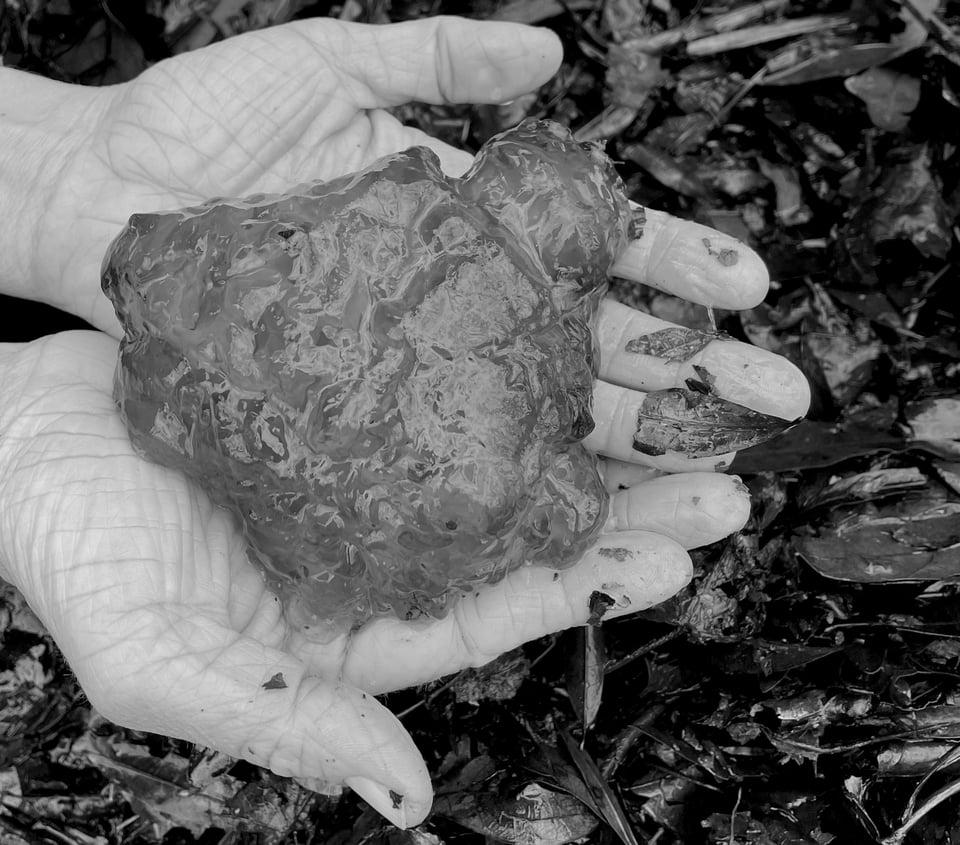
What is the value of preserving something that habitually disappears? Within the pool, the act of making, year by year, seems an act of faith. An invisible gesture is performed, leaving no immediately apparent evidence of its offerings to its environment. However, as the seasons pass, the ways in which it enables a complex set of relations to emerge is revealed. The pool disseminates as a lifeblood of the forest, its traces radiating indefinitely outward. In the fullness of time, the invisible gesture provides a tangible existence to many. It extends like a gift far beyond the Obligates and into the greater terrestrial habitat, as the species whose lives orbit these pools depend on the sustenance which crawls and springs from them annually. Without them, the pulse of this place would be irreversibly interrupted.
What might it mean to meditate on a place tethered to Earth’s tempo, especially at a time when the rapid evolution of our technology requires thinking, dreaming, and existing in smaller and smaller increments?3 The buildings in a city are optimized technologies; they facilitate exchange, lubricate trade, collect data, and maximize the flow of currency. They are designed to extract value from raw material by wringing it of any perceived uselessness. Indeed, the product of a post-industrial capitalist society is speed. The logic that museums follow, for example, prioritizes preservation in an effort to thwart life's inevitable conditions. Conversely, the vernal pool is a public form of shared memory that reflects a nuanced attitude towards permanence. It mediates a relationship to the course of time by giving it a more-than-human measure. In the pool, the airtight, documentarian recall of memory within human archives gives way to the idea that preservation requires an inevitable transformation. Womb-like, the matter of the pool reconstitutes itself cyclically, in conference with its surroundings and maybe even the moon.
There are particular ways in which the place of the pool actively produces the bodies of its inhabitants. Evolving in unison to it, the Obligates are compulsory as a consequence of being bound to the pool’s schedule, yet simultaneously flexible in how they straddle the boundary between what lies both above and below its surface. Gill-bearing and sunbathing at different points in their life cycles, they are slippery in an ecological sense. Similarly, cities are not an exclusive product of the potential of flesh and stamina. They constitute in tandem the phenomenological thinking and reflecting capacities of their inhabitants. These varied landscapes channel the energies necessary for highly specialized personhoods to form and articulate themselves. They are living-rooms, where space seeps into all that it contains because, “of course architecture is not just about shelter; it’s also the way in which we project ourselves onto the world.”4
Like the Obligates, humans are organisms with strict environmental and symbiotic requirements. We too are members of a fabric of relations, the physical embodiment of a continuously shifting border zone. Engineering ourselves toward oblivion, how might we adapt our practices in order to sustain another season? Perhaps as another form, outside of this place where dreams are externalized and made rigid by a system of discrete codes. As the primary concern of the State is to preserve itself, it is now most crucial to give time a new rhythm, one of a practical and material relationship with Earth. May the vernal pool be acknowledged as a representative of all becomings: that of inevitably becoming imperceptible. In them, life maneuvers through a hydraulic model, where “every becoming taken to the limit dissolves its subject, [...] ancient atomism is inseparable from flows, and flux is reality itself.”5
[1] Kim Wells, The Importance of Vernal Pools (Richmond, VA: Virginia Department of Conservation and Recreation, 2023).
[2] Elizabeth Grosz, Space, time, and perversion (Oxfordshire, UK: Routledge, 1995).
[3] See time as a deluge of data within AI learning models where it is quantified in concepts such as: Tokens Per Second, Floating Point Operations per Second, Trillions of Operations per Second, Time per epoch, and Request Throughput.
[4] Nzinga B. Mboup, “Recovering In-Situ Intelligence” with Owen Hopkins, E-Flux Architecture, 2025.
[5] Deleuze and Guattari, A Thousand Plateaus (Paris, FR: Les Éditions de Minuit, 1980).
Tyna Ontko is an artist and writer living and working in the Hudson Valley of New York. Projects she's contributed to include Curious 9, the Rose Books Hotline, Ancient Tech News, and Provenance Research. Her work on the Are.na essay unknowingly began during a two year period of time spent in Virginia, where she engaged with vernal pools through various field recording processes.
This piece was originally published in the Are.na Annual Vol. 7, themed “pool,” which is almost sold out in our Gift Shop. It’s now or never :)
ICYMI, we sent out our first issue of the Are.na Community Newspaper via this newsletter earlier this month. It includes a Classifieds section, which, by the way, there’s still time to sign up for Laurel’s Are.na Pairing Service.
The Are.na Team