
An interview with physical technologist Kiran Scott de Martinville
Introducing Are.na Frame, an Open-Source E-Ink Display for Channels
by Charles Broskoski and Kiran Scott de Martinville
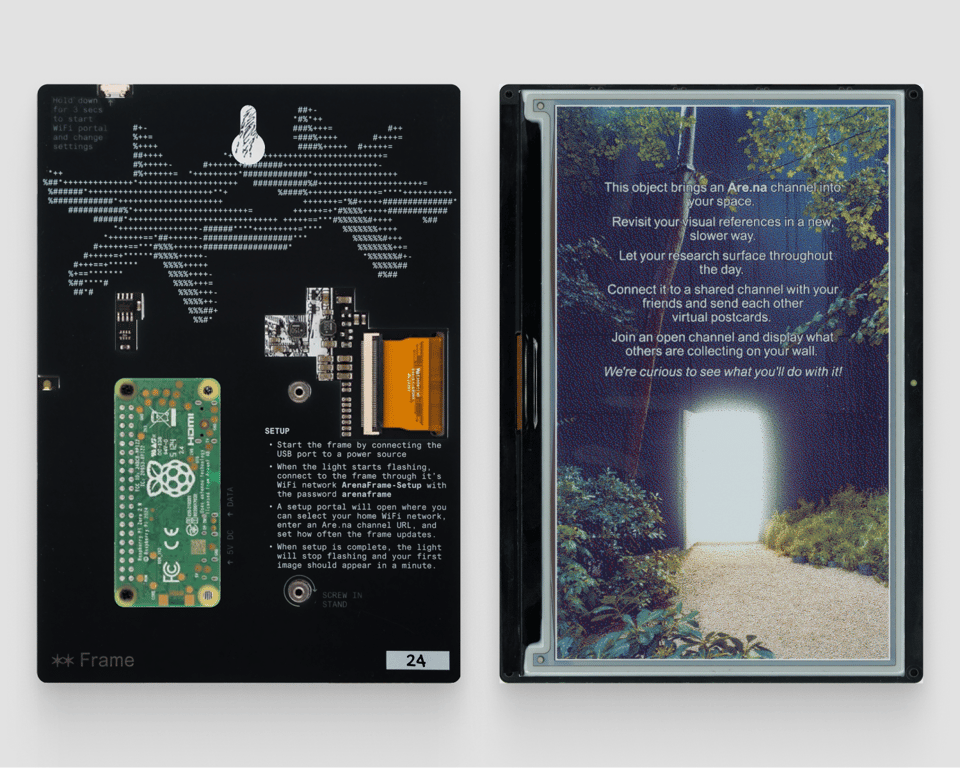
I met Kiran Scott de Martinville in Budapest in 2025, at a design conference called POV. I had just done a talk and my nerves were slightly frayed, but I felt an immediate sense of comfort when he introduced himself. He wanted to show me a project he was calling Are.na Frame, an e-ink display that rotates through the contents of an Are.na channel. Although I detest the word “widget,” the frame is essentially an Are.na widget for the physical world: a lightweight way of giving a set of information some physicality. I was shocked by what a good idea it was and how nicely it was assembled. It struck me as a physical manifestation of what we aspire to when we work on Are.na — to create something elegant and almost invisible at the same time. It was considerate in that it allowed the content of what was being displayed to shine through; it took the concept of “frame” seriously.
A few months went by and I kept thinking about the frame and scrolling through Kiran’s Are.na profile. I don’t have much of a personal connection to hardware myself, but I’ve realized through Kiran (and other folks in the same space, like Teal) that, similar to software 20 years ago, hardware is going through an open-source renaissance. As a result, building physical devices is more accessible than ever. And the implications of that are exciting: imagine a world where hardware is not just built by large corporations but by people you know. Where hardware is extendable, repairable, and customizable.
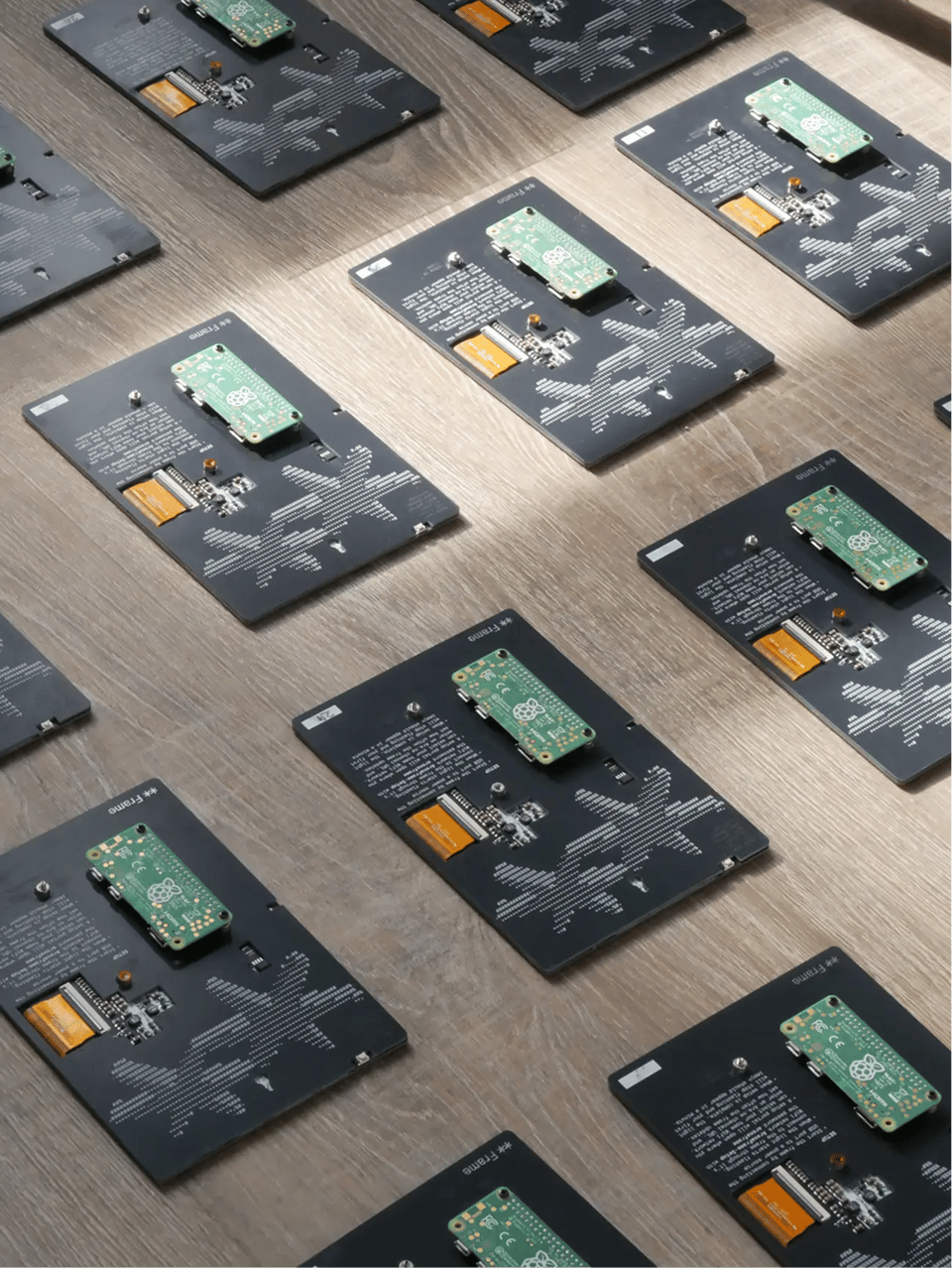
And now, many months later, we’re honored to partner with Kiran to present Are.na Frame, an open-source e-ink display that brings your channels into the physical world. We’re selling a limited number in our Gift Shop, and Kiran also put together some instructions if you want to assemble one yourself.
Kiran is a great example of the type of person who should be shaping the physical world of computation. He has highly refined taste and the motivation to not just build interesting devices, but also to leave a trail for others to follow behind him. Below, I talk to him about Are.na Frame, his process and motivations for making it, and what’s driving open-source hardware development.
— Charles Broskoski
I looked up your last name and was wondering, are you related to Édouard-Léon Scott de Martinville? I also saw this in your “-sdm-research” channel. What’s the story there?
He’s my great-great-great-great-great-grandfather. A French printer who recorded the first ever sound, his own voice, in 1857. The wild thing is, it never occurred to him to play it back. He just wanted to see a human voice, to use the waveforms as a kind of shorthand. When Edison cracked recording and playback eight years later, it naturally went global. My ancestor rarely gets credited for making the first audio recording.
So wild. Did you grow up knowing about him? Are there other people in your family who have a similar practice?
My grandfather told me the story at a young age and showed me the original phonautograph and everything. It was definitely a very influential moment for me. I don’t think anyone else in my family has had a similar practice since, but I feel like he’d be into what I’m doing now.
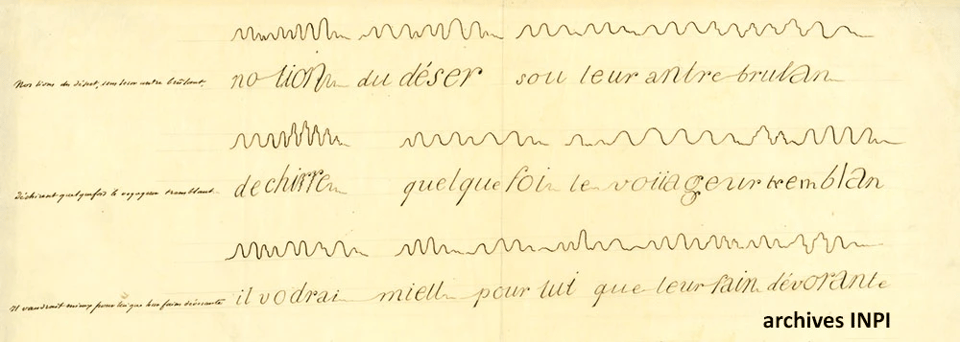
In the mid-2000s some U.S. researchers managed to locate and decode the original recordings. You can go down a rabbit hole here.
I love the idea of wanting to see a wave form. The first thing it made me think of is your Are.na bio: “physical technology.” Can you say more about that phrase?
“Physical technology” is my current attempt to compress my practice and what excites me into one neat little phrase. I’ve always been half-technical, half-creative. I studied engineering, then taught myself industrial design, and my most interesting work happens at the intersection of both. Each side continuously talks to the other.
I’m also using “technology” in a very broad sense. All the impressive frontier intelligence we’re constantly keeping up with is one end of the spectrum, but a book is also an incredible piece of technology. It’s automatic, unintrusive, with no power or wifi required. I think the idea for the frame came out of thinking about that tension.
I think I know the tension you mean, but how would you describe it? And do you think this tension has something to do with the increasing interest in e-ink?
I’d maybe call it the tension between more technology and less life. For a while, an increase in one meant an increase in the other, but a lot of people are feeling like that’s changed. Most of our waking hours are spent staring at glowing screens optimized for engagement and attention. E-ink feels counterculture to that: its slow refresh prevents passive consumption, and the displays being non-emissive make them less dopamine-hijacking by default. E-ink displays can’t replace every screen we use, but they are a more intentional medium.
When I first started playing with connected e-ink displays, I used them to stay in touch with close friends and older relatives, and for sharing our lives in a slower way, free from the algorithm-driven streams a lot of us feel controlled by. More connection through less tech. As the idea evolved I realized those sentiments resonated with Are.na and its users.
I want to quickly bring up the story of meeting you at POV in Budapest. You had the frame with you and we looked at it together.
I think the thing that struck me the most was the transition between one block to the other. The screen has to do a rapid sort of flashing between the two images to “clear” the pixels. Am I describing that right? Something about that process really underscores just how physical the whole project is.
Yeah I remember! I was on a side quest to meet you, talk about Are.na, and show you the object. I knew you'd find it compelling.
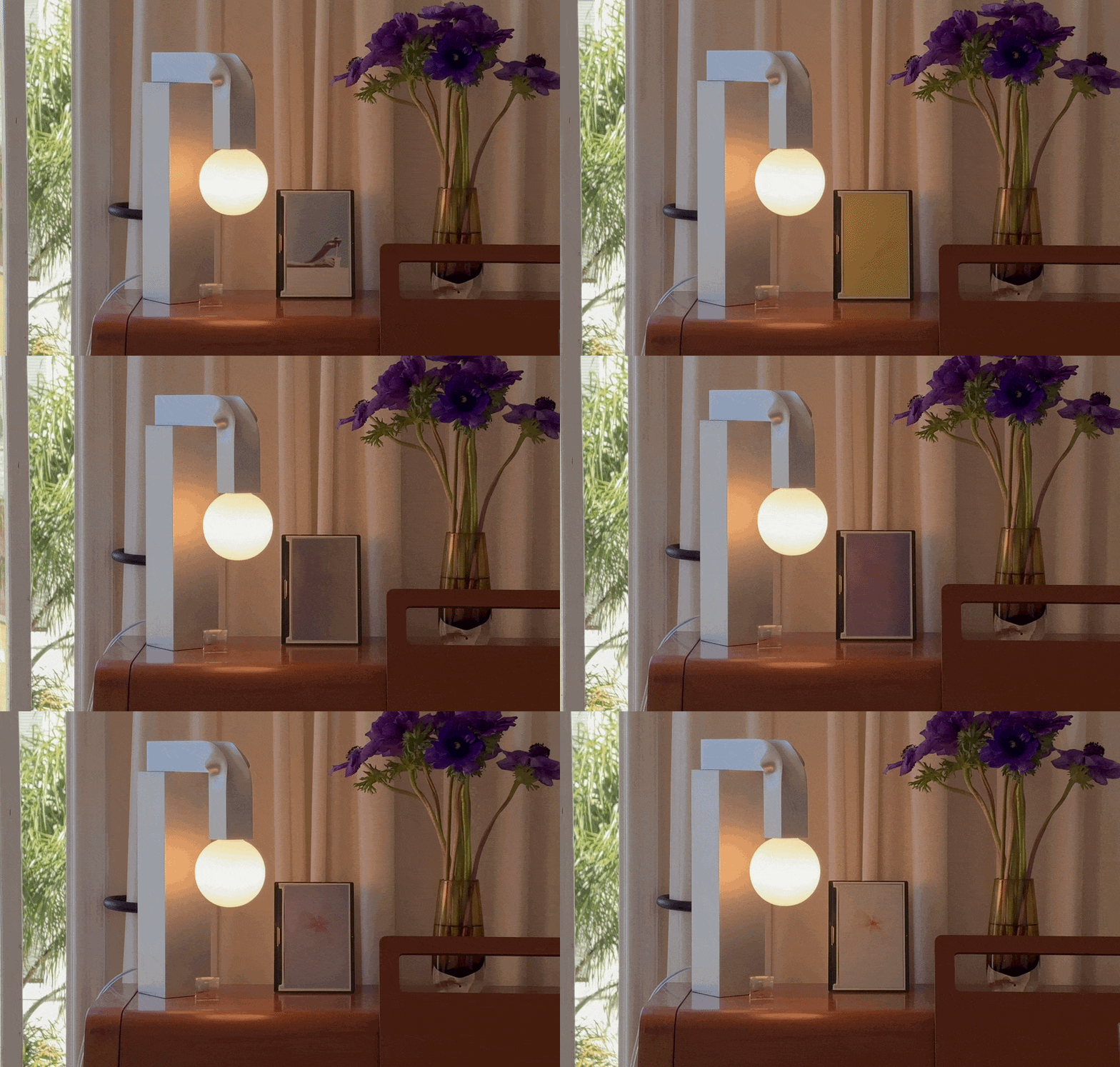
The way e-ink works is by physically moving charged pigment particles inside tiny cells, which is why it’s so much slower than light-emitting displays, but also why it can hold an image without power. The color variant in the frame has six pigments: red, yellow, blue, green, black, and white. When it updates to a new block, the display builds up each color layer individually, similar to how spot color printing works. That’s the psychedelic flashing effect you saw. It feels somewhere between an analog and digital process.
So interesting. How did you learn about all this? Was it mostly self-directed?
Yes, mostly self-directed. I went down a rabbit hole as part of my obsession with the technology of e-ink. It was originally developed at Xerox PARC (the same lab behind “The Mother of All Demos”). For a long time a single company held the patents, but those have recently expired, and we’re starting to see new developments reach hobbyists through open-source hardware companies.
A UK-based maker-supplier called Pimoroni was early to distribute this new generation of color e-ink. The whole maker/hacker community is really strong here, with people teaching each other, sharing code, solving problems together online and in shared spaces. That culture was a big part of how I learned.
And now with intelligent coding tools, building your own personalized hardware is more accessible than it’s ever been. I encourage people to hack their frame and make it do their own thing. The one I have in my flat has a camera that friends use when they visit, creating an archive of everyone who’s come through.
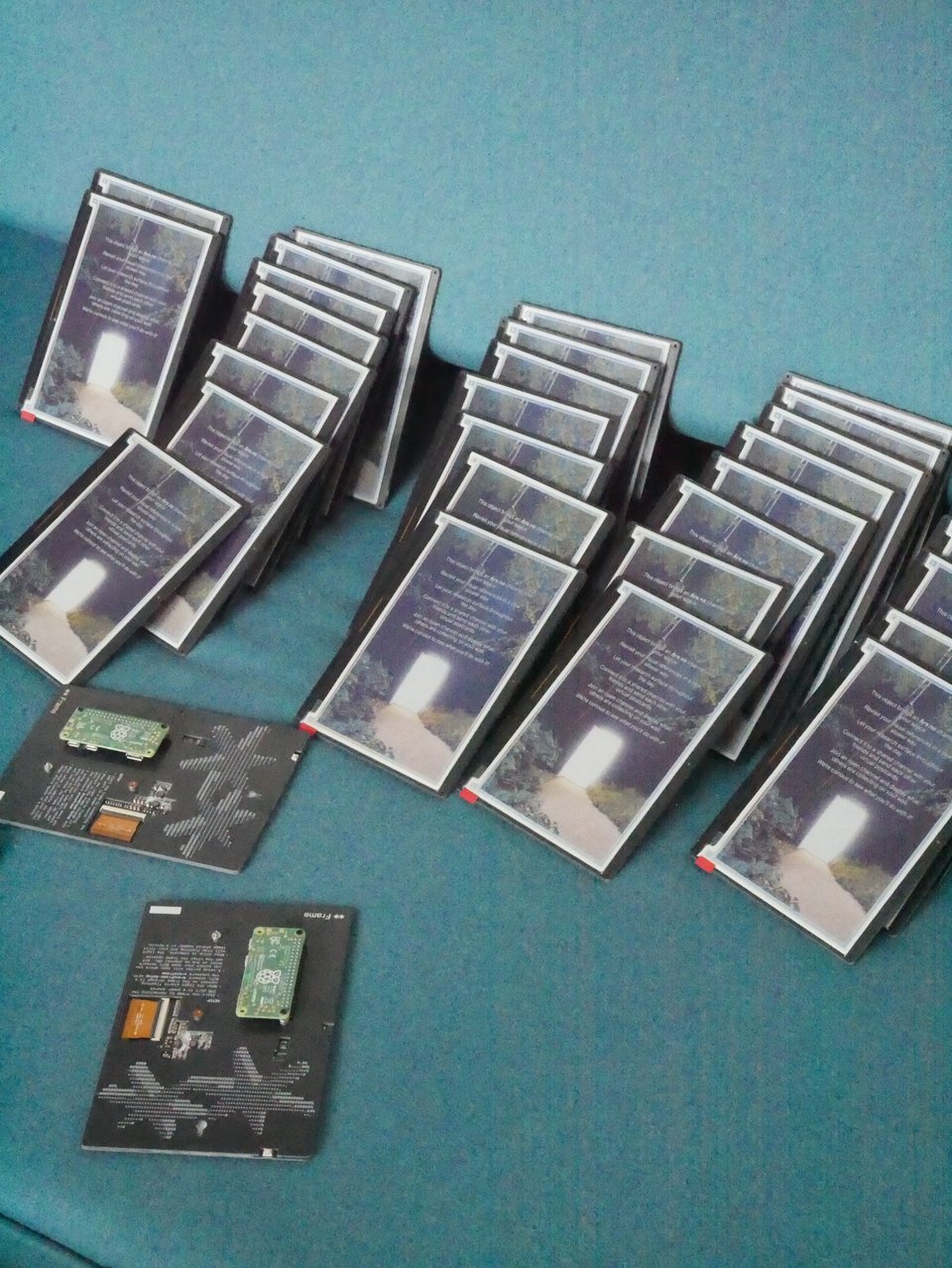
Can you talk a little more about how the open-source community is evolving, specifically for hardware? I know that LLM-based coding has really ignited the open-source community for software, but what is driving open-source hardware development? And can you talk about your thinking behind also releasing this as an open-source project?
Are.na has always had an “open-source by default” approach that runs through both how the platform is built and the ethos of its community, so releasing the frame this way felt natural. Instructions on what you need and how to put it together are going to be made available along with the run we’re releasing on the Gift Shop.
There’s a rich lineage of open-source hardware that made this project possible. Arduino democratized microcontrollers, helping educate generations on electronics and empowering people to hack and build their own projects. Raspberry Pi put a full Linux computer in anyone’s hands, making it possible to handle more complex tasks and connect to the internet. That culture is worldwide. If you search for a DIY electronics project, someone out there has likely already done it and published instructions.
What’s exciting now is how LLM-based tools are extending that invitation further. With decades of maker culture as training data, they can help write firmware, debug problems, recommend components, explain how to wire things correctly, the nuances of which pins handle which protocols, etc. These tools make that knowledge conversational and accessible. I think we’re at the start of a new wave of people building their own devices: specifically tailored to their needs, private, personalized to what they like and what they can afford. Less one-size-fits-all, less planned obsolescence.
Do you have other ideas for Frame that you haven’t done yet? Or other non-frame related projects that you could talk about? I was noticing a lot of audio-related channels, and wondering if you were going to continue with your lineage of technology for sound.
Having Frame integrated with Are.na really opens up the possibilities. I have a friend who has a pair and uses them with their long-distance partner to share images of their lives. I'd also love to make a billboard-sized one connected to an open channel, so anyone walking past could add something, though I’m sure we’d end up seeing some wild images.
Music and sound has been a core interest of mine for a long time. Recently I’ve been continuing the “visualization of sound” lineage by experimenting with distributed mode loudspeakers. They vibrate a sheet of material instead of a driver to produce sound, giving you a soundstage that’s great at filling spaces. They also have a flat, “frame”-like form that makes them easy to transport and good for activating spaces that don’t have sound.
The most interesting part, though, is that the frequencies create waves and natural geometries on the surface of the material, a natural audio visualizer. If you’ve seen the physics demo of a Chladni plate, it's the same idea. I’ve been experimenting with how light interacts with these cymatics, using water caustics and lasers. I’m not sure if it becomes an installation, a home product, or something else entirely, but the journey so far has been delightful.
Wow, full circle. Like your great-great-great-great-great-grandfather, you are also driven to see audio. I'm excited to see where this path takes you.
Charles Broskoski is one of the many co-founders of Are.na.
Kiran Scott de Martinville is a industrial designer and technologist based between London and San Francisco, building new physical products.
As always, you can read this interview on Are.na Editorial.
You can buy an Are.na Frame on our Gift Shop.
The Are.na Team