
Adventures in virtual carpooling
Objects In Mirror Are Closer Than They Appear
by Tejumola Bayowa and Mingjia Chen
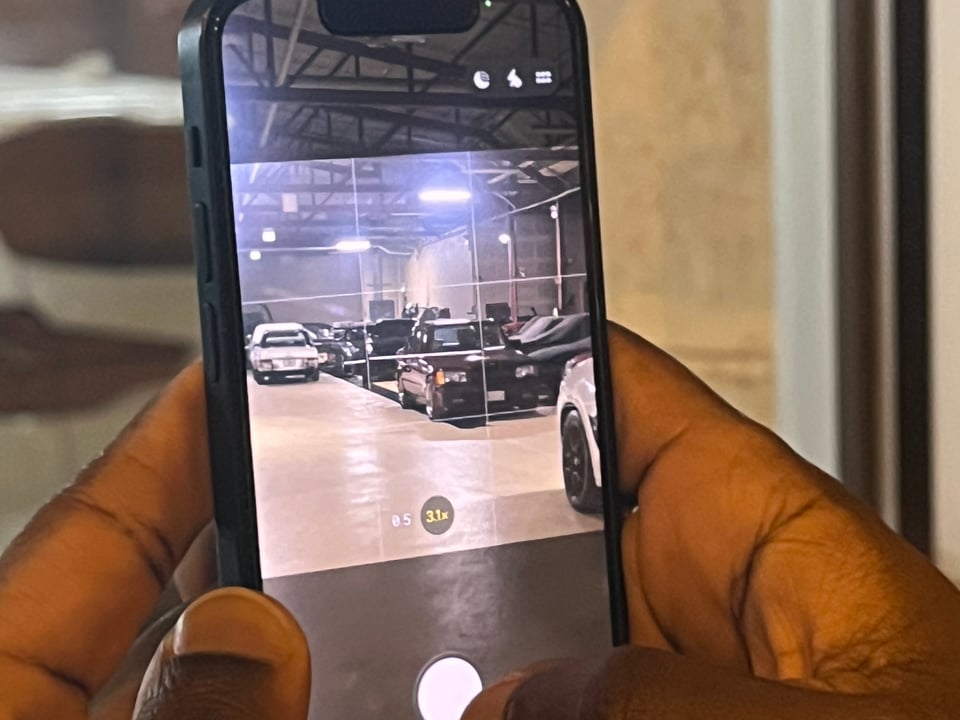
This conversation is from Are.na Annual Vol. 7, “pool.”
Mingjia Chen: Looking back at some of the images we’ve sent each other, a question that comes to mind is: what were we thinking at those points in time? Why did we stop to take a picture, and why did we send particular images to each other? What was happening at the moment when we saw a car, a sign, or whatever? Perhaps these reflections could be a good way to start this conversation.
Tejumola Bayowa: I agree. When I was looking through the pool of images in our Are.na channel, I was reflecting on what was happening at the particular time I took each image. Where was I? Who was I with? Why did I take this picture? What attracted me to the picture? So before even trying to connect the photos to anything external, I was trying to remember what was happening internally at the time of taking them.
Mingjia: It's difficult to remember some of the images and why we captured them.
Tejumola: One of the few images I distinctly remember is the one from Niagara Falls on my drive to Boston from Chicago. I stopped by to see the Falls and in the park area there was a man making large bubbles and a little girl jumping up trying to catch them.

Mingjia: It’s a very surreal image.
Tejumola: And very much about time, too. I distinctly remember the photo because it brings back so many feelings I had internally at the park and during that trip: the excitement of relocating to a new city for graduate school, the anxiety of meeting new people and making friends, and the unknown of what a return to normalcy would be like after being in a bubble for so long due to COVID.
Mingjia: The image captures a moment where you were in pause before having to encounter certain questions.
Tejumola: Yes, the brief respite before the bubble literally and figuratively popped.
Mingjia: I think I've sent you more car images in general.
Tejumola: Yes, I like receiving your “vroom” images. They have this blurred effect from you being in a moving car or because of a camera defect.
Mingjia: Now that you mention it: do you remember the image of the car parked next to a plaza in Manaus, Brazil? It was so blurry because my phone was broken.
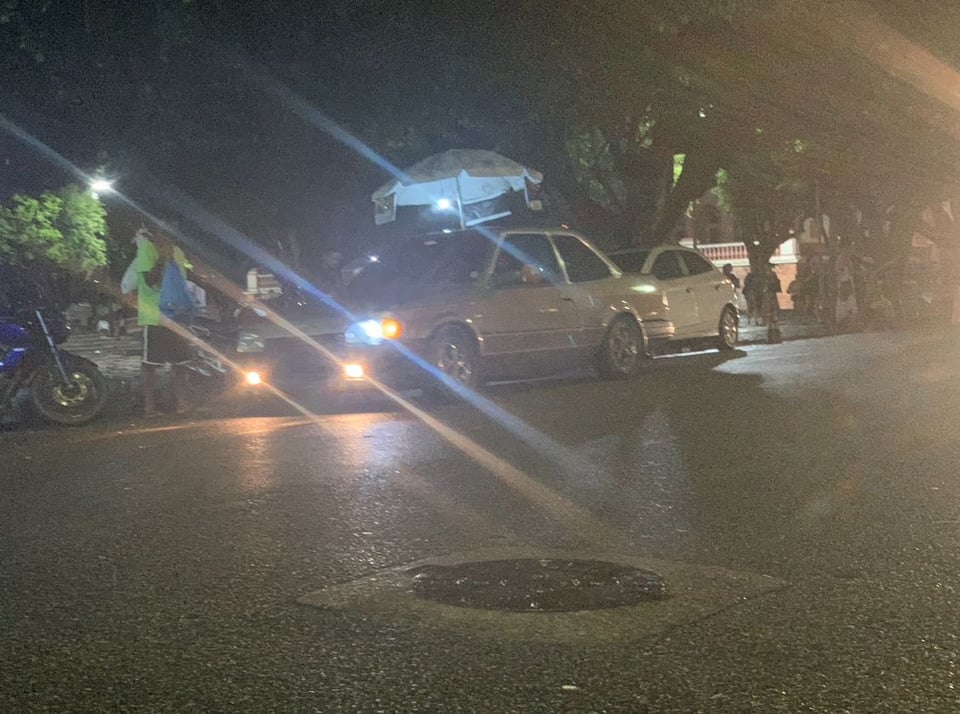
Tejumola: When did your fascination with cars begin?
Mingjia: My family didn't own a car growing up. I would pay attention to different cars I liked on the street and try to convince my parents to get them. This was around the time of the Transformers movie. I was fascinated with the idea of it — cars with the ability to convert into robots.
Tejumola: The idea of transformation resonates with me. I remember many of the transformative experiences in my life from the perspective of the journey in a passenger seat. I view our channel as an attempt to archive these transient moments and feelings.
Mingjia: Even though we both took several road trips over the last three years during our time in architecture school, we weren’t able to travel together. Our conflicting schedules and commitments didn’t let us share the passenger seat.
Tejumola: This ritual of exchanging images became our version of virtual carpooling: a way to travel together, even when physically apart.
Mingjia: On a larger scale, the images also reveal unexpected threads of connection in seemingly very different contexts.
Tejumola: The pictures of Shanghai you sent look nice. You said it’s your first time there?
Mingjia: Being in Shanghai feels strange. I’m still getting used to it.
Tejumola: What feels strange about it?
Mingjia: All the cars on the streets are electric and most of them have been made in the past five years. Someone told me that in Shanghai the government restricts the number of license plates issued because there are so many cars. If you get a gas car, you need to pay a premium of around 15,000 USD to get it registered. Meanwhile, with an electric vehicle, you get a free license plate. Gas cars on the street tend to be expensive models because the owners can afford the premium.
Tejumola: I’m guessing that the pink Rolls Royce in your photo wasn’t electric, right?
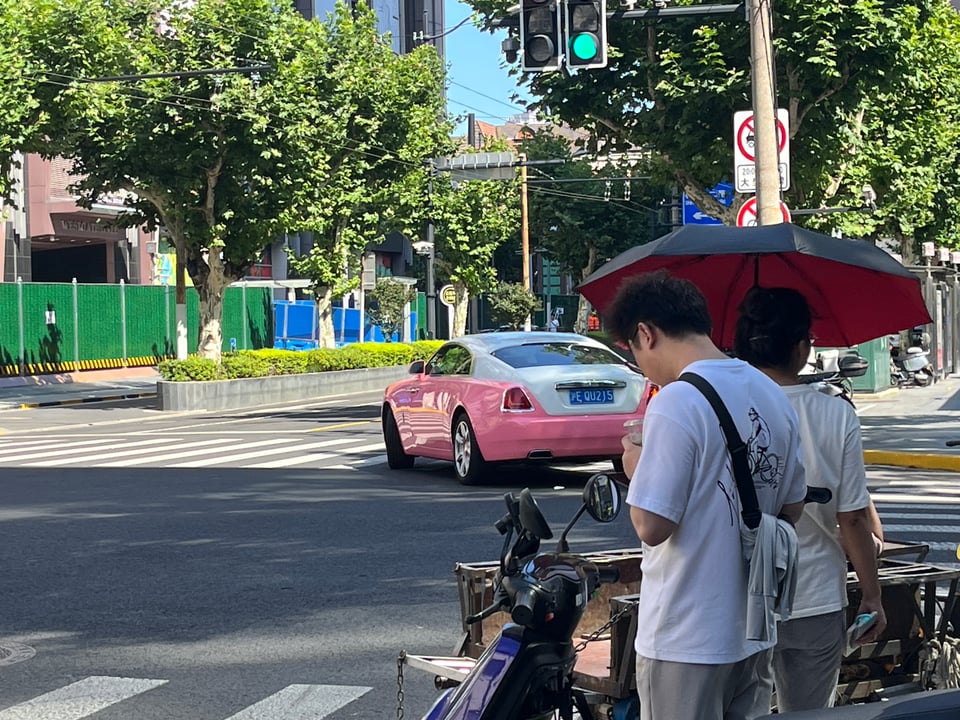
Mingjia: Well, that one definitely wasn’t. Something else I’ve noticed is that people here smoke and drive a lot. There’s usually a new car smell mixed with cigarette smoke.
Tejumola: When I was in Turkey, I called an Uber to get me back to the airport for my flight to Chicago. The driver was the craziest one I’ve ever had. He was driving above the speed limit, smoking a cigarette, and scrolling TikTok.
Mingjia: I need to visit Chicago sometime. Not in the winter.
Tejumola: Yeah, definitely. Either in spring, summer, or fall.
Mingjia: And I think I need to rent a car.
Tejumola: Every time I'm on Lake Shore Drive in Chicago, I think, “Oh, Mingjia would love this drive.” There is also Lower Wacker Drive. You know a number of scenes in Batman were filmed there.
Mingjia: I did not know that.
Tejumola: Yeah, the one with Christian Bale. A lot of it was shot in Chicago.
Mingjia: That checks out — Gotham City feels like Chicago.
Tejumola: I remember reading that Chicago’s Art Deco skyscrapers and history of organized crime were some key factors why the city was selected to represent Gotham.
Mingjia: You live in Gotham City.
Tejumola: I feel like Batman driving through Lower Wacker. It’s a series of dark underground junctions and intersections with no GPS service.
Mingjia: If you don’t know the way, you are lost in the underground maze.
Tejumola: Are you flying to your hometown tomorrow morning?
Mingjia: Tomorrow night — it is a short flight from Shanghai to Dalian.
Tejumola: What is the vibe of your hometown? It is a coastal town, right?
Mingjia: It is by the Pacific. I would describe Dalian as having a similar climate to Boston but with the pace of Manaus. It feels slightly behind the rest of the country but very urbanized. People don’t think of it as a big city.
Tejumola: You haven’t been back for a long time. Do you think you’ll be surprised by what you see?
Mingjia: Yes, I think so. Is it hot in Mexico City right now?
Tejumola: No, it’s the rainy season. It is typically between 60 and 75 degrees Fahrenheit. The forecasts on the weather apps are not very accurate. You just have to look up and read the clouds.
Mingjia: Good to always carry an umbrella then. Did you get some time to walk around in the first week?
Tejumola: Yesterday I walked an hour and twenty minutes from my apartment in San Rafael to Museo Jumex. There are a lot of streets named after European cities. To get to work, I walk down Calle Versalles and Calle de Turin. When I feel like taking a longer route after work, I go through Berlin, Vienna, Roma, Budapest, and Madrid.
Mingjia: That happens in North America, too. Colonialism ran out of names to use.
Tejumola: You know how I kept sending you images of Volkswagen Beetles?
Mingjia: Yeah.
Tejumola: I was looking into it. From what I saw on Wikipedia, they were common as taxis. They were introduced to the country during a German exhibition in 1954, and Volkswagen built a plant here. A lot of Beetles were made throughout the ‘70s with special insignias and they became a symbol of Mexican national pride.
Mingjia: Are they still on the streets as taxis?
Tejumola: Not really, but some are still in good condition. I sent you a picture of one painted in a beautiful dark shade of blue.
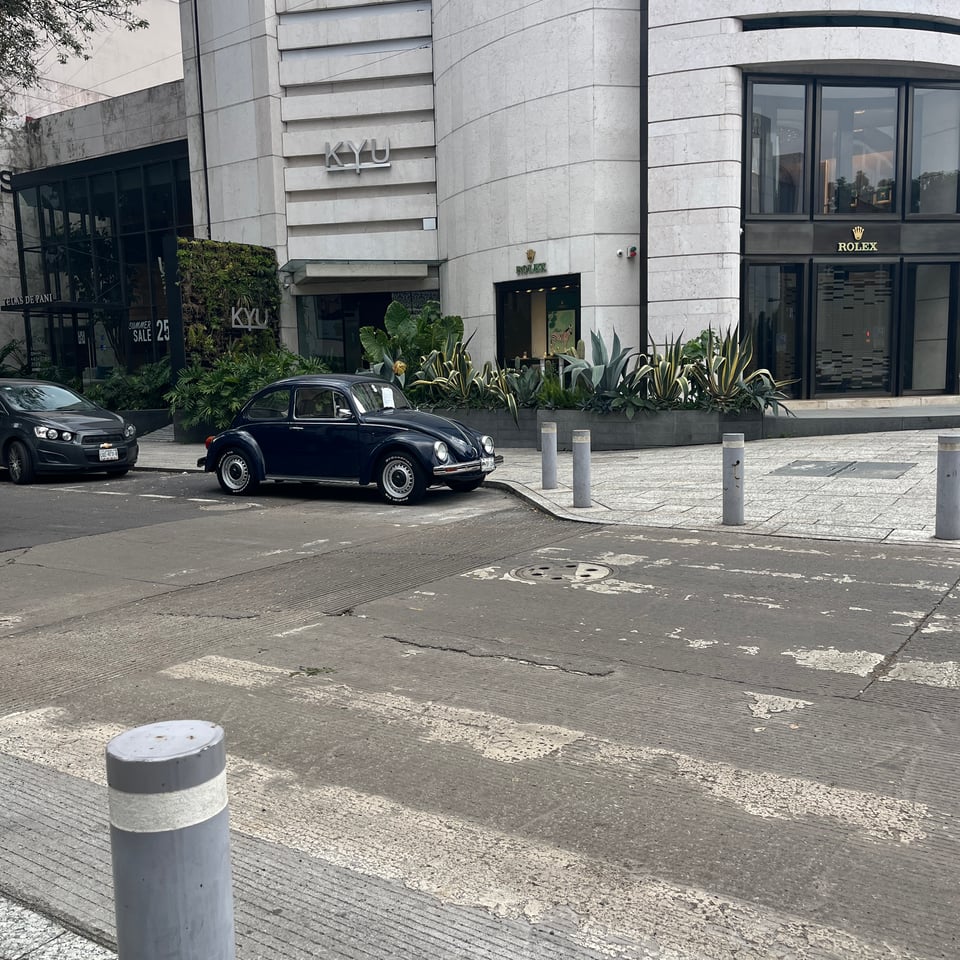
Mingjia: It looks very clean. I also saw many Volkswagen taxis back in Dalian. Everywhere else in China, taxis are mostly Chinese and Japanese cars. Ever since I was a kid, Volkswagens have been taxis in Dalian. The history is similar to what you described. Volkswagen was introduced to China as it opened up foreign investments in the 1980s and built a factory in Northern China. There were so many Volkswagen taxis in Dalian. They are a vivid part of my memory of the place.
Tejumola: My uncle had a Beetle when I was young. He got it when he was trying to start a taxi business.
Mingjia: What have you been eating in Mexico?
Tejumola: I had Panda Express last night. How is the food in Dalian? Do you go out a lot when you’re there?
Mingjia: The food is good. I don’t go out that much in Dalian because my family insists on cooking every meal. My dad has been obsessed with baking. He makes his own bread now and it is quite good. My mom discovered okra last year. She makes an okra salad and I told her my friends in Boston use okra to make stews and add it to curry. She just sent me a picture of her first attempt at okra stew. I’ll send it to you.

Tejumola: In Nigeria, it is called okro. You should show the Nigerian okro soup to your mom as a reference.
Mingjia: I will, it looks really good. Recently okra is getting popular in China. But I am not sure if I’ll like the okra salad because of how slimy it is.
Tejumola: A nickname for okro soup is “drawing soup” because when you scoop it, it stretches from the plate to your mouth.
Mingjia: I might like okra in soup form better.
Tejumola: I did my groceries at Walmart today. I intensely dislike when I am in a different country and I see the same US stores everywhere. But it was the most convenient thing to do.
Mingjia: I also go to Walmart when I am in Dalian.
Tejumola: There’s a Walmart in Dalian?
Mingjia: Yeah, not only that, but this Walmart is also underground beneath a giant open plaza.
Tejumola: Why is it underground?
Mingjia: Dalian used to have a lot of underground malls, so I think Walmart just followed this trend and built its store underground. This Walmart in Dalian is connected to other little shopping streets and its presence is very integrated into the underground mall. It is the opposite of a big-box store where you have to drive and park. When I moved to the US I had to relearn Walmart. I’ve been to the Walmart near Hudson, New Hampshire, a few times. It is so different.
Tejumola: We've learned a lot about our shared experiences through sending these images to each other over the years. There are certain connections I think we would never have known without them.
Mingjia: I've noticed that these images aren’t necessarily about the cars themselves, rather they’re capsules that bring us into each other’s worlds. And I think more than anything, the images represent a sense of trust in our friendship.
Tejumola Bayowa’s work engages the built environment with a focus on inclusivity and an attention to what is often overlooked. He holds a BA in Art History from the University of Illinois and an MArch from MIT.
Mingjia Chen (he/they) enjoys documenting and reflecting on unassuming experiences as modes of inquiry into his work. He is currently completing his degrees in architecture and planning at MIT where he was the co-editor of Thresholds 53:Idle. Recently, he was also trained as a shuttle bus driver.
As always, you can also read this piece on Are.na Editorial.
btw, we’re working on the next Are.na Community Newspaper, which goes out in this newsletter. If you have any news or want to advertise a Classifieds, please add to these channels!
The Are.na Team