Weekly API Evangelist Governance (Guidance) For January 12th, 2026
Welcome to 2026. I hope you got some rest over the holidays, and are ready for the work we have in front of us on the table this year. I have to be honest, I am very troubled by what is going on politically in the world around us, which I see as being fueled by technology. For me, I am finding escape in my work on my new startup. While I don’t feel that technology is the solution to our problem, I also know that we can’t be ignorant of how technology is being used in service of fascism right now. So, with that said, I am finding purpose in my work this year, while holding several conflicting things in my head—the world is burning, technology is fueling that burning, that my work is a sort of escape, and that I can also minimize the flames through my work.
Open Waters with Nafitko
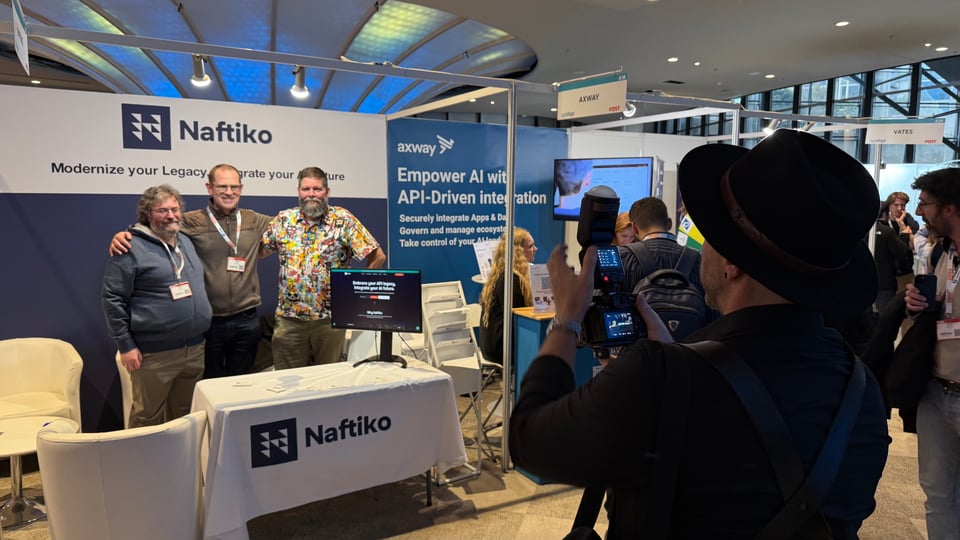
Naftiko means Navy. We officially launched my new startup Naftiko at APIDays in Paris back in December. We are now officially open for business, but still a few months away from any product you can get your hands on. No problem, there is a lot of work to be done on open-source standards, tooling, storytelling, and conversations. Naftiko is focused on helping enterprise organizations make sense of the thousands of integrations it takes to run your average global business today. I see the API sprawl that has consumed enterprises in the last decade as the open ocean, and Naftiko as the leading naval specification and tooling provider in a massive global landscape mostly covered in water. We have our work cut out for us, but it will be exciting and unpredictable work to make happen, which I am confident that we can have significant outcomes.
What Is an Application?
I am working (once again) to understand what an application is. It is simple word, with so many variations in meaning depending on who and when you to with. I am deep diving into five separate specifications that are being used to define applications in context of containers and Kubernetes orchestration. I have pulled the JSON Schema for each of these specifications and done a “diff” to see what the most common properties are. I am now producing examples of each and mocking up as an API so I can see the variations in how each application defines “dependencies”, whether it is a database or a 3rd-party API. I am confident that the boundaries of what is an application, and the other interfaces we are dependent on will continue to shape the enterprise landscape beyond this AI application phase we find ourselves in.
What is an Interface?
I am working (once again) to understand what an interface is. It is simple word, with so many variations in meaning depending on who and when you to with. I am deep diving into twenty separate specifications that are used to describe interfaces, including OpenAPI and AsyncAPI, but also new players like MCP and A2A. Like with application specs, I am doing a “diff” across these specs to see and understand the overlap. The schema and servers they all use, to the unique pieces like capabilities, skills, and workflows. I am confident that very few of the people doing the individual specifications have looked across all of the specifications—you can see it in their design and implementation. Next I am creating an interface exchange, which means I will mock each individual spec as it’s own simple HTTP API, and then provide a variety of synthetic interface examples—alongside the application work. (Hint, they are related when it comes to programming)
I Interface, I Don’t Apply
The only way I am able to maintain my sanity in the world of technology right now is staying within my lane (pun intended). Throughout my career as the API Evangelist I have stayed out of desktop, web, mobile, device, and network applications. I intend to do the same with AI, but like previous waves, I find that applications are where power accrues, and that vendors and pundits really enjoy blurring the lines between the two. AI is an application. Now, there are ways in which AI can be used as part of API lifecycle and governance, copilots and agents are applications. There is a lot of money to be made in making people forget the past and by blurring the lines between applications and the interfaces they use. It is how platforms accumulate power by shifting domains onto their platforms before people realize what is happening. Web and mobile applications have been doing this for a while now, but AI has kicked things into overdrive when it comes to moving “your” business domain onto someone else’s platform.

Connecting Dots with ABNF
I learned more about Augmented BNF for Syntax Specifications (ABNF) this week, with BNF standing for Backus–Naur form, which is a notation system for defining the syntax of formal languages, especially programming languages, using production rules to describe how symbols can be combined. It is one of those “blah blah” background technologies I’ve heard many times but did not slow down enough to understand what the hell was going on. It is used by OpenAPI, Arazzo, JSONPath, and almost every other specification, and it is how I will connect the dots across the application and interface specifications I dove into above. It is how I will connect the dots with what is dependency for application specs, and it is how I will connect the dots with what is a capability across the interface specs. ABNF is how I will make sense of the madness across the rush of new specifications out there today, and settle in on whatever the meaningful center is for any given moment in 2026 and beyond.
Market Research, GTM, and Revenue
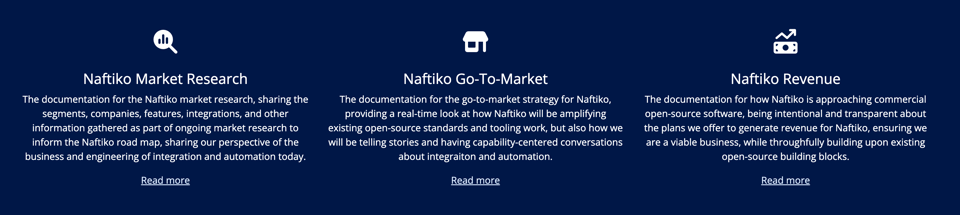
As we build Naftiko, Jerome is leading the charge on the corporate and product realm, where I am owning market research, go-to-market, and revenue. I have always enjoyed the market research and go-to-market activities of a startup, by making them my own. I never liked the sales hustle until I helped build Postman’s. The sales team was the first that didn’t frustrate me and feel like they were slowing things down—they were energetic, innovative, and smart guys. I enjoyed my time learning from them. I am interested in taking what I learned from the process and apply as part of my own motion. I am confident in my ability to open the door to sales conversations in new an novel ways, but I am less confident in my ability to close sales deals. I am looking to change this. In my API Evangelist fashion, you can find my market research, go-to-market, and revenue work out in the open and documented so that I can share and tell the story along the way, which is one of my ways of opening doors.
Focusing on Capabilities
All my storytelling for Naftiko is focused on capabilities, and for API Evangelist it will all be about how the capabilities sausage is being made. The mission of Naftiko is to align existing engineering efforts with business outcomes, and capabilities are how we will do this. You can see the first draft of the schema capability I am developing, as well as the first prototype schema for API reusability, which is our top use case. It is natural for API Evangelist to blah blah blah out the technical details of all of this around us, but it isn’t so easy to blah blah blah out the business details. My partner in crime Claire Barrett has been workshopping this with me, and it is something you’ll likely see some videos from shortly, but I am to shift the narrative towards business outcomes, balancing between product and engineering. This doesn’t mean we leave the technical details behind—it means that we bridge the two, so you will see a lot of negotiation from me on Naftiko properties, but also here on API Evangelist to bridge this.
Naftiko Signals
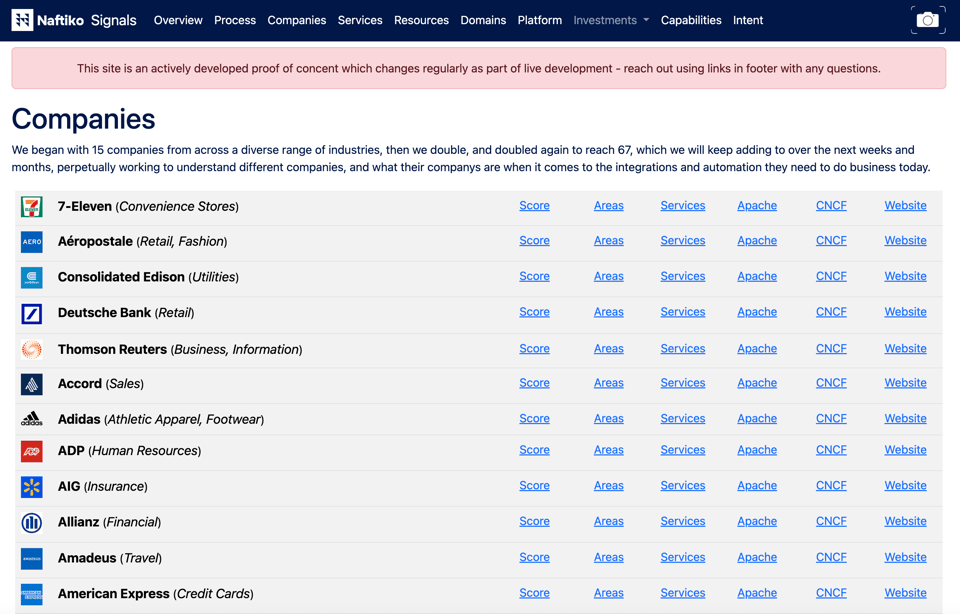
One outcome of the market research and revenue work I have done for Naftiko is what I call Naftiko Signals, which began as a way to gather signals for sales targets, but has grown into something much bigger. I’ve profiled over 60 companies, gathering signals from common public enterprise outputs like blog posts, press releases, and job postings, to understand the investments companies are making. Blog posts and press releases aren’t always an honest representation of what I am looking for, but job posts can provide a very honest look. And a diff across them, provides a nice blend of the enterprise fiction and non-fiction. There are a lot of lessons available in these signals, for Naftiko, but also the community, and the companies themselves. As with most of my work, I am doing this work out in the open, which means a perpetually half-finished site and application, and a lot of storytelling to go along with.
Finding the Stories
I am excited about the storytelling opportunity at the intersection of Naftiko market research, go-to-market-and revenue work. There is so much to understand in there. It is such a sprawling and chaotic information landscape right now, and I have managed to dial in my approach to finding the signal across this work over the last six months. I feel like I have been able to set the table for 2026 in an interesting way. Leveraging Jerome’s vision for Naftiko into an interesting and compelling new landscape for API Evangelist to study, engage in conversations, and tell stories from. This is what I do. This is why I am in the API game. Sure, I like making money, and I want Naftiko and our customers to be successful, but finding the real human stories that matter within the noise is what actually keeps me going. I am genuinely looking forward to 2026, and have the same 2013 energy I had with API Evangelist, but now I have fifteen years of experience, as well as 1.5M in funding to see what stories I can tell.
"Storytelling reveals meaning" - Robert McKee