Weekly API Evangelist Governance (Guidance) For April 20th, 2026
You will have to stick with me as I continue to shift around my world as the API Evangelist, while simultaneously building Naftiko. These worlds are intertwined, but I’ve been investing most of my cycles into Naftiko during Q1, and only some of the times getting around to publishing my weekly newsletter—with very few blog posts actually published this year. In Q2 I am looking to change this. I have a strong foundation with my Naftiko go-to-market, so it makes sense to figure out how to best leverage my other work, while also continuing to invest across my projects in logical ways.
It is interesting to be building something new, from the ground up, and then pick up your head and remember that you have a mature website and audience available, as I do with API Evangelist. While it is a fraction of what it was back in the day, I still get thousands of people to the site each week, and it is something that grows exponentially when I increasing the volume of my storytelling. So, now that Naftiko GTM has set sailed, I am thinking more seriously about how I carve out and prioritize time in my day for thoughtfully crafting stories for the blog, but I also wanted to understand where it fits in with the bigger picture as well.
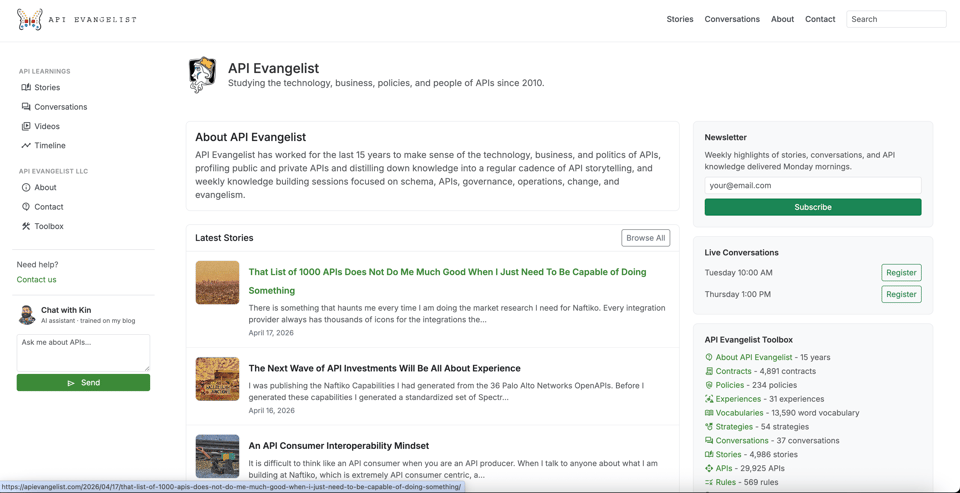
API Evangelist
The API Evangelist blog, and telling stories the primary purpose of the apievangelist.com domain. The second purpose is profiling APIs, which generates the knowledge and research used in my storytelling. While I position API Evangelist as a place for anyone to learn about the technology, business, and politics of APIs, the reality is that I have grown pretty advanced and high level over the years—something I should think about reigning in. First, I just need to get back to publishing at least one story a day, then I can start thinking about what else I should be doing on API Evangelist when it comes to the tone and scope of my stories.
I am very happy with the current API Evangelist site. It showcases the stories from over the years, making them available via a search and chat. It also still has my toolbox for profiling all of the APIs I study. I’m current investing in refining and expanding how I profile APIs, replacing a lot of my deterministic scripting for artificial intelligence, with validation all along the way. Claude has gotten extremely good over the last two years when it comes to “artifacting”, and the APIs.json, OpenAPI, AsycAPI, JSON Schema, JSON-LD, Naftiko Capabilities, Spectral rules, and other artifacts in my API Evangelist toolbox are primarily AI generated these days, and JSON Schema and Spectral rule validated.
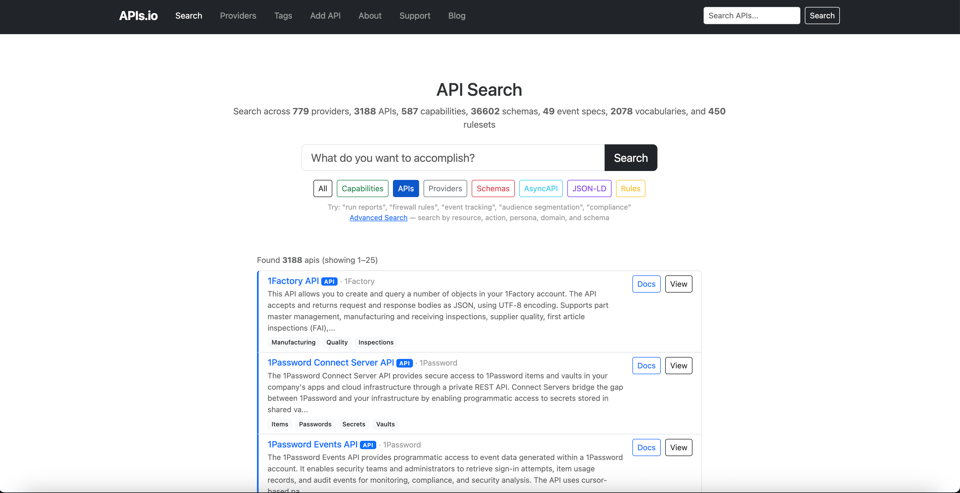
APIs.io Search
API Evangelist profiling of APIs feeds the APIs.io search engine, so it was a good time to refactor the pipeline from API Evangelist to APIs.io. Honestly I think the APIs.io website will require an entirely new approach to deal with the volume of data that API Evangelist is producing now that I’ve turned up the volume again. I like how the site search works, and the browse by provider and tags, but just the sheer number of APIs now is too much, and I went and added schema and other artifacts into the mix. Oh well, I will keep refining and when I hit a breaking point I will refactor the website to accommodate the scope of the data.
APis.io is a great name for a site, but I am not convinced API search is anything people care about anymore. However, with that said, I think there is a lot of context present across the APIs.io index, and with the latest enhancements to my API Evangelist profiling—this context has increased. I’ve added schema, both JSON Schema and JSON Structure, JSON-LD, as well as examples. I am working to get beyond just the API here, and understand what is needed to strike the deterministic balance required to integrate AI into the enterprise. Ultimately I do not think it is the APis.io search engine interface that will matter, and it will be the API behind, as well as the machine-readable artifacts indexed at APis.io that will matter, which when combined with the rating, pricing, rate limits, and other economic aspects of API Evangelist profiling—it all becomes pretty interesting.
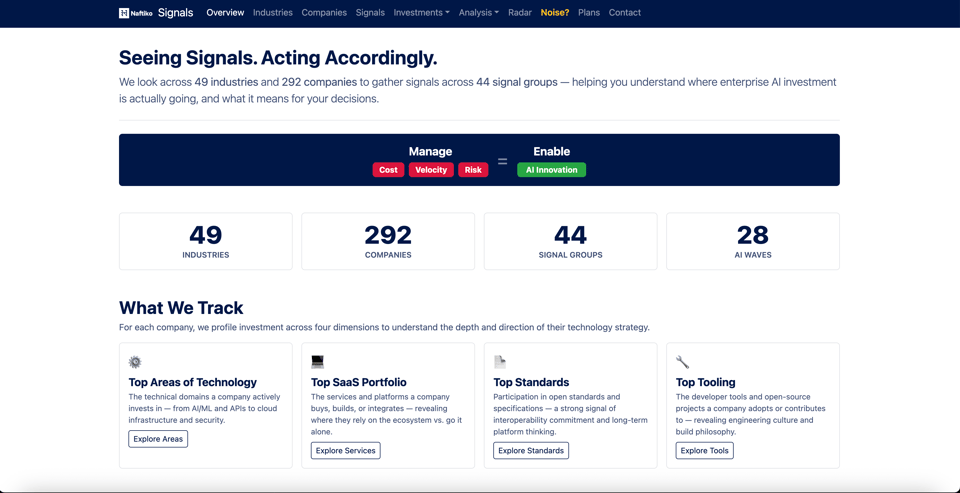
Naftiko Signals
Next up, I have Naftiko Signals, where I’ve profiled the public signals for 292 enterprises, trying to understand how they have responded to artificial intelligence. I am expanding this 3X this quarter. There is a wealth of insights and context present in these signals. The list of services and open-source tooling that these companies have invested in is powering the prioritization engine in the API Evangelist crawler and profiler, which shapes the storytelling on API Evangelist, the indexes of APis.io, as well as the blog posts, podcasts, white papers, and other content I publish as part of Naftiko.io.
I am considering how this data can be used alongside API Evangelist and APIs.io. I am using the APIs I profile as part of API Evangelist to drive conversations I am having with Naftiko design partners. I am using the signals data to prioritize which APIs I profile. What else? I am exploring how the context I am engineering with Naftiko Signals at the industry, regional, company, and role level can be used to search APIs.io and API Evangelist. I am convinced that people do not care about APIs, and thus they will not care about searching for APIs via a search engine, but what if the search met them where they are, and had the context they needed.
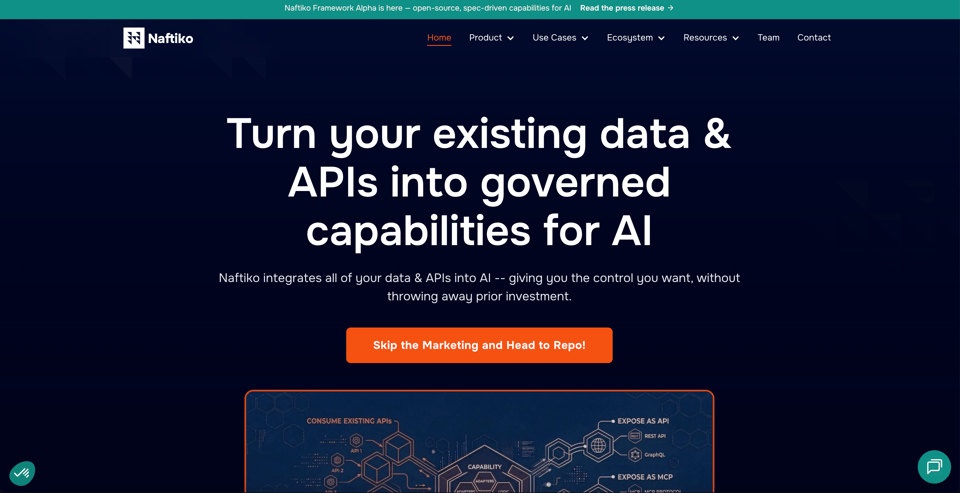
Naftiko Fleet
Now we get to the end game for me right now. People using Naftiko. The key to riding these worlds will be Naftiko Capabilities, which I am producing from the artifacts, data, and context being generated daily across API Evangelist, APIs.io, and Naftiko Signals. I’ve already been able to produce some very compelling and useful Naftiko Capabilities from this work, which can be executed via the Naftiko Framework. The trick with this work is I need to get people to move over the line with using Naftiko—I can’t be the one to walk it over the line. They gotta do the work to understand the value of the capability, because it is their capability not mine.
The semantics of a Naftiko Capability are different that that of an OpenAPI or AsyncAPI. There is more business intent in a capability. There is more of a specific need for a specific set of stakeholders. The way I need GitHub will vary from the way you use GitHub, which OpenAPI and AsyncAPI doesn’t always capture. A capability has more intent and purpose, and business stakeholder metadata. The consumes side of a capability reflect a specific need, and the exposes side of the capability translates that specific need into exactly the value required for a specific business outcome of a single company or team, within a specific domain.
Markets
The market is very irrational right now. Trying to understand where I am at with API Evangelist has taken a lot of work, and is directly dependent on what I am building at Naftiko. APIs.io is very dependent on API Evangelist, and all of it is in response to the signals I am gathering with Naftiko Signals. API Evangelist is very much the technology, business, and politics of APIs, and APIs.io is very much about discovery, and Naftiko Signals is about gathering meaning signals of where the investment is actually occurring. Naftiko is about actually integrating and moving in the direction you want, which discovery and signals are key too, and the technology, business, and politics of Apis is key to sustaining your business in an increasingly volatile market.
I’d say I am about a week or two away from this newsletter getting back to what y’all think an API Evangelist newsletter should be. I have Naftiko all sorted out and moving int he direction I need. I have API Evangelist profiling and the pipeline with APIs.io doing what I need. I have Q1 of Naftiko Signals giving me what I need to understand this crazy market. Now I just need to get back to writing stories everyday on API Evangelist, and curating interesting things from across the the space—then I can aggregate what I am seeing here in the newsletter. So, I appreciate you bearing with me as I figure all of this out. If you’ve tuned into me for a while, you know that I tend to talk out loud and work out in the open, until I find the balance needed—almost there. Thank you for staying tuned!
"To improve is to change; to be perfect is to change often." - Winston Churchill