Against consumer populism
We're more than consumers
(I’m Henry Snow, and you’re reading Another Way.)
In 1946, Congressional Democrats suffered a crushing defeat to Republicans. The latter successfully campaigned on rising postwar prices. Harry Truman wrote a speech complaining Americans had “desert[ed]” him for “a piece of beef, a side of bacon.” He was right, and he was equally right not to send it. In my upcoming book Control Science– which you can and should preorder now (that’s a link you can click) from Verso or wherever books are sold!-- I talk about how this moment was part of a changing popular and academic understanding of economics. Today I want to instead use some details from that to look at how we talk about prices, consumption, and production.
The “vibecession” debate, a years-long discourse over whether and how much Americans’ sense that the economy is bad and getting worse is based in vibes vs. material reality, has been vicious. The stakes are high. If inflation is as politically toxic as it seems to be the left might be doomed. If, as you’ll see from more left-liberal and economist types, “the economy” is not that bad and the problem is how people feel, progressive economic policy is maybe saved.
But, the counterargument goes, if “the economy” is good, why do so many financial transactions feel bad? Aren’t the “vibecession” types wielding charts against people’s lived experiences? Ignoring suffering even? In contrast, if “the economy” is bad, then we might get political change. I don’t mean to discount anyone’s economic suffering, but I get the sense much of this debate is instrumental projecting. The reductionist political maxim "it’s the economy, stupid,” has become it must be the economy, either to re-elect Democrats or to abolish capitalism depending upon your preferred outcome.
I also am not and refuse to become some kind of anthropologist of the online— I think this requires skills and capacities I don’t have to do right— but this happens outside of the internet too. This morning my gas pump had TRUMP DID THIS inscribed in Sharpie next to the Regular gas button. Did the person writing this genuinely feel rage about gas— or did they hope to disseminate their more righteous anger about a brutal war to the less-engaged by connecting it to material issues? I have a feeling it might be the latter.
When we say “Trump Did This” we’re hoping “the economy” will break through the right’s bigotry and electoral apathy. We are hoping that economics can prove decisive over all else. Unfortunately, the fact that it often can is precisely the source of many of our problems.
And one particular place where we go wrong is what we might call consumer populism: things are expensive and unreasonable because They are conspiring to make prices higher. Greedy corporations and corrupt politicians are the reason gas costs more than you might like and Nintendo games are 70 bucks and you can’t buy eggs. Or you can but you won’t like it. The Dollar Menu is like three dollars now. This was at the forefront of the last election. The right-wing version of this was powerful, unfortunately.
But like populism in general, consumer populism is flexible; you don’t have to be right-wing to believe affordability is important or to put it at the forefront of your political messaging. In the political center, some Democrats have promoted “affordability” as a way to bypass hard questions of democracy or social and cultural issues. On the left, meanwhile, Zohran Mamdani was elected Mayor of New York on an “affordability” platform, talking about grocery prices and rent.
There are I think four major problems with consumer populism: bad microeconomics, bad macroeconomics, bad politics, and bad ethics. I’ll cover them in that order. On microeconomics, let’s go back to 1946. This is a graphic from a union film produced as an intervention in the Congressional elections of that year:
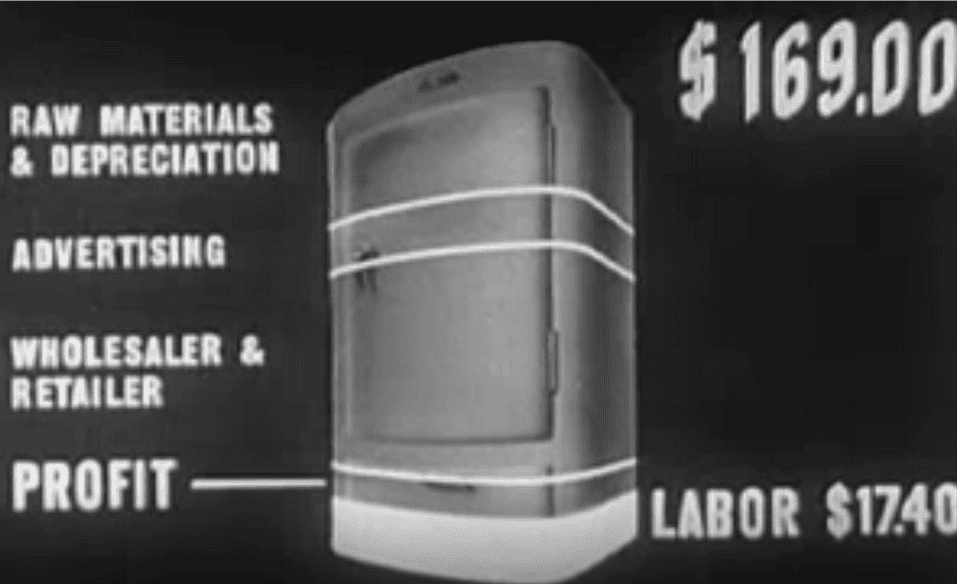
It breaks down a General Electric refrigerator visually into different costs. You can see labor is only around 15% of the cost, which is an excellent argument for a union demanding a wage increase. But let’s also point out how narrow the profit slice is in here. This is a pretty good profit margin, eyeballing it, but it’s not much– it’s less than labor’s share, and far less than every other cost as well.
The Marxist critique is that this is labor value being taken from the workers. I find that analysis useful within limits. One of its implications is about who is being ripped off: workers, not consumers. The consumer’s choice is the means by which downward wage pressure is exerted in a market society. Consumers and workers are directly at odds; part of the reason for the thermostatic whiplash of our politics is that we are all both consumers and workers, and can identify with each differently in different circumstances.
But more on that in a bit– let’s just talk numbers. There is both a ceiling and a floor to profits. Consumers are one reason for that ceiling: there are prices one simply will not pay. The structure of the economy creates a floor. GE cannot eliminate its own profit share, or it would not exist. While I’d love a world not dependent upon profit, we can’t expect corporations, creatures of the world as it is, to act like that new world (in which they cannot exist as they are!) is already here. I mean that practically. The “profit” share here serves important economic functions, from dividends for shareholders to price signalling (investors want to invest in more profitable firms).
Consumer populism is, at its best, a call to carve more out of that profit share and put it in other and better places. There are real and good reasons for doing this. But at its worst, consumer populism is a lionization of the downward wage pressure consumer choice always exerts, and an unrealistic call for cutting those profits beyond the level they can be cut. Often, consumer populism misdiagnoses the problem in ways convenient for those in power.
It also masks structural problems with capitalism itself. Maine Senate candidate Graham Platner recently cut an ad complaining Big Pharma is somehow linked to the closure of rural hospitals. Those are both bad things, but if there was some non-obvious link he didn’t explain it. An America with less powerful pharmaceutical firms would not necessarily, as far as I can tell, be one where rural hospitals stay open. Both the problems of Big Pharma and the increasing penny-pinching efficiency of our health systems are the result of market competition, deep issues with our politics, etc.
But if you respond to every economic issue with “the problem is capitalism” or something similarly structural, it’s going to be hard to push concrete incremental solutions (including those that might take us away from capitalism). My biggest complaint here, and the reason I’ve touched on these themes in this newsletter regularly, is that left consumer populists misunderstand what capitalism is. Capitalism is, by and large, amazing for the consumer, and the consumer is one of the most powerful actors in capitalism. Even capitalists are beholden to your desires! Or at least, your whims.
It can feel rhetorically compelling to say grocery store customers and grocery store workers are both victims of Big Grocery. But Stop and Shop or ALDI is a vehicle by which you and I extract more labor for less money from store employees. The same goes for meatpacking firms, farms, you name it. Consumer populism of all flavors displaces blame, misdiagnoses power, and misidentifies who benefits. Not all the time, not in all cases, but overall.
===
That alone isn’t enough for us to abandon it though. Maybe diagnoses that aren’t true are still politically useful. And should we really weep for big business? No. But bad diagnoses produce bad solutions, and that’s especially clear in the second problem area of consumer populism: macroeconomics. Early 2020s inflation was a product of crises– COVID and the invasion of Ukraine– and a necessary trade-off for our response to crisis. We dumped money into the economy to save it from COVID, and it worked spectacularly. If we hadn’t, more people would be suffering right now.
The problem with the inflation-unemployment tradeoff is that inflation directly affects everyone. Unemployment affects only the unemployed or precariously-employed with similar directness and clarity. This is a weakness in modern capitalist democracy, because deflation is catastrophic and inflation is often necessary. News media and especially ordinary people regularly talk about how prices have not “gone down” yet– across the economy they cannot. This would be deflation. It’s catastrophic.
Inflation can pit workers and consumers against each other. A “hot” labor market (like parts of the COVID-era stimulus economy) with low unemployment is good for wages even for the employed, as long as they correctly identify their wage increases as a macroeconomic phenomenon. In 1946, General Electric Employee Relations head Lemuel Ricketts Boulware was furious that workers were defending inflation. They didn’t have much savings anyway. As long as wages went up faster than prices, why was it their problem? He and his companions on the right developed new ways of communicating, and new ideas to communicate, about economics in order to put a stop to this. Already in 1946, the consumer side of two-faced America was able to overpower the worker side, but Boulware and company, as I discuss in detail in the book, made it worse.
===
This brings us to our third problem area: politics. None of what I am saying would matter here if consumer populism was an effective way to achieve good policy. In most circumstances, I don’t think it is. The first two problems we discussed are among the reasons for this: since consumer populism misidentifies microeconomic developments it points toward ineffective policy, and since it pulls on the unemployment side of the inflation-unemployment trade off, it encourages bad fiscal and monetary policy.
Consumer populism also produces weak political coalitions. It identifies shared interests where there is in fact significant division. For example, both American political parties have in their party platforms calls to make housing more affordable and a better investment. This is impossible. Prices cannot go up and also down. Whichever side you pick, someone loses, and your coalition splinters or feels betrayed.
The Mamdani campaign suggests some ways of co-opting rather than being co-opted by affordability. Affordability rhetoric works better politically the more it gets away from generalized consumer dissatisfaction and toward particular problems with appropriate solutions. Mamdani’s affordability rhetoric centered on two specific commodities that are absolute necessities– food and housing. The latter is an especially awful market that needs to change. He has tied this rhetoric to specific solutions to both intervene within the market and to limit its influence (municipal grocery stores). This kind of affordability rhetoric deprioritizes vague consumer identity, points toward problems that can be solved rather than sentiments that are hard to address, and challenges the power of the market in our lives.
===
Fourth and finally, let’s go deeper, beyond politics and into philosophy: consumer is not a valuable or meaningful moral position. I am skeptical that the typical consumer really is being ripped off. If egg prices go up because of a bird flu cull, that is unfortunate for me, but I am not being wronged. In fact, less aggressive public health measures that would allow prices to go down would be the moral wrong here. The consumer is by and large ripping off the worker, too.
Even some of the worst injustices consumers suffer as consumers (not as “ordinary Americans” or workers or citizens but in their economic capacity as buyers) just illustrate how nice the American consumer really has it. Consider “shrinkflation,” the practice of lowering the amount of product in a unit stealthily (more air in a bag, redesigned smaller bottles). This is actually deceptive– yes, you could just compare bag sizes, but no one does that for all purchases and no one should have to. But quickly enough I can tell there is less in the bag. And I can choose not to buy them!
My point isn’t that big corporations are good. They exploit us as workers, poison us as neighbors, and oppress us as political actors. But as consumers they mostly serve us. If occasionally they take a cut, I’m unconvinced this deserves the level of outrage it often seems to garner. There are a lot of Americans struggling economically right now! But they’re struggling as workers– the problem is that while many prices are low, their wages are lower. (The other problem is housing prices specifically, which are terrible). Folding that problem into consumer populism isn’t right and isn’t helpful.
Consumer populism is at best a broken compass. Sometimes it points north. I am glad people are angry about gas prices and I hope it helps stop our illegal war in Iran. But when we complain about our gas tanks first and human lives second, what are we doing to ourselves, to our politics, to our country? “Affordability” might be an effective short term political meme. But I’m not a strategist, and my job is to help people understand the world rather than sell a particular vision of it. Consumer populism causes us to misunderstand ourselves and our world. We are worse for it.