
"The only thing that's here is you and me"
an essay about my favorite f***ing movie
I wrote a guest essay for my friend Claire C. Holland’s newsletter about sex and the movies! Naturally, I wrote about Moonstruck. I am cross-posting below for anyone who doesn’t fuck with Substack. I highly recommend Claire’s work, especially her book of horror poetry, I Am Not Your Final Girl (Amazon affiliate link).
I was too young the first time I saw Moonstruck. Not literally (I was a young teen), but in the sense that, while I was already developing a sharp appreciation and taste for the movies, I still didn’t fully understand or necessarily even recognize a very important technique: melodrama, which is arguably the primary tone of Moonstruck. I could not appreciate the old woman cursing the airplane her sister is on because 50 years earlier her sister stole her boyfriend—I took it literally. Melodrama is not literal; it is emotional.
I also, crucially, had never been in love.
And I did not understand opera yet. This was largely due to a lack of exposure, which may seem strange when I tell you that I grew up in the Metropolitan Opera House, my second home the bowels of the building where the orchestra lurks. But I was only there during the spring ballet season; my father was the timpanist. He got started as a sub for the Metropolitan Opera orchestra in the mid-seventies, and when American Ballet Theatre needed to form their own orchestra in 1977 instead of borrowing the resident musicians every spring, my father was hired as the principal timpanist. He kept that job until he died.
I still don’t understand opera except in a vague theoretical sense, and I’m shamefully unfamiliar with Puccini, whose La Boheme Loretta and Ronny attend. But you know what I am familiar with? Rent. So that gives me the plot (sort of), and my midlife understanding of melodrama gives me everything else I need to know. (But, you know, if I say anything silly and incorrect about opera, it’s fair to assume I know that I know nothing.)
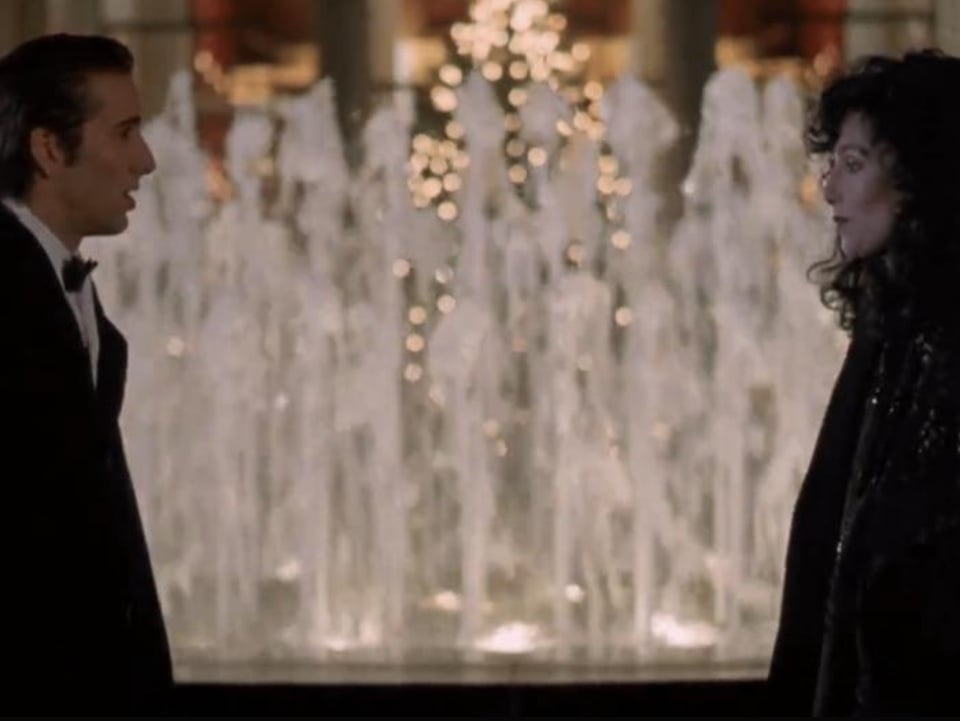
In Moonstruck, everyone is dying but no one dies. Everyone is charmed by the full moon, wolves howling their pain and also their love.
Loretta (Cher), a pragmatic widow in her late 30s, lives in Brooklyn with her parents and works as a bookkeeper for several local businesses. She accepts a proposal from Johnny Cammareri (Danny Aiello), who she does not love but believes will take care of her. Johnny’s awkward proposal is the opening of the movie, and he immediately flies to Sicily where his mother is actively dying. He asks Loretta to do him a favor while he’s gone: invite his brother Ronny to the wedding. So Loretta goes to the Cammareri bakery, where she finds Ronny (Nicolas Cage), who has a wooden hand, sweating in the basement, shoveling loaves in and out of the ovens.
This scene, more than almost any other, embodies melodrama. The ovens are hot, Ronny has sweated through his shirt, and Loretta contrasts him perfectly—her hair is graying and her curls out of control, but everything else about her is tidy and she has the emotional regulation he lacks. Loretta is barely even regular drama, and that is by choice. It also will not last.
Ronny is not pleased with her invitation, because according to him Johnny ruined his life by distracting him, causing the loss of his hand and subsequent loss of his fiancée. He gives an impassioned monologue about it (“I lost my hand! I lost my bride!”) and demands that Chrissy (Nada Despotovich), who works at the bakery, bring him “the big knife” so he can kill himself. (Because this is opera, Chrissy refuses loudly and then quietly says that she is in love with Ronny but knows he can never love since he lost his bride and his hand.)
Loretta, of course, decides he will feel better if he eats a steak, which she cooks for him in his apartment upstairs from the bakery. He accuses her of being caught in an animal trap and she says he is a wolf, that all men are wolves. They continue to fight/banter until it reaches a fever pitch and they have sex, after which he says he loves her and she delivers the infamous slap and “Snap out of it!” along with one of my favorite exchanges: “You ruined my life!” “It was ruined when I got here!” (She has a point.)
When I was a teenager, I struggled with the conflation (in all media, not just Moonstruck) of (romantic) love and sex. Never having known either, how was I supposed to know which was which? Was I supposed to conflate one with the other?
Ronny knows he is in love with Loretta after they have sex—is he conflating one with the other? Well, no. I would say that he understands (but probably couldn’t articulate) that sex is a way of knowing someone, and when he knows Loretta, he loves her.
He promises he will leave her alone if he can have one night with her at the opera, which is apparently the only other thing he loves. She gets a makeover (whatever, it was 1987) and meets him at the Metropolitan Opera House (“Where’s the Met?”) where they watch La Boheme. When they get back to Brooklyn, it is freezing, and he tries to convince her to come upstairs to his place again. She argues, and he makes one of the thesis statements of the movie (in a distractingly exaggerated Brooklyn accent):
“Loretta, I love you. Not—not like they told you love is. And I didn’t know this either: Love don’t make things nice. It ruins everything. It breaks your heart. It makes things a mess! We—we aren’t here to make things perfect. The snowflakes are perfect. The stars are perfect. Not us. Not us. We are here to ruin ourselves and to break our hearts and to love the wrong people and—and die! I mean, the storybooks are bullshit! Now, would you come upstairs with me and—and get in my bed?”
(This is the only scene that I find more melodramatic than when we meet Ronny, but it is also very sincere.)
The difference between me and Ronny is I think love does make things nice. It does all the other things he says too, but it also makes things nice. (I think the movie believes this too.)
When I watched Moonstruck in my youth, I don’t think I got that, but when I watched it more recently I recognized it: love is knowing someone. I don’t believe that love is necessary for sex, and I’ve had sex with people I didn’t love, but…In the late ’90s I had two boyfriends (in a row, not concurrently) who told me they loved me: the first time, it prompted me to decide not to sleep with him because I didn’t love him and didn’t want that imbalance; the second time, I had already slept with and (because?) I loved him. Almost 30 years later, loving him still makes things nice, and knowing him makes me love him.
I was born in the late seventies, which makes me late gen X or early Millennial (depending who you ask). Much of the media that I inhaled in my adolescence was made by and/or for older Xers—think Singles, Reality Bites, Dazed and Confused. But the rest of it was decidedly by and for boomers: Beaches, When Harry Met Sally, Overboard…even The Princess Bride, a movie that raised my entire generation, was not necessarily made for us.
Moonstruck belongs in the latter category, but I think I learned the most from it, despite not realizing it until recently. Or maybe I didn’t learn a thing from it, and it is pure happenstance that I align with its view—or at least its character Ronny’s view—that love and sex are mixed up things that happen to us, that kind of seem like the worst thing that could happen but actually might be the best.
All I know is the movie has influenced me in every way it reasonably could. I wrote my first novel the spring my father died, and with him, my relationship to the Met Opera House. I had already been trying to write a novel, a few attempts that weren’t quite failures but weren’t successes either. But his death and the unfinished business of his art—in addition to being a musician, he was an incredible photographer—spurred me to follow my own dreams, or something like that.
I write romance, primarily. And the book of my heart, a book that probably won’t see the light of day, was inspired by Moonstruck. Not the plot, but the imperfections of people and the way love is a way of knowing someone, but sometimes it’s inconvenient and desperate, life-ruining and a lot like the opera—only I put the ballet in my book, because it isn’t Moonstruck.
Loretta’s mother Rose, played by the inimitable Olympia Dukakis, is married to Cosmo (Vincent Gardenia), who has taken up with Mona (Anita Gillette). Loretta finds out about Mona when the two illicit couples run into each other at the Met. She does not tell Rose, because she doesn’t have to. Rose knows, somehow. Director Norman Jewison and screenwriter John Patrick Shanley trust us enough to not explain how. This is not the only parallel to Loretta’s affair with Ronny, though it is the most direct. Is the movie saying that everyone is unfaithful in love/in lust/when the moon is full? I don’t think so, but it could be read that way.
While Loretta and Cosmo are at the opera, Rose goes out to dinner alone and strikes up a conversation with Perry (John Mahoney), a professor who we have seen get dumped by two of his own students partway through extremely inappropriate dates. Perry halfheartedly hits on Rose, but she is uninterested (“I’m too old for you.” “I’m too old for me!”). What she wants is not to have her own affair, but to understand why men do it. Perry has no answer, so she asks Johnny, the wayward fiancé, who has unexpectedly returned from Sicily. He does not know the answer, and in trying to reply in the way he thinks Rose wants, hits upon it: because they fear death.
When everything comes to a head after Loretta comes home the next morning, the entire family—nearly everyone in the movie other than Perry and Mona—is in the kitchen. Johnny’s mother did not die, so he has decided he cannot marry Loretta. Rose tells Cosmo to stop seeing Mona. And Ronny proposes to Loretta, who gives up (some of) her pragmatism and admits that she loves him back. “That’s too bad,” Rose tells her, echoing (mirroring) her response to Loretta’s engagement to Johnny (“Do you love him?” “No.” “Good. When you love them, they drive you crazy because they know they can”).
It’s melodrama at its finest. It’s opera. Everyone is dying but no one dies.
The Romancing the Vote auction starts today and goes through Sunday, and among many, many other glorious things, you have the chance to bid on a full manuscript copy edit by moi. Do go check it out! There are almost 1000 items and many are buy now!


Add a comment: