All Saints Gazette

Archives
March 9, 2026

Pastoral Letter from the Bishop

Dear friends,

I attach below an important pastoral letter from Bishop Mark Edington regarding the present state and future of All Saints Amsterdam. At this time, I will refrain from further comment, except to ask you to read it, considering well both his teaching and his recommendations.

The recommendations the bishop makes will go to the Committee on Mission Congregations and the Council of Advice. The COMC meets tomorrow, and I will be in touch again afterward about what this means concretely.

As the WhatsApp channel has become a rather toxic and unhelpful medium, I take the Convocation’s suggestion of disabling user posts for the time being. You may feel free to reach out to me directly if you would like to talk.

Friends, whatever else you may think or feel, please pray for one another.

Blessings,
Kyle+
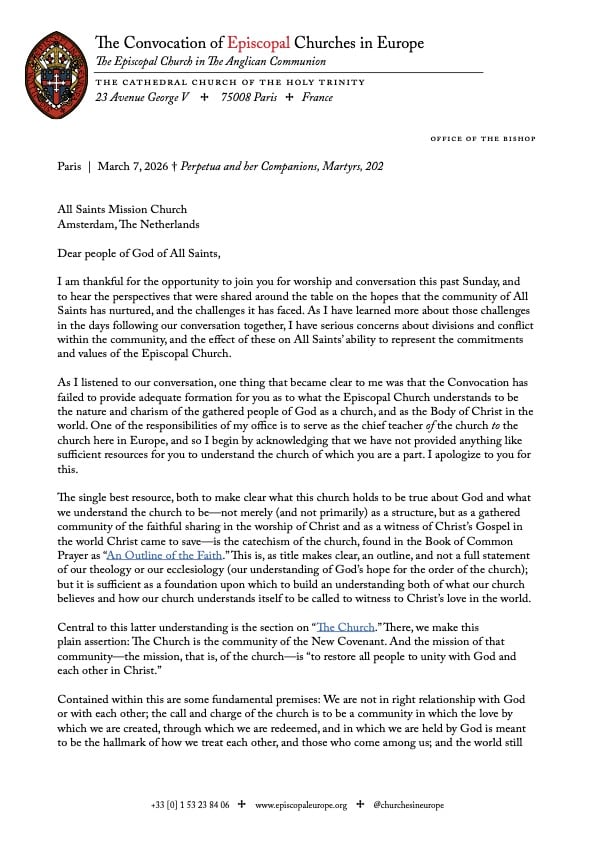
The Convocation of Episcopal Churches in Europe

The Episcopal Church in The Anglican Communion

the cathedral church of the holy trinity

23 Avenue George V U 75008 Paris U France

office of the bishop

Paris | March 7, 2026 † Perpetua and her Companions, Martyrs, 202

All Saints Mission Church
Amsterdam, The Netherlands

Dear people of God of All Saints,

I am thankful for the opportunity to join you for worship and conversation this past Sunday, and
to hear the perspectives that were shared around the table on the hopes that the community of All
Saints has nurtured, and the challenges it has faced. As I have learned more about those challenges
in the days following our conversation together, I have serious concerns about divisions and conflict
within the community, and the effect of these on All Saints’ ability to represent the commitments
and values of the Episcopal Church.

As I listened to our conversation, one thing that became clear to me was that the Convocation has
failed to provide adequate formation for you as to what the Episcopal Church understands to be
the nature and charism of the gathered people of God as a church, and as the Body of Christ in the
world. One of the responsibilities of my office is to serve as the chief teacher of the church to the
church here in Europe, and so I begin by acknowledging that we have not provided anything like
sufficient resources for you to understand the church of which you are a part. I apologize to you for
this.

The single best resource, both to make clear what this church holds to be true about God and what
we understand the church to be—not merely (and not primarily) as a structure, but as a gathered
community of the faithful sharing in the worship of Christ and as a witness of Christ’s Gospel in
the world Christ came to save—is the catechism of the church, found in the Book of Common
Prayer as “An Outline of the Faith.”This is, as title makes clear, an outline, and not a full statement
of our theology or our ecclesiology (our understanding of God’s hope for the order of the church);
but it is sufficient as a foundation upon which to build an understanding both of what our church
believes and how our church understands itself to be called to witness to Christ’s love in the world.

Central to this latter understanding is the section on “The Church.”There, we make this
plain assertion: The Church is the community of the New Covenant. And the mission of that
community—the mission, that is, of the church—is “to restore all people to unity with God and
each other in Christ.”

Contained within this are some fundamental premises: We are not in right relationship with God
or with each other; the call and charge of the church is to be a community in which the love by
which we are created, through which we are redeemed, and in which we are held by God is meant
to be the hallmark of how we treat each other, and those who come among us; and the world still
living outside an awareness of God’s love is meant first to glimpse it by what they see in us. “By
this everyone will know that you are my disciples, if you have love for one another.” ( John 13:35)

We come to the community bringing our own commitments and hopes, and that is of course
true of any community. But as disciples, we must also bring an awareness that our sight is faulty,
our perspective incomplete, and our vision not always God’s vision. This imposes upon anyone
in a community called to “restore all people to unity with God and each other” a first duty of
humility in our own self-regard, and grace in our treatment of others. It also means, no matter
what cause to which we align ourselves, that as a Christian community our first obligation is to
the worship of God, not the worship of our own commitments; our commitments follow from,
and do not have primacy over, our understanding of God’s command to live in love with our
neighbor. We do not gather as a community of shared commitments in the world, for there are
others who share the same hope and believe in the same Gospel who have other commitments;
and the fact that they do, and that they see the world differently, does not make them wrong. We
gather as people aware of our need for God’s mercy, amazed at God’s gift of God’s self for us,
and acting in gratitude, not in despair, as both the recipients and bearers of God’s hope.

As Saint Paul taught, in such a community the hallmark of our regard for each other is mutual
support; “Therefore encourage one another and build up each other” (1 Thessalonians 5:11a).
The community of disciples is not engaged in a competition over the righteousness of individual
causes or perspectives, because the gathered church seeks always to discern how God’s law of
love should work itself out first in our treatment of others, especially others gathered with us at
the table where we share Christ’s gift of himself to us.

Since my time with you this past Sunday, I have seen messages exchanged by members of the
community that I cannot understand as consistent with this understanding of the church. It
is not for me to say whether, in some other setting, such a conversation would or could lead to
an outcome that would accomplish some worthy purpose. But it is both within my authority
and a part of my responsibility to discern whether such conduct is recognizable as aligned with
the understanding of the Episcopal Church of “the community of the New Covenant”; and I
am clear that it is not. Nor can I see that it is a faithful representation to the world of what our
church is, what it stands for, and what it hopes to offer.

With this in view, and with deep sorrow, I cannot see a future for All Saints as it is currently
constituted, at least not as a community affiliated with the Episcopal Church; and I will
recommend to the Committee on Mission Congregations that they advise the Council of Advice
that the mission should be suspended for now. Our commitments to racial justice, to the full
inclusion of all people in the full life of the church, to working for justice and peace among all
people, are urgent and necessary; but they arise from and are expressions of a more fundamental
commitment to respect the dignity of all people. This is a commitment we understand to be
both rooted in, and characterized by, a way of being in community as disciples characterized by a
loving regard for each other. Seen from this perspective, All Saints is not recognizably Episcopal
in any clear sense, and it is my responsibility to both name that and to communicate that
conclusion to those with whom I share in the governance of the Convocation.

I know that there are those among you who long for a community such as the one I have tried
to describe here. Your hope for such a community of faith was very clear to me, and I am sorry
to feel as though you are being deprived of that hope. I believe with all my heart, as I said while
I was there, that there is both the need for the witness of this church in Amsterdam, and the will
to bring it about. But a community in which the trading of accusations is regarded as acceptable
discourse is not such a church, and for the sake of those who have come with good will and
genuine hope to create such a Christian community of the Episcopal Church I cannot allow it
to continue. My fervent prayer is that in some future day a path will be opened to us to respond
anew to God’s call in mission there, and I am eager to work to make that possible.

Faithfully in Christ,

The Right Reverend Mark D. W. Edington
Bishop of the Convocation
cc: Audrey Jolivet–Habiby, Chair, Committeee on Mission Congregations
Ward Greenberg, President, Council of Advice
Mission File

+33 [0] 1 53 23 84 06 U www.episcopaleurope.org U @churchesineurope
Don't miss what's next. Subscribe to All Saints Gazette:
Powered by Buttondown, the easiest way to start and grow your newsletter.