long weekend into a long week
work
Even though I took last weekend and Monday off, work this week was very busy. This is for a few different reasons I think: my course is in full swing, my collaborator is visiting, so I want to meet with him, I'm trying to recruit PhD students, a postdoc, and work with a couple undergraduates. So even though the Crypto deadline was last week, I didn't really feel like my workload lightened up.
Despite the quantity of work, though, it's all important for me to do. I'm excited to push through the papers that I'm working on, start new papers, and to really get my lab started. I also feel like I'm stabilizing for teaching my class. I did block cipher modes, CCA, and authenticated encryption this past week, and this coming week I get to finish up our symmetric-key half of the course with MACs and hash functions! I definitely have a better understanding of how much material I can get through in my lecture, too.
non-work
Last weekend was really fun! My partner and I had a really good day on Valentine's, and we were also able to go out on Sunday and Monday before the weather took a more unfortunate turn. We did our dim sum trip, walked around Chinatown as a pre-new years celebration, and took another hand-building pottery class. We also watched a lot of Ted Lasso to try to relax from our outings, and we're almost done with all the episodes out to date. It's a rewatch for me, but the narrative still holds up and is interesting.
After my partner left on Monday, I pivoted pretty heavily to work. My other friend is also defending his own PhD this coming week (Congrats!!), so we had to cancel our typical Baldur's Gate 3 playing. I've pretty much just used my extra time to catch-up/get ahead on work.
Reading wise, I'm still slowly making my way through Burning Questions which is a really nice book to passively listen to. Margret Atwood has a really good way of writing that lets you think about and process what she's saying while you hear it. I've also learned a good bit about literature and politics from her own perspective.
questions
- When someone proves that assumption X implies some primitive Y, how much should cryptographers take that as evidence that X is false?
- Strictly speaking, I think proving that X implies more things gives some evidence that X is false. But, I don't have a good gauge how much this should count.
- I think for myself, I only think about this when X implies either indistinguishability obfuscation or (to a lesser extent) fully homomorphic encryption.
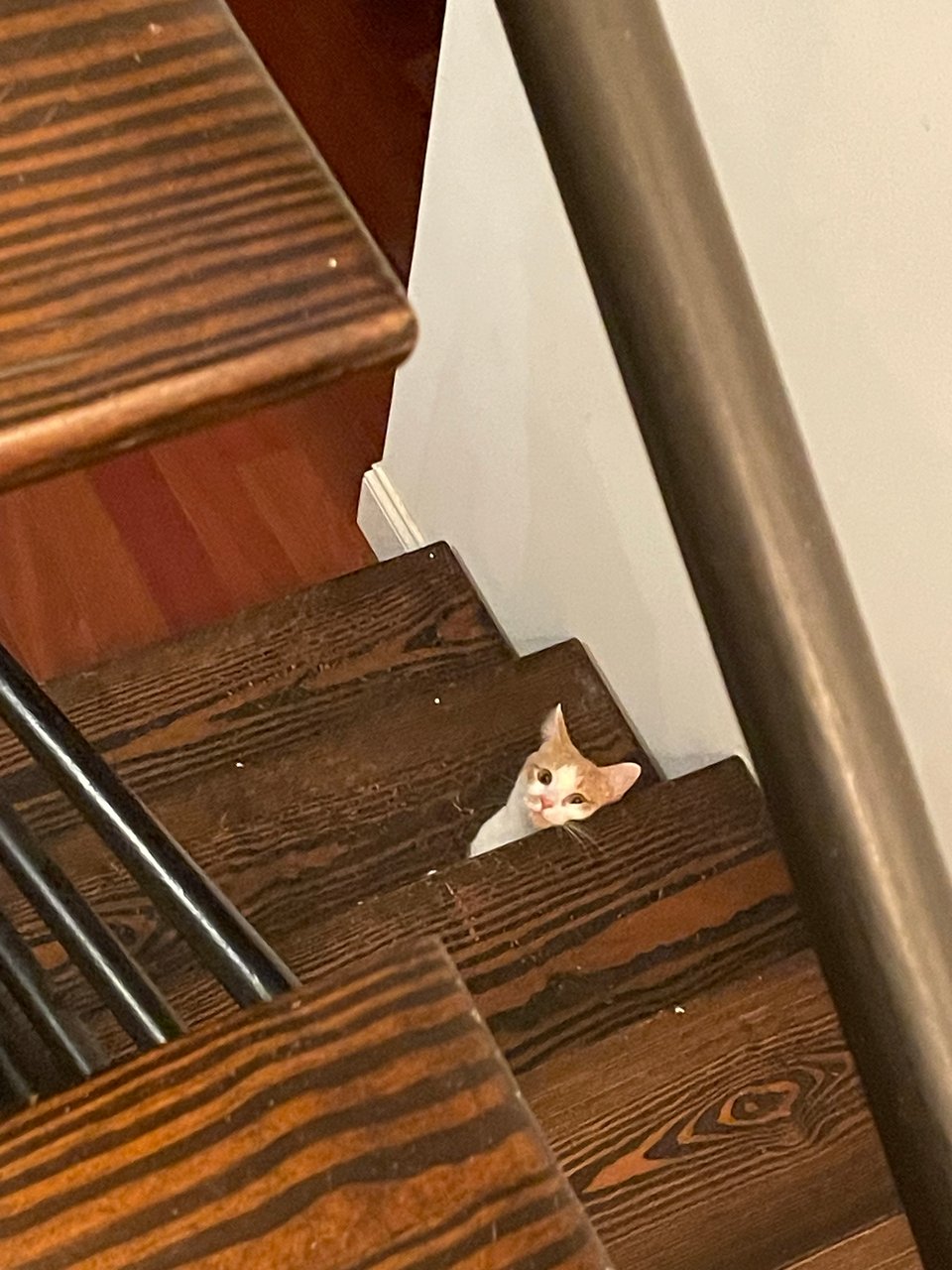
Thanks for reading to the end! Here's are some pictures of my cat from this week.