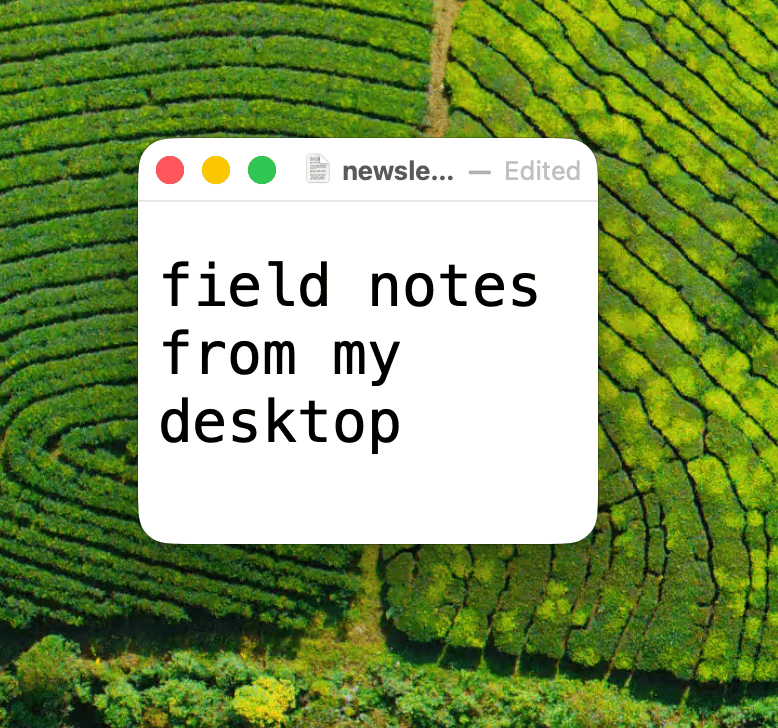
Field notes from my desktop (spring edition)
2026-03-22
Hi,
If you’re receiving this email, it’s because you're subscribed to my newsletter, Field notes from my Desktop. 💻🪴
I try to send these field notes once a quarter at most, in an effort to live more seasonally. Everyone seems to have a newsletter these days, and I don’t want to crowd your inbox.
You might have been added to this mailing list after an internet infrastructure walk, or been in a workshop I’ve organized on the poetic web, attended a talk about alternative education, or even found the sign-up form on my website. Either way, I’m grateful you’re here.
For this edition, I’ve divided this newsletter into three sections: News (with updates and invitations from my desktop), Rambling (on a particular web-native topic), and Seedlings (for readings, funds, jobs and topics of all sorts). Feel free to sort through, share, delete, unsubscribe, whatever suits you. No pressure.
🍃 News
This year, I’m working on a few projects that might be of interest.
With the Software Sustainability Institute this year, I’ll be seeding connections between the worlds of academic computing and creative computation. Please fill out this form is you’re interested in being either interviewed or participating in the project. I’ll be giving a workshop about poetic computing at their annual conference in Belfast this April, and reaching out to the first round of interviewees in the next week or so.
The other is a personal project: a digital and physical walk across the Baekdusan mountain range on the Korean peninsula. There’s not a lot of public information about the project yet, but I just wrote an essay for HTML Review’s newest issue about it. Thank you to Max and Shelby for being such thoughtful and supportive editors.
Finally, the internet infrastructure walks are back! I recently ran another pair of walks for Open Data Day, and everyone who joined was so curious and wonderful that I thought I’d run a few more. If you’re interested in joining a future walk in London, I’ve added up a few more dates on luma.
🥾 Rambling on the poetic web
I’ve increasingly started to describe my current body of work as stewarding a more “poetic web”. A friend asked me what that means the other day, so I thought I’d take the opportunity to explain here.
A few years ago, I was a fellow with the School of Commons (who are currently looking for a new institutional host btw!), where I worked on a project called “poetic tactics to counter extraction (and other ways to train attention)” about developing tools to better engage with the attention economy. The project came from my own personal experience, and out of a kind of desperate desire for a better way to engage with the stream of noise intrinsic to digital life, which had intensified during the COVID-19 lockdowns.
Amidst so many collective crises over the past few years, which themselves have emerged from many endemic crises before them, I turned to poetry to cope, to think, to feel without going numb. David Whyte reminded me that instead of feeling lost, "wherever you are is called Here”. Adrienne Rich helped me to remember that "words are maps" in the wreckage of it all. Mary Oliver's perspective on the clarity of retrospection was a gift: "one day you finally knew what you had to do, and began".
I came back to Rainer Maria Rilke’s “Letters to a Young Poet” (my constant companion in my 20s) and Audre Lorde's Poetry is Not a Luxury, particularly the part where she says:
“Poetry is the way we help give name to the nameless so it can be thought. The farthest external horizons of our hopes and fears are cobbled together by our poems, carved from the rock experiences of our daily lives”.
This brought me to wondering about whether there might be more poetic experiences to be found on the web, and I soon found that I was far from alone in thinking about this.
Artist Chia Amisola calls the poetic web “a practice and process towards a place: a web that is more handmade, expressive, and intimate; where site-making is a political, personal, and poetic act". Kristtofer Tjalve’s Naive Weekly has been collecting notes from the quiet, odd, and poetic web for years now. The School of Poetic Computation of course embodies this ethos in their very name. There are countless others.
Maybe all these projects, personal and professional, are all “poetic tactics”, organised with the hope of seeing things differently. In a time of mass surveillance, endless wars, and AI slop, perhaps poetry might remind us that all is not lost. It certainly helps me.
🌱 Seedlings
These links (and a few more) are all collected on this are.na board.
- Local-first UX: A talk by Eileen Wagner about how local-first technology (i.e. files stored on your computer) are pushing back against the ubiquity of the cloud.
- Philosophy of Walking: A book I’m currently reading on walking (for obvious reason).
- Digital Gardens: A classic piece by Maggie Appleton on networked self-publishing. I recently returned to it while debugging my blog.
- Limit: I’ve been using this app from the Freedom team since January, and it’s really made me think differently about my screen time.
- Research Revival Fund: Have a research idea without a home? This ongoing fund may be able to help.
- Community Privacy Residency 2026: A 3-week residency. Applications due Sunday, 29 March.
- Other Almanac Open Call: A reimagining of the Old Farmer's Almanac. Open until 1 April.
- Internet Phone Book: The call for the second edition is out! Add your website. The call will close in a few months.
- What we Think is a Decline in Literacy is a Design Problem: An article by Carlo Iacono that I've been thinking about a lot about. How can we design across the mediums available to us, earnestly and without contempt for the screen alone?
From my desktop, to the radio waves of my local library's wifi network, to a copper cable in London, to an internet cable and onward to you.
I hope this added more poetry to your week(end). See you in the next set of field notes.
Always,
Anne
Don't miss what's next. Subscribe to Field Notes from my Desktop:

Add a comment: